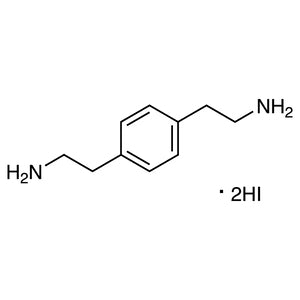
2,7-Diaminofluorene Dihydrochloride is a chemical compound widely used in laboratory settings as a foundational material for constructing complex chemical structures, particularly in the field of materials science. This compound plays a crucial role in the development of Covalent Organic Frameworks (COFs), which are porous materials with unique properties such as high porosity and thermal stability. Its application extends to research and development in various scientific disciplines, where it serves as a key building block for synthesizing advanced materials. Due to its structural versatility and chemical stability, it is highly valued in modern laboratory environments for its ability to facilitate precise molecular assembly.
The compound’s chemical structure features two amino groups at positions 2 and 7, which enable it to form covalent bonds with a variety of molecules. This reactivity allows for the creation of highly ordered and functionalized materials. Its stability under various reaction conditions and controlled reactivity make it a preferred choice for researchers aiming to design and synthesize novel materials. These properties ensure that it remains a reliable and effective component in the synthesis of advanced functional materials.
In Indonesian laboratories, 2,7-Diaminofluorene Dihydrochloride is commonly used in research related to material science, organic chemistry, and emerging technologies. It supports the development of innovative materials with tailored properties, contributing to advancements in both academic and industrial research. Its application is widespread across educational institutions and research centers, where it plays a vital role in the exploration of new material systems.
- Covalent Organic Frameworks (COFs) synthesis: This compound serves as a linker to connect molecular units, enabling the formation of highly porous and stable materials with customizable properties.
- Organic chemistry research: It is used in the synthesis of complex organic molecules due to its reactivity and structural versatility.
- Material science innovation: Its role in creating functionalized materials makes it essential for developing new materials with specific applications.
- Advanced functional material development: The compound's ability to form covalent bonds allows for the creation of materials with tailored chemical and physical properties.
- Academic and industrial research: It is widely utilized in both educational and industrial settings for the exploration of new material systems and applications.
| Brand | TCI |
|---|---|
| CAS number | 13548-69-1 |
| Molecular formula | — |
| Purity | — |
| Category | Materials Science > Material Building Blocks > Covalent Organic Frameworks (COFs) Linkers |
| Pack sizes | Available in standard laboratory quantities |
| Physical form | Solid powder |
| Storage | Store in a cool, dry place away from moisture and direct sunlight |
This compound should be stored in a cool, dry environment to maintain its chemical stability and prevent degradation. It is recommended to use airtight containers to protect it from moisture and humidity, which can affect its reactivity and purity. Due to its chemical nature, it should be handled in a well-ventilated area, and appropriate personal protective equipment should be worn when working with it. Avoid exposure to heat or direct sunlight, as these conditions may alter its properties. It is important to follow standard laboratory safety protocols to ensure safe handling and storage.
—
Produk Terkait
-
N,N'-Bis[4-di(m-tolyl)aminophenyl]-N,N'-diphenylbenzidine TCI B5634
Regular price From Rp 2.677.500,00Regular price -
N,N-Bis(4'-diphenylamino-4-biphenylyl)amine TCI B5676
Regular price From Rp 1.590.750,00Regular price -
1,4-Bis[4-(N,N-diphenylamino)styryl]benzene TCI B5820
Regular price Rp 2.889.600,00Regular price -
(1R,2R)-1,2-Bis(2,4,6-trimethylphenyl)ethylenediamineDihydrochloride TCI B5914
Regular price Rp 2.199.750,00Regular price -
(1R,2R)-1,2-Bis(4-methylphenyl)ethylenediamineDihydrochloride TCI B6240
Regular price Rp 2.174.550,00Regular price -
(1S,2S)-N~1~,N~2~-Dibenzylcyclohexane-1,2-diamineDihydrochloride TCI B6390
Regular price From Rp 3.605.700,00Regular price -
(1R,2R)-N1,N2-Dibenzylcyclohexane-1,2-diamineDihydrochloride TCI B6393
Regular price From Rp 3.605.700,00Regular price -
1,4-BenzenediethanamineDihydroiodide TCI B6570
Regular price From Rp 2.068.500,00Regular price
![N,N'-Bis[4-di(m-tolyl)aminophenyl]-N,N'-diphenylbenzidine (CAS 199121-98-7) - TCI B5634 - AMI Scientific](http://amiscientific.com/cdn/shop/files/TCI2510B5634.jpg?v=1771058153&width=533)

![1,4-Bis[4-(N,N-diphenylamino)styryl]benzene (CAS 55035-42-2) - TCI B5820 - AMI Scientific](http://amiscientific.com/cdn/shop/files/TCI2510B5820.jpg?v=1771057994&width=533)