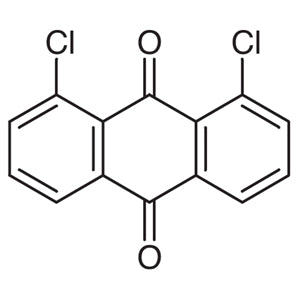
1,8-Dichloroanthraquinone is a chemical compound widely used in organic reactions and the synthesis of complex compounds. It belongs to the anthraquinone family and features two chlorine atoms at positions 1 and 8. This compound plays a crucial role in laboratory settings as a building block for various chemical processes. Its versatility makes it a valuable resource for researchers aiming to develop new materials, pharmaceuticals, and industrial chemicals. Due to its structural complexity, it is often employed in multi-step synthetic pathways.
The compound's reactivity and chemical stability under controlled conditions make it a preferred choice for substitution and oxidation reactions. Its ability to participate in diverse chemical transformations is enhanced by its molecular structure, which allows for multiple functional group modifications. Additionally, its sensitivity to moisture and air highlights the need for careful handling and storage. These properties make it suitable for advanced chemical research and industrial applications where precision and control are essential.
In Indonesian laboratories, 1,8-Dichloroanthraquinone is commonly used in organic chemistry research and the synthesis of complex compounds. It is a key reagent in academic and industrial settings, supporting experiments that require specific chemical precursors. Its availability in the local market ensures that researchers and institutions can access this compound for their studies. Its role in both teaching and research underscores its importance in the chemical sciences within Indonesia.
- Organic synthesis experiments benefit from 1,8-Dichloroanthraquinone due to its reactivity and ability to undergo substitution reactions.
- Antiseptic compound development utilizes this compound as a precursor for creating antimicrobial agents with specific chemical structures.
- Pigment synthesis applications rely on its anthraquinone framework for producing dyes and colorants with desired properties.
- Industrial chemical production uses it as a building block for manufacturing various chemical intermediates.
- Research in chemical reactivity and functional group modification benefits from its versatility in different reaction conditions.
| Brand | TCI |
|---|---|
| CAS number | 82-43-9 |
| Molecular formula | — |
| Purity | — |
| Category | Chemistry > Building Blocks > Non-Heterocyclic Building Blocks |
| Pack sizes | Available in various quantities as per standard laboratory requirements |
| Physical form | Solid |
| Storage | Store in a cool, dry place away from moisture and air exposure |
1,8-Dichloroanthraquinone should be stored in a cool, dry environment to prevent degradation due to moisture and air exposure. It is recommended to use airtight containers to minimize contact with atmospheric moisture. The compound is sensitive to humidity, so maintaining a controlled storage environment is essential. Proper labeling and secure storage are necessary to ensure safety and prevent accidental exposure. Laboratory personnel should handle the compound with care, using appropriate personal protective equipment. Regular monitoring of storage conditions ensures the compound remains stable and suitable for use in chemical experiments.
—
Produk Terkait
-
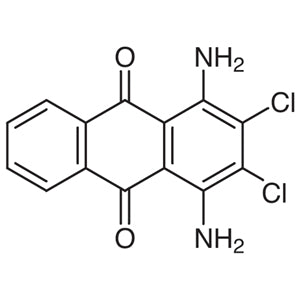
1,4-Diamino-2,3-dichloroanthraquinone TCI D2725
Regular price From Rp 584.850,00Regular price -
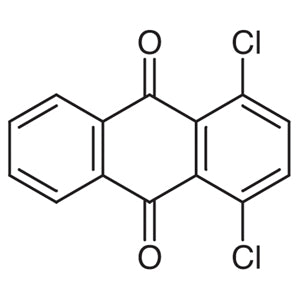
1,4-Dichloroanthraquinone TCI D2518
Regular price From Rp 4.664.100,00Regular price -
1,5-Dichloroanthraquinone TCI D0328
Regular price Rp 1.405.950,00Regular price -
Anthraquinone TCI A0502
Regular price From Rp 477.750,00Regular price -
Anthraquinone-2-carbonylChloride TCI A0503
Regular price From Rp 3.180.450,00Regular price -
Anthraquinone-2-carboxylicAcid TCI A0504
Regular price From Rp 2.889.600,00Regular price -
1,4-Anthraquinone TCI A2686
Regular price From Rp 2.466.450,00Regular price -
1-(Methylamino)anthraquinone TCI M0255
Regular price From Rp 1.670.550,00Regular price