

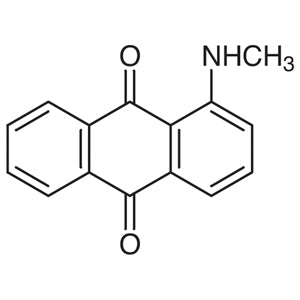
1-(Methylamino)anthraquinone is a chemical compound widely used as a building block in the synthesis of complex molecules. This compound serves as a fundamental component in organic chemistry, offering versatility in structural modification to achieve desired properties. Its anthraquinone core is a key structural motif in many bioactive compounds, making it a valuable resource for researchers aiming to develop new materials, pharmaceuticals, and industrial chemicals. In laboratory settings, it is essential for creating colored compounds, drugs, and other specialized chemical products. Its chemical stability and controlled reactivity make it a reliable choice for various synthetic processes.
The compound’s anthraquinone structure allows for effective substitution and reduction reactions, facilitating efficient synthesis pathways. This makes it a preferred choice for chemists and pharmacologists who require reliable and predictable chemical behavior. Its stability under various reaction conditions ensures consistent results, while its reactivity can be finely tuned to suit specific experimental needs. These properties contribute to its widespread use in both academic and industrial research environments.
In Indonesian laboratories, 1-(Methylamino)anthraquinone is commonly used in organic chemistry and pharmacology research. Local researchers rely on this compound to expand their understanding of molecular structures and biological activities. Its availability in various packaging options supports its use in both small-scale experiments and larger research projects. The compound’s versatility and reliability make it an essential tool for advancing scientific knowledge in Indonesia.
- Organic synthesis of bioactive compounds due to its anthraquinone core and reactivity.
- Development of pharmaceuticals as a building block for drug molecule design.
- Creation of colored compounds for use in dyes and pigments in industrial applications.
- Research in pharmacology to study molecular structures and biological activities.
- Support for chemical modification processes in material science and polymer chemistry.
| Brand | TCI |
|---|---|
| CAS number | 82-38-2 |
| Molecular formula | — |
| Purity | — |
| Category | Chemistry > Building Blocks > Non-Heterocyclic Building Blocks |
| Pack sizes | Available in various sizes to suit different experimental needs |
| Physical form | Solid (exact form may vary depending on supplier) |
| Storage | Store in a cool, dry place away from direct light |
This compound should be stored in a cool, dry environment, away from direct sunlight and moisture. It is recommended to use airtight containers to prevent exposure to air and humidity, which could affect its stability. Proper ventilation is essential when handling the compound to minimize inhalation risks. Avoid contact with skin and eyes, and use appropriate personal protective equipment such as gloves and safety goggles. Due to its chemical nature, it should be kept away from incompatible substances like strong oxidizing agents. Regular inspection of storage conditions ensures the compound remains in optimal condition for use in laboratory applications.
—
Produk Terkait
-
2-Amino-3-hydroxyanthraquinone TCI A0315
Regular price From Rp 903.000,00Regular price -
1-Amino-2-methylanthraquinone TCI A1255
Regular price Rp 1.803.900,00Regular price -
1-Aminoanthraquinone TCI A0590
Regular price From Rp 717.150,00Regular price -
1-Amino-4-hydroxyanthraquinone TCI A0314
Regular price Rp 4.161.150,00Regular price -
1-Nitroanthraquinone TCI N0127
Regular price From Rp 2.094.750,00Regular price -
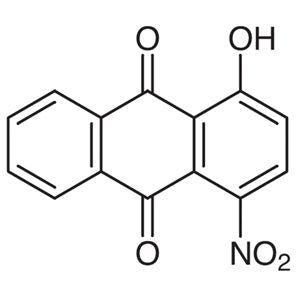
1-Hydroxy-4-nitroanthraquinone TCI H0765
Regular price From Rp 3.312.750,00Regular price -
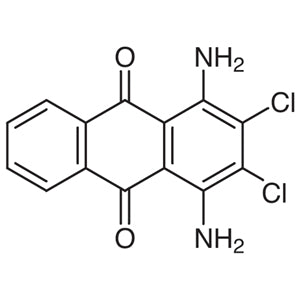
1,4-Diamino-2,3-dichloroanthraquinone TCI D2725
Regular price From Rp 584.850,00Regular price -
1,1'-Iminodianthraquinone[forDeterminationofBoron] TCI D0133
Regular price Rp 8.983.800,00Regular price


![1,1'-Iminodianthraquinone [for Determination of Boron] (CAS 82-22-4) - TCI D0133 - AMI Scientific](http://amiscientific.com/cdn/shop/files/TCI2510D0133.jpg?v=1767100907&width=533)