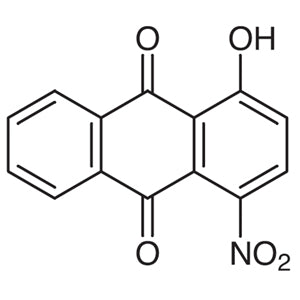
1-Hydroxy-4-nitroanthraquinone is a chemical compound widely used in organic reactions as a building block or reagent. It belongs to the anthraquinone family, with hydroxyl and nitro groups attached at specific positions, giving it unique chemical properties. This compound plays a crucial role in laboratory settings, particularly in the synthesis of complex organic molecules. Its versatility makes it a valuable tool for researchers working in various fields, including organic chemistry and pharmaceutical development.
The compound’s reactivity and oxidizing nature make it a preferred choice for specific chemical transformations. The presence of the nitro group enhances its oxidizing properties, which is beneficial in reactions requiring oxidative conditions. Its ability to undergo substitution and modification reactions further expands its utility in synthetic chemistry. Due to its chemical stability under controlled conditions, it remains a reliable reagent for laboratory applications.
In Indonesian laboratories, 1-Hydroxy-4-nitroanthraquinone is commonly used in organic chemistry research, especially in academic and research institutions. It is essential for the development of new compounds and the study of molecular structures. Its role in oxidation and substitution reactions makes it a key component in various synthetic processes. Researchers rely on its predictable behavior to achieve desired chemical outcomes in their experiments.
- Organic Synthesis: This compound is ideal for synthesizing complex organic molecules due to its reactivity and ability to undergo substitution reactions.
- Pharmaceutical Research: It is used in the development of new drugs, particularly in reactions requiring oxidative conditions or structural modifications.
- Oxidative Reactions: The nitro group provides strong oxidizing properties, making it suitable for reactions that require oxidation of organic substrates.
- Structural Modification Studies: Its unique chemical structure allows it to be a key reagent in studies focused on molecular transformation and functional group manipulation.
- Analytical Chemistry: It serves as a reference material for studying reaction mechanisms and evaluating reagent performance in various chemical processes.
| Brand | TCI |
|---|---|
| CAS number | 81-65-2 |
| Molecular formula | — |
| Purity | — |
| Category | Chemistry > Building Blocks > Non-Heterocyclic Building Blocks |
| Pack sizes | Available in various quantities as per supplier specifications |
| Physical form | Solid |
| Storage | Store in a cool, dry place away from direct sunlight and incompatible materials |
This compound should be stored in a cool, dry environment, away from direct sunlight and sources of heat. It is recommended to use airtight containers to prevent moisture absorption and contamination. Due to its oxidizing nature, it should be kept separate from reducing agents and flammable materials. Proper labeling and safe handling procedures are essential to ensure laboratory safety. Always use appropriate personal protective equipment when handling this compound to minimize exposure risks. Regular monitoring of storage conditions is advised to maintain its chemical integrity and ensure safe usage in laboratory settings.
—
Produk Terkait
-
1-Nitroanthraquinone TCI N0127
Regular price From Rp 2.094.750,00Regular price -
1-(Methylamino)anthraquinone TCI M0255
Regular price From Rp 1.670.550,00Regular price -
1,4-Diamino-2,3-dichloroanthraquinone TCI D2725
Regular price From Rp 584.850,00Regular price -
1-Aminoanthraquinone TCI A0590
Regular price From Rp 717.150,00Regular price -
1,5-Dinitroanthracene-9,10-dione TCI D6017
Regular price From Rp 1.298.850,00Regular price -
2-Amino-3-hydroxyanthraquinone TCI A0315
Regular price From Rp 903.000,00Regular price -
1-Amino-2-methylanthraquinone TCI A1255
Regular price Rp 1.803.900,00Regular price -
1-Amino-4-hydroxyanthraquinone TCI A0314
Regular price Rp 4.161.150,00Regular price