

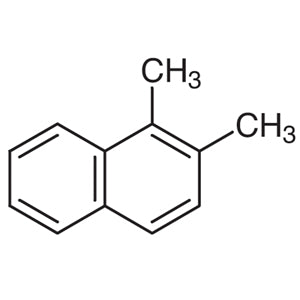
1,2-Dimethylnaphthalene is a chemical compound widely used in laboratory settings for its versatility in organic synthesis and chemical experimentation. As a non-heterocyclic building block, it plays a crucial role in the development of complex molecules and functional group transformations. Its aromatic structure provides stability, making it a reliable component in various chemical processes. This compound is particularly valued for its ability to participate in substitution and ring-opening reactions, which are fundamental in synthetic chemistry.
The compound’s non-polar nature and stable molecular framework make it a preferred choice for applications requiring structural integrity under varying reaction conditions. Its high boiling point allows it to be used in distillation processes and high-temperature reactions without undergoing significant decomposition. Additionally, its compatibility with a wide range of functional groups enhances its utility in multi-step synthetic pathways. These properties make it an essential reagent in both academic and industrial research environments.
In Indonesian laboratories, 1,2-Dimethylnaphthalene is commonly used in chemical research, especially in higher education institutions and research centers. It is frequently selected for its availability and effectiveness in complex reactions, particularly in the synthesis of heterocyclic compounds. Its role in pharmaceutical and chemical development makes it a valuable resource for scientists working on drug discovery and material synthesis.
- Synthesis of heterocyclic compounds for pharmaceutical development due to its stable aromatic structure and reactivity.
- Organic reaction intermediates in multi-step synthetic pathways because of its ability to undergo substitution and ring-opening reactions.
- High-temperature reaction processes such as distillation due to its high boiling point and thermal stability.
- Functional group modification in complex molecule synthesis because of its compatibility with various chemical groups.
- Research in chemical engineering and material science for its role in creating advanced chemical structures.
| Brand | TCI |
|---|---|
| CAS number | 573-98-8 |
| Molecular formula | — |
| Purity | — |
| Category | Chemistry > Building Blocks > Non-Heterocyclic Building Blocks |
| Pack sizes | Available in various quantities as per standard laboratory supply |
| Physical form | Liquid |
| Storage | Store in a cool, dry place away from direct sunlight and incompatible materials |
This compound should be stored in a cool, dry environment, away from direct sunlight and sources of heat. It is recommended to use airtight containers made of materials that are chemically inert to prevent contamination and degradation. Due to its non-polar nature, it may require storage in glass or polyethylene containers. General laboratory precautions include avoiding inhalation of vapors and ensuring proper ventilation when handling. It is important to keep the compound away from incompatible substances such as strong oxidizers. Always follow standard safety protocols to ensure safe handling and storage in laboratory settings.
—
Produk Terkait
-
1,4,5-Trimethylnaphthalene TCI T1711
Regular price Rp 2.889.600,00Regular price -
2,3,5-Trimethylnaphthalene TCI T0772
Regular price Rp 2.942.100,00Regular price -
2-Methylnaphthalene TCI M0372
Regular price From Rp 557.550,00Regular price -
1-Methylnaphthalene TCI M0371
Regular price From Rp 530.250,00Regular price -
2-Ethylnaphthalene TCI E0147
Regular price Rp 5.089.350,00Regular price -
1-Ethylnaphthalene TCI E0146
Regular price From Rp 2.279.550,00Regular price -
1,5-Dimethylnaphthalene TCI D2764
Regular price From Rp 1.644.300,00Regular price -
1,4-Dimethylnaphthalene TCI D1006
Regular price From Rp 3.287.550,00Regular price


