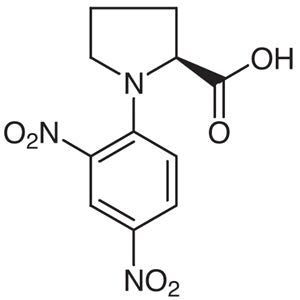
N-(2,4-Dinitrophenyl)-L-proline is a chemical compound widely used in chemical and biochemical experiments, particularly within the field of peptide chemistry. As a derivative of proline, an essential amino acid, this compound plays a crucial role in various laboratory processes. It is commonly employed as a substrate or inhibitor in specific chemical reactions, making it indispensable for researchers working in biochemical and pharmaceutical applications. Its unique molecular structure enables it to participate in a range of analytical and synthetic procedures, contributing to the advancement of scientific studies.
The compound exhibits chemical stability and solubility in organic solvents such as ethyl acetate and acetone, which enhances its utility in laboratory settings. Its high reactivity in specific chemical environments makes it a preferred choice for experiments requiring precise and controlled reactions. The molecular complexity of N-(2,4-Dinitrophenyl)-L-proline also allows it to be used in the analysis of molecular structures and the study of enzyme activity. These properties make it a versatile tool for researchers aiming to achieve accurate and reproducible results.
In Indonesian laboratories, N-(2,4-Dinitrophenyl)-L-proline is frequently utilized in chemical and biochemical research, especially in academic institutions and research organizations. It is a key component in experiments related to the synthesis of complex compounds and molecular structure analysis. Its application extends to enzyme activity testing and peptide synthesis, supporting a wide range of scientific investigations. The compound is an essential resource for researchers seeking to explore the intricacies of biochemical processes.
TCI brochures (PDF)
- Amino Acids and Peptide Synthesis Reagents 2025-08-14 · p. 19
Related TCI products
- TCI D1040 1602-42-2 Nalpha-(2,4-Dinitrophenyl)-L-arginine
- TCI D1039 14401-07-1 N-(2,4-Dinitrophenyl)-DL-threonine
- TCI D1037 1655-64-7 N-(2,4-Dinitrophenyl)-L-serine
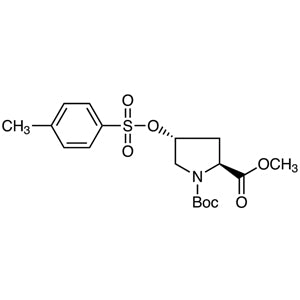
- TCI B5247 88043-21-4 N-(tert-Butoxycarbonyl)-trans-4-(p-toluenesulfonyloxy)-L-proline Methyl Ester
- TCI B4787 73323-65-6 N-(tert-Butoxycarbonyl)-D-proline Methyl Ester
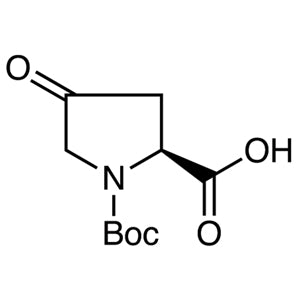
- TCI B4141 84348-37-8 N-(tert-Butoxycarbonyl)-4-oxo-L-proline
- Peptide Synthesis: This compound serves as a substrate in peptide synthesis reactions, enabling the formation of complex molecular structures with high specificity.
- Enzyme Activity Testing: Its reactivity allows it to be used as a substrate for enzyme assays, helping to determine catalytic efficiency and activity in biochemical processes.
- Molecular Structure Analysis: The compound's unique molecular structure makes it suitable for analytical techniques such as spectroscopy and chromatography.
- Chemical Reactivity Studies: It is ideal for experiments investigating the reactivity of amino acid derivatives in different chemical environments.
- Biochemical Research: Its use in biochemical research supports the study of protein interactions and functional analysis of biological systems.
| Brand | TCI |
|---|---|
| CAS number | 1655-55-6 |
| Molecular formula | — |
| Purity | — |
| Category | Chemistry > Chemical Biology > Peptide Chemistry |
| Pack sizes | Available in various quantities as per supplier specifications |
| Physical form | Solid powder |
| Storage | Store in a cool, dry place away from direct sunlight |
This compound should be stored in a cool, dry environment, away from direct sunlight and sources of heat. It is recommended to use airtight containers to prevent moisture absorption and contamination. Due to its chemical reactivity, it should be handled with care, using appropriate personal protective equipment such as gloves and safety goggles. It is advisable to store it in a well-ventilated area to minimize exposure to fumes. Proper labeling of containers is essential to ensure safe handling and prevent accidental use. Always follow standard laboratory safety protocols when working with this material.
—
Product Categories
Produk Terkait
-
Nalpha-(2,4-Dinitrophenyl)-L-arginine TCI D1040
Regular price Rp 4.266.150,00Regular priceRp 2.998.800,00Sale price Rp 4.266.150,00 -
N-(2,4-Dinitrophenyl)-DL-threonine TCI D1039
Regular price Rp 1.140.300,00Regular priceRp 812.700,00Sale price Rp 1.140.300,00 -
N-(2,4-Dinitrophenyl)-L-serine TCI D1037
Regular price Rp 1.113.000,00Regular priceRp 793.800,00Sale price Rp 1.113.000,00 -
N-(tert-Butoxycarbonyl)-trans-4-(p-toluenesulfonyloxy)-L-prolineMethylEster TCI B5247
Regular price Rp 610.050,00Regular priceRp 442.050,00Sale price Rp 610.050,00 -
N-(tert-Butoxycarbonyl)-D-prolineMethylEster TCI B4787
Regular price Rp 822.150,00Regular priceRp 590.100,00Sale price Rp 822.150,00 -
N-(tert-Butoxycarbonyl)-4-oxo-L-proline TCI B4141
Regular price Rp 1.351.350,00Regular priceRp 960.750,00Sale price Rp 1.351.350,00 -
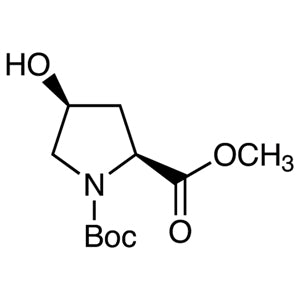
N-(tert-Butoxycarbonyl)-cis-4-hydroxy-L-prolineMethylEster TCI B3987
Regular price Rp 742.350,00Regular priceRp 534.450,00Sale price Rp 742.350,00 -
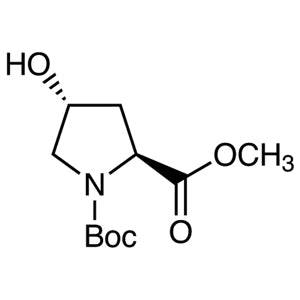
N-(tert-Butoxycarbonyl)-trans-4-hydroxy-L-prolineMethylEster TCI B3843
Regular price Rp 822.150,00Regular priceRp 590.100,00Sale price Rp 822.150,00