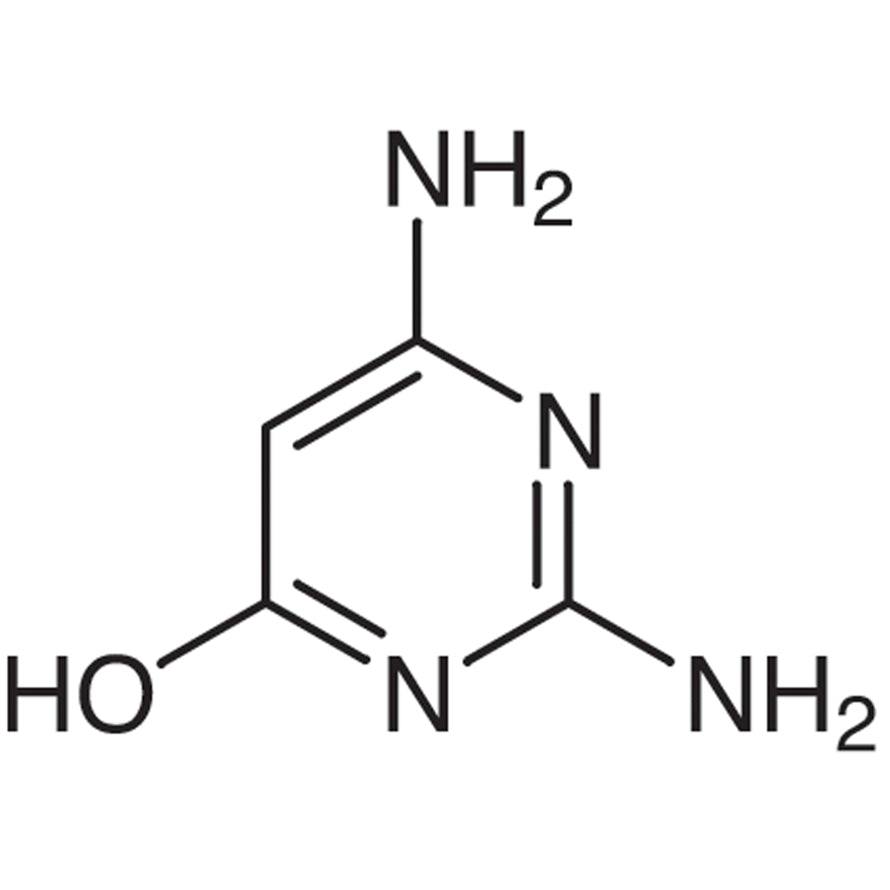
TCI D1321 2,4-Diamino-6-hydroxypyrimidine is a heterocyclic compound of the pyrimidine class that carries two amino groups and one hydroxy group on a six-membered nitrogen-containing ring. Registered under CAS number 56-06-4, this material is a highly important heterocyclic building block because its skeleton resembles the core portion of the nucleic acid base guanine, making it an efficient starting point for constructing purines, pteridines, and nucleobase analogues. In the laboratory it is used as a starting material for the synthesis of pharmaceutical intermediates, as a reagent in the preparation of folate derivatives, and as a research chemical in biochemical studies related to pterin metabolic pathways.
The property that makes this compound so widely chosen is its remarkably versatile substitution pattern. The two amino groups provide nucleophilic reaction sites for condensation, acylation, or the formation of new rings, while the hydroxy group at position six exists in a keto-enol tautomeric equilibrium that opens additional pathways of reactivity, including conversion into more reactive chloro derivatives. This combination allows fused ring systems to be assembled in only a few synthetic steps, which shortens route development and reduces the number of intermediates that have to be isolated and purified along the way.
The solid form of the material makes accurate weighing straightforward, which suits the way synthetic and analytical work is normally organised in Indonesian laboratories. It is typically handled in university research groups, pharmaceutical and biochemical research units, and analytical service laboratories where heterocyclic intermediates are prepared on a small to moderate scale. Because it is dispensed by weight from a solid stock, it fits routine bench workflows in which reagents are portioned out as needed for individual reactions.
TCI brochures (PDF)
- Reactive Oxygen Species (ROS) and Oxidative Stress Research Reagents 2026-04-23 · p. 2
- Reagents for Biological Research 2025-03-11 · p. 37
Related TCI products
- Synthesis of pharmaceutical intermediates: the compound serves as a starting material whose two amino groups and hydroxy group allow rapid elaboration into more complex drug-relevant heterocyclic structures.
- Preparation of folate derivatives: it acts as a reagent in routes toward folate-related compounds, since its pyrimidine core corresponds directly to a structural fragment found in those molecules.
- Construction of purine and pteridine ring systems: the guanine-like skeleton means fused bicyclic frameworks can be assembled through ring-forming condensations in only a few synthetic steps.
- Preparation of nucleobase analogues: because the ring resembles the core of the nucleic acid base guanine, it provides an efficient entry point into modified nucleobase structures for research purposes.
- Biochemical research on pterin metabolism: the material is used as a research chemical in studies that investigate metabolic pathways involving pterins and their related heterocyclic compounds.
| Brand | TCI |
|---|---|
| CAS number | 56-06-4 |
| Molecular formula | — |
| Purity | — |
| Category | Chemistry > Building Blocks > Heterocyclic Building Blocks |
| Pack sizes | available in the packaging options listed for this catalogue item |
| Physical form | solid, which allows accurate weighing during dispensing |
| Storage | — |
- Product code: D1321
Store the container tightly closed in a cool, dry place away from direct sunlight, moisture, and sources of heat or ignition, and keep it separated from incompatible reagents. The original manufacturer container is the most suitable primary packaging; if the material is transferred, use a clean, dry, well-sealed glass or chemically compatible plastic container with a clear label. Handle the solid in a fume hood or a well-ventilated area to limit dust exposure, and wear a laboratory coat, safety goggles, and suitable chemical-resistant gloves. Weigh the compound carefully to avoid generating airborne dust, close the container immediately after dispensing, and consult the manufacturer's safety data sheet before use and before disposal of any residues.
—
Produk Terkait
-
4,5-Diamino-6-hydroxypyrimidine TCI D4488
Regular price From Rp 664.650,00Regular price -
6-Nitroindazole TCI N0399
Regular price From Rp 1.060.500,00Regular price -
Melatonin TCI M1105
Regular price From Rp 1.936.200,00Regular price -
4-Amino-6-hydroxypyrimidine TCI A2439
Regular price From Rp 769.650,00Regular price -
4-Amino-2-dimethylamino-6-hydroxypyrimidineHemihydrate TCI A1469
Regular price Rp 2.518.950,00Regular price -
2-Amino-4,6-dihydroxypyrimidine TCI A1099
Regular price Rp 1.035.300,00Regular price -
2,4,5-Triamino-6-hydroxypyrimidineSulfate TCI T0335
Regular price Rp 1.510.950,00Regular price -
2-HydroxypyrimidineHydrochloride TCI H0480
Regular price From Rp 477.750,00Regular price