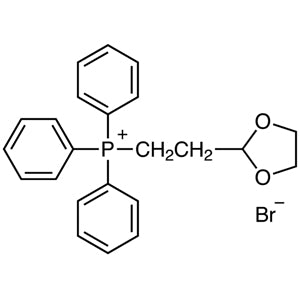
TCI D2056 2-(1,3-Dioxolan-2-yl)ethyltriphenylphosphonium Bromide is a phosphonium salt developed specifically as a reagent for carbon–carbon bond formation. The molecule consists of a central phosphorus atom bearing three phenyl groups together with an ethyl chain whose terminus carries a 1,3-dioxolane ring, that is, an aldehyde function already protected as a cyclic acetal. In the laboratory, this salt is converted into the corresponding phosphonium ylide with the aid of a base and then reacted with carbonyl compounds in the Wittig reaction, forming carbon–carbon double bonds in a directed and controlled manner.
The property that makes this reagent a preferred choice is the masked aldehyde group carried within the molecule. Once the Wittig olefination has taken place, the dioxolane ring can be reopened by acid hydrolysis to liberate a free aldehyde at the end of the newly formed chain. In other words, the reagent performs a chain extension while simultaneously leaving behind a reactive functional group for the next transformation, a strategy that is highly efficient in stepwise synthesis. As a solid phosphonium salt, the compound is also stable under ordinary storage, easy to weigh accurately, and does not demand handling as demanding as that required for organometallic reagents.
In Indonesian laboratories, this reagent is typically used in synthetic organic chemistry work at universities, research institutes, and industrial research units where multi-step synthesis routes are developed. It suits benchtop-scale Wittig olefination experiments, teaching and postgraduate research on carbonyl chemistry, and the preparation of intermediates that require a defined double bond followed by a recoverable aldehyde terminus. Its solid, easily weighed form fits routine laboratory practice without the elaborate infrastructure that more sensitive reagent classes would require.
TCI brochures (PDF)
- Wittig Reagents 2026-01-09 · p. 3
- Titanium Reagents Julia-Kocienski Olefination Reagents Peterson Reaction Reagents Z-Selective Horner-Wadsworth-Emmons Reagents 2025-03-28 · p. 6
Related TCI products
- TCI T2718 115754-62-6 Tributyl(1,3-dioxolan-2-ylmethyl)phosphonium Bromide
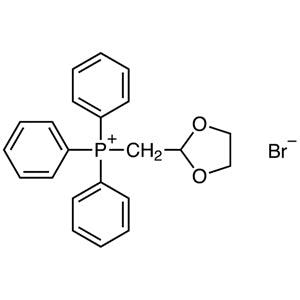
- TCI D2164 52509-14-5 (1,3-Dioxolan-2-yl)methyltriphenylphosphonium Bromide
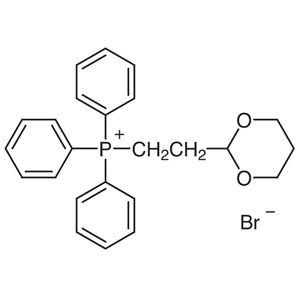
- TCI D1655 69891-92-5 2-(1,3-Dioxan-2-yl)ethyltriphenylphosphonium Bromide
- TCI B4486 111198-09-5 [(1H-Benzotriazol-1-yl)methyl]triphenylphosphonium Chloride
- TCI P1019 4423-79-4 2,2-Pentamethylene-1,3-dioxolan-4-one
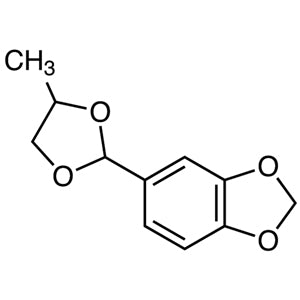
- TCI M2483 61683-99-6 4-(4-Methyl-1,3-dioxolan-2-yl)-1,2-methylenedioxybenzene
- Wittig olefination of aldehydes and ketones: the salt is deprotonated to the ylide with a base and then delivers a controlled, directed carbon–carbon double bond at the former carbonyl position.
- Homologation and chain extension: the reagent lengthens a carbon skeleton in a single olefination step, giving synthetic chemists a predictable way to build up larger frameworks from simple carbonyl starting materials.
- Protected-aldehyde introduction: the 1,3-dioxolane ring carries the aldehyde in masked form through the olefination, so the sensitive function survives basic ylide conditions without competing side reactions.
- Multi-step synthesis of intermediates: after acid hydrolysis of the acetal, the liberated aldehyde terminus becomes the handle for further transformations, making the reagent valuable in stepwise route design.
- Teaching and research on carbonyl and ylide chemistry: as a stable, weighable solid phosphonium salt, it demonstrates ylide generation and Wittig methodology without the handling complexity of organometallic reagents.
| Brand | TCI |
|---|---|
| CAS number | 86608-70-0 |
| Molecular formula | — |
| Purity | — |
| Category | Chemistry > Synthetic Reagents > C-C Bond Formation [Synthetic Reagents] |
| Pack sizes | available in the catalogue pack sizes offered for this product code |
| Physical form | solid phosphonium salt |
| Storage | stable under ordinary laboratory storage conditions |
- Chemical name: 2-(1,3-Dioxolan-2-yl)ethyltriphenylphosphonium Bromide
Store the reagent in a tightly closed original container, kept dry and protected from moisture, in a cool, well-ventilated chemical storage cabinet away from strong acids and sources of ignition. Because the acetal function is sensitive to acidic hydrolysis, avoid contact with acidic vapours during storage. Handle the solid in a fume hood, use a clean and dry spatula for weighing, and reseal the container promptly to limit moisture uptake. Wear a laboratory coat, chemical-resistant gloves, and safety goggles when weighing or transferring the material. Prepare ylide solutions only under the anhydrous conditions required by the reaction, and follow the safety data sheet supplied with the product for full handling, spillage, and disposal guidance.
—
Produk Terkait
-
Tributyl(1,3-dioxolan-2-ylmethyl)phosphoniumBromide TCI T2718
Regular price Rp 4.081.350,00Regular price -
(1,3-Dioxolan-2-yl)methyltriphenylphosphoniumBromide TCI D2164
Regular price From Rp 2.016.000,00Regular price -
2-(1,3-Dioxan-2-yl)ethyltriphenylphosphoniumBromide TCI D1655
Regular price From Rp 1.936.200,00Regular price -
[(1H-Benzotriazol-1-yl)methyl]triphenylphosphoniumChloride TCI B4486
Regular price From Rp 1.193.850,00Regular price -
2,2-Pentamethylene-1,3-dioxolan-4-one TCI P1019
Regular price From Rp 1.670.550,00Regular price -
4-(4-Methyl-1,3-dioxolan-2-yl)-1,2-methylenedioxybenzene TCI M2483
Regular price Rp 2.386.650,00Regular price -
4-Fluoro-1,3-dioxolan-2-one TCI F0731
Regular price From Rp 1.829.100,00Regular price -
Ethyl2-(2,4-Dimethyl-1,3-dioxolan-2-yl)acetate(mixtureofdiastereoisomers) TCI E1417
Regular price From Rp 610.050,00Regular price


![111198-09-5 [(1H-Benzotriazol-1-yl)methyl]triphenylphosphonium Chloride - AMI Scientific](http://amiscientific.com/cdn/shop/files/TCI2510B4486.jpg?v=1768204328&width=533)