

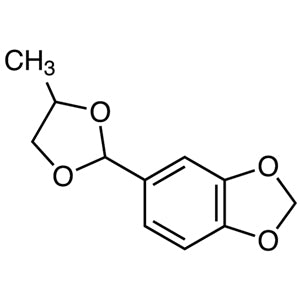
4-(4-Methyl-1,3-dioxolan-2-yl)-1,2-methylenedioxybenzene is a complex organic compound widely used in laboratory settings for its versatile chemical properties. It is a key reagent in organic synthesis, particularly in the development of heterocyclic compounds and phenolic derivatives. This compound is valued for its ability to participate in a variety of chemical reactions, making it an essential tool for researchers working in synthetic chemistry. Its molecular structure, which includes a benzene ring linked to an oxirane and methyl group, provides a stable yet reactive framework for chemical transformations.
The compound’s predictable chemical behavior and controlled reactivity make it a preferred choice for laboratory applications. Its solubility in organic solvents ensures ease of use in various synthetic procedures. Additionally, its stability under controlled conditions allows for consistent results in experiments. These properties make it a reliable reagent for both academic and industrial research. The compound is also compatible with a range of reaction conditions, enabling researchers to tailor their synthetic approaches effectively.
In Indonesian laboratories, this compound is commonly used in organic chemistry, pharmaceutical research, and material science. Researchers in universities and research institutions rely on it for the synthesis of new compounds and the optimization of existing synthetic processes. Its availability in the local market supports ongoing scientific advancements and innovation in these fields. The compound’s role in supporting diverse research areas underscores its importance in the Indonesian scientific community.
Related TCI products
- TCI B1230 2635-13-4 4-Bromo-1,2-methylenedioxybenzene
- TCI M0658 274-09-9 1,2-Methylenedioxybenzene
- TCI B2019 29668-44-8 3,4-Ethylenedioxybenzaldehyde
- TCI A1356 28657-75-2 6'-Amino-3',4'-(methylenedioxy)acetophenone
- TCI M1378 7797-83-3 2,3-(Methylenedioxy)benzaldehyde
- TCI M0874 3162-29-6 3',4'-(Methylenedioxy)acetophenone
- Organic synthesis is a primary application where this compound is used to create complex heterocyclic structures due to its reactive functional groups.
- Pharmaceutical research benefits from its use in the development of new drug compounds, as it can serve as a building block for various therapeutic agents.
- Material science applications leverage its chemical stability and reactivity for the creation of advanced polymers and functional materials.
- Analytical chemistry uses it as a standard for chromatographic and spectroscopic analysis due to its well-defined molecular structure.
- Environmental studies incorporate it in the investigation of chemical degradation processes and the behavior of organic pollutants in different matrices.
| Brand | TCI |
|---|---|
| CAS number | 61683-99-6 |
| Molecular formula | — |
| Purity | — |
| Category | TCI |
| Pack sizes | Available in various quantities to meet different research needs |
| Physical form | Solid, typically in crystalline or powder form |
| Storage | Store in a cool, dry place away from light and moisture |
This compound should be stored in a cool, dry environment, away from direct sunlight and moisture to maintain its chemical integrity. It is recommended to use sealed containers made of glass or inert plastic to prevent contamination and degradation. Due to its organic nature, it is important to handle it with appropriate personal protective equipment, such as gloves and safety goggles, to ensure laboratory safety. The compound should be kept in a well-ventilated area to minimize exposure to vapors. Proper labeling of storage containers is essential for safe handling and to prevent accidental misuse. Always follow standard laboratory safety protocols when working with this and similar chemical substances.
—
Produk Terkait
-
4-Bromo-1,2-methylenedioxybenzene TCI B1230
Regular price From Rp 769.650,00Regular price -
1,2-Methylenedioxybenzene TCI M0658
Regular price From Rp 875.700,00Regular price -
3,4-Ethylenedioxybenzaldehyde TCI B2019
Regular price From Rp 530.250,00Regular price -
6'-Amino-3',4'-(methylenedioxy)acetophenone TCI A1356
Regular price Rp 2.782.500,00Regular price -
2,3-(Methylenedioxy)benzaldehyde TCI M1378
Regular price From Rp 2.439.150,00Regular price -
3',4'-(Methylenedioxy)acetophenone TCI M0874
Regular price Rp 3.312.750,00Regular price -
Tributyl(1,3-dioxolan-2-ylmethyl)phosphoniumBromide TCI T2718
Regular price Rp 4.081.350,00Regular price -
2,2-Pentamethylene-1,3-dioxolan-4-one TCI P1019
Regular price From Rp 1.670.550,00Regular price


