


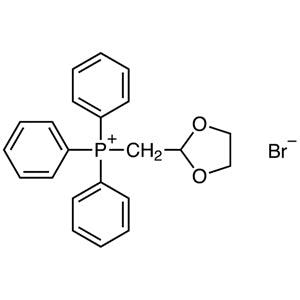
2-(1,3-Dioxan-2-yl)ethyltriphenylphosphonium Bromide is a synthetic reagent widely used in chemical laboratories for the formation of carbon-carbon bonds. It plays a crucial role in organic chemistry by facilitating substitution and coupling reactions under controlled conditions. This compound is particularly valuable for its ability to interact with various organic substrates, making it a versatile tool in synthetic chemistry. Its presence in laboratory workflows supports the development of complex organic molecules, contributing to advancements in chemical research and industrial applications.
The compound's chemical stability and controlled reactivity make it a preferred choice for researchers working in synthetic chemistry. Its complex molecular structure allows for precise reaction conditions, enabling high specificity in chemical transformations. The reagent's ability to participate in multiple reaction types, such as coupling and substitution, enhances its utility in diverse synthetic strategies. These properties ensure reliable performance across a range of experimental setups, making it a trusted component in both academic and industrial research environments.
In Indonesian laboratories, this reagent is commonly used in organic chemistry research, especially in the synthesis of complex compounds. It is a key material in laboratories focused on developing new chemical structures and improving synthetic methodologies. Its application is widespread in both academic and research settings, supporting the pursuit of innovative chemical solutions. The compound's reliability and effectiveness make it a standard choice for chemists working on advanced synthetic projects.
TCI brochures (PDF)
- Wittig Reagents 2026-01-09 · p. 3
- Titanium Reagents Julia-Kocienski Olefination Reagents Peterson Reaction Reagents Z-Selective Horner-Wadsworth-Emmons Reagents 2025-03-28 · p. 6
Related TCI products
- TCI D2056 86608-70-0 2-(1,3-Dioxolan-2-yl)ethyltriphenylphosphonium Bromide
- TCI T2718 115754-62-6 Tributyl(1,3-dioxolan-2-ylmethyl)phosphonium Bromide
- TCI D2164 52509-14-5 (1,3-Dioxolan-2-yl)methyltriphenylphosphonium Bromide
- TCI B4486 111198-09-5 [(1H-Benzotriazol-1-yl)methyl]triphenylphosphonium Chloride
- TCI B3905 847682-00-2 1,3-Bis[(2,2-dimethyl-1,3-dioxan-5-yl)oxy]-2-propanol
- TCI B3702 125995-13-3 tert-Butyl 2-[(4R,6R)-6-(2-Aminoethyl)-2,2-dimethyl-1,3-dioxan-4-yl]acetate
- Organic synthesis reactions where carbon-carbon bond formation is required due to its ability to facilitate coupling and substitution reactions.
- Development of complex organic molecules in research settings where precise reactivity and selectivity are essential.
- Catalytic processes in chemical synthesis where controlled reactivity and stability are critical for successful outcomes.
- Research in pharmaceutical and materials science where the formation of specific molecular structures is necessary.
- Analytical applications in chemical testing where the compound's reactivity and stability support accurate and reproducible results.
| Brand | TCI |
|---|---|
| CAS number | 69891-92-5 |
| Molecular formula | — |
| Purity | — |
| Category | Chemistry > Synthetic Reagents > C-C Bond Formation [Synthetic Reagents] |
| Pack sizes | Available in various quantities as per standard reagent packaging |
| Physical form | Solid or liquid, depending on the specific formulation |
| Storage | Store in a cool, dry place away from moisture and direct sunlight |
This reagent should be stored in a cool, dry environment to maintain its chemical stability and prevent degradation. It is recommended to keep it in a tightly sealed container to avoid exposure to moisture and air, which may affect its reactivity. Proper ventilation is essential when handling the compound to minimize inhalation risks. Avoid contact with skin and eyes, and use appropriate personal protective equipment such as gloves and safety goggles. The compound should be stored away from incompatible materials to ensure safety in the laboratory setting. Regular inspection of storage conditions is advised to ensure optimal preservation of the reagent's properties.
—
Produk Terkait
-
2-(1,3-Dioxolan-2-yl)ethyltriphenylphosphoniumBromide TCI D2056
Regular price From Rp 2.254.350,00Regular price -
Tributyl(1,3-dioxolan-2-ylmethyl)phosphoniumBromide TCI T2718
Regular price Rp 4.081.350,00Regular price -
(1,3-Dioxolan-2-yl)methyltriphenylphosphoniumBromide TCI D2164
Regular price From Rp 2.016.000,00Regular price -
[(1H-Benzotriazol-1-yl)methyl]triphenylphosphoniumChloride TCI B4486
Regular price From Rp 1.193.850,00Regular price -
1,3-Bis[(2,2-dimethyl-1,3-dioxan-5-yl)oxy]-2-propanol TCI B3905
Regular price Rp 3.340.050,00Regular price -
tert-Butyl2-[(4R,6R)-6-(2-Aminoethyl)-2,2-dimethyl-1,3-dioxan-4-yl]acetate TCI B3702
Regular price From Rp 477.750,00Regular price -
2-[5-[(Acryloyloxy)methyl]-5-ethyl-1,3-dioxan-2-yl]-2-methylpropylAcrylate(cis-andtrans-mixture)(stabilizedwithMEHQ) TCI A3441
Regular price From Rp 717.150,00Regular price -
2-Azido-1,3-bis[(2,2-dimethyl-1,3-dioxan-5-yl)oxy]propane TCI A2474
Regular price Rp 4.743.900,00Regular price


![111198-09-5 [(1H-Benzotriazol-1-yl)methyl]triphenylphosphonium Chloride - AMI Scientific](http://amiscientific.com/cdn/shop/files/TCI2510B4486.jpg?v=1768204328&width=533)
![847682-00-2 1,3-Bis[(2,2-dimethyl-1,3-dioxan-5-yl)oxy]-2-propanol - AMI Scientific](http://amiscientific.com/cdn/shop/files/TCI2510B3905.jpg?v=1768815545&width=533)
![125995-13-3 tert-Butyl 2-[(4R,6R)-6-(2-Aminoethyl)-2,2-dimethyl-1,3-dioxan-4-yl]acetate - AMI Scientific](http://amiscientific.com/cdn/shop/files/TCI2510B3702_705847bc-29c8-4b1a-a9b8-9f4767f456f2.jpg?v=1767433734&width=533)
![125995-13-3 tert-Butyl 2-[(4R,6R)-6-(2-Aminoethyl)-2,2-dimethyl-1,3-dioxan-4-yl]acetate - AMI Scientific](http://amiscientific.com/cdn/shop/files/TCI2510B3702.jpg?v=1772179478&width=533)
![87320-05-6 2-[5-[(Acryloyloxy)methyl]-5-ethyl-1,3-dioxan-2-yl]-2-methylpropyl Acrylate (cis- and trans- mixture) (stabilized with MEHQ) - AMI Scientific](http://amiscientific.com/cdn/shop/files/TCI_2d23138a-b518-415d-aefb-3428d352b070.png?v=1766990301&width=533)
![87320-05-6 2-[5-[(Acryloyloxy)methyl]-5-ethyl-1,3-dioxan-2-yl]-2-methylpropyl Acrylate (cis- and trans- mixture) (stabilized with MEHQ) - AMI Scientific](http://amiscientific.com/cdn/shop/files/TCI2510A3441_f179309e-2b81-4117-b739-ac1ecccfff63.jpg?v=1769055145&width=533)
![1392500-07-0 2-Azido-1,3-bis[(2,2-dimethyl-1,3-dioxan-5-yl)oxy]propane - AMI Scientific](http://amiscientific.com/cdn/shop/files/TCI2510A2474.jpg?v=1767082932&width=533)