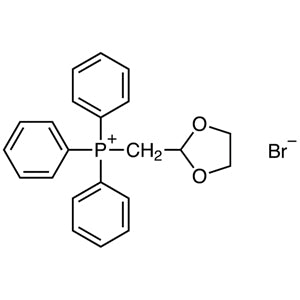
TCI D2164 (1,3-Dioxolan-2-yl)methyltriphenylphosphonium Bromide is a phosphonium salt that serves as a Wittig reagent precursor carrying an aldehyde group already protected as a cyclic 1,3-dioxolane acetal. In organic synthesis laboratories, this compound becomes a strategic choice whenever a chemist needs to extend a carbon skeleton while simultaneously installing an aldehyde group at the end of the newly formed chain. After deprotonation by a strong base, the salt forms a phosphorus ylide that reacts with aldehydes or ketones to build a carbon–carbon double bond, and the acetal it carries along can be hydrolysed in a subsequent step to unmask the carbonyl group.
The advantage that makes this reagent so widely used lies in the built-in protection of its aldehyde group. A free aldehyde is far too reactive to take part under Wittig conditions, because it would react with the ylide itself, so masking it as a dioxolane is an elegant and thoroughly proven solution. As a solid phosphonium salt, the material is stable under ordinary storage, is easy to weigh out accurately, and does not require the awkward handling associated with liquids. The dioxolane ring holds up well under the strongly basic conditions the Wittig reaction demands.
In Indonesian laboratories, this reagent fits naturally into synthetic organic chemistry work at universities, research institutes, and industrial R&D groups where multi-step syntheses are carried out. Its solid form and ordinary storage requirements suit local laboratory conditions, where accurate weighing on an analytical balance is more practical than transferring sensitive liquids. Chemists building extended carbon frameworks with a terminal carbonyl group rely on it as a dependable, well-documented route.
TCI brochures (PDF)
- Carbon Homologation / Degradation Reagents 2021-09-09 · p. 2
- Wittig Reagents 2026-01-09 · p. 3
- Titanium Reagents Julia-Kocienski Olefination Reagents Peterson Reaction Reagents Z-Selective Horner-Wadsworth-Emmons Reagents 2025-03-28 · p. 6
Related TCI products
- TCI T2718 115754-62-6 Tributyl(1,3-dioxolan-2-ylmethyl)phosphonium Bromide
- TCI D2056 86608-70-0 2-(1,3-Dioxolan-2-yl)ethyltriphenylphosphonium Bromide
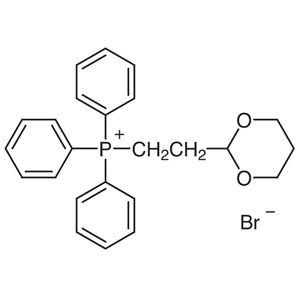
- TCI D1655 69891-92-5 2-(1,3-Dioxan-2-yl)ethyltriphenylphosphonium Bromide
- TCI B4486 111198-09-5 [(1H-Benzotriazol-1-yl)methyl]triphenylphosphonium Chloride
- TCI P1019 4423-79-4 2,2-Pentamethylene-1,3-dioxolan-4-one
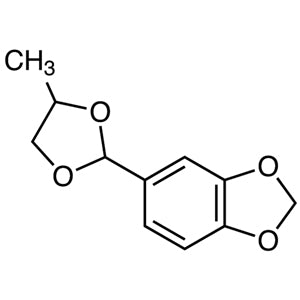
- TCI M2483 61683-99-6 4-(4-Methyl-1,3-dioxolan-2-yl)-1,2-methylenedioxybenzene
- Carbon–carbon bond formation via the Wittig reaction: after deprotonation with a strong base, the salt generates a phosphorus ylide that couples with aldehydes or ketones to form an alkene.
- Carbon chain extension in multi-step synthesis: it lengthens an existing carbon skeleton while simultaneously delivering a protected aldehyde group to the end of the new chain.
- Masked aldehyde introduction: the dioxolane acetal carries the aldehyde functionality through the reaction unharmed, since a free aldehyde would be consumed by the ylide itself.
- Protecting-group strategy studies: the compound demonstrates how a cyclic acetal survives strongly basic Wittig conditions and is later removed by hydrolysis to unmask the carbonyl.
- Teaching and methodology development in organic synthesis: as a stable, accurately weighable solid reagent, it supports reproducible practical work on ylide chemistry and olefination.
From the TCI brochure
- Wittig reaction for two-carbon homologation of aldehydes: 1) D2164, LiOMe, THF, 0 °C to 70 °C; 2) aq. HCl, THF
| Brand | TCI (Tokyo Chemical Industry) |
|---|---|
| CAS number | 52509-14-5 |
| Molecular formula | — |
| Purity | — |
| Category | Chemistry > Synthetic Reagents > C-C Bond Formation [Synthetic Reagents] |
| Pack sizes | available in standard TCI catalogue pack sizes; please confirm the current option when ordering |
| Physical form | solid phosphonium salt |
| Storage | stable under ordinary laboratory storage conditions in a closed container |
Data from the TCI brochure
| Kemasan | 5g / 25g |
|---|
Source: TCI brochure RR038 (2021-09-09)
Store the reagent in a tightly closed original container, kept dry and away from moisture, in a cool, well-ventilated chemical store away from strong bases and incompatible materials. As a solid phosphonium salt it is convenient to weigh out on an analytical balance; keep the container closed when not in use to prevent moisture uptake and caking. Handle it in a fume hood with safety glasses, gloves, and a laboratory coat, and use clean, dry spatulas and glassware. Deprotonation with strong base should be performed under controlled anhydrous conditions. Label all working solutions clearly and dispose of residues through the laboratory's chemical waste route.
—
Produk Terkait
-
Tributyl(1,3-dioxolan-2-ylmethyl)phosphoniumBromide TCI T2718
Regular price Rp 4.081.350,00Regular price -
2-(1,3-Dioxolan-2-yl)ethyltriphenylphosphoniumBromide TCI D2056
Regular price From Rp 2.254.350,00Regular price -
2-(1,3-Dioxan-2-yl)ethyltriphenylphosphoniumBromide TCI D1655
Regular price From Rp 1.936.200,00Regular price -
[(1H-Benzotriazol-1-yl)methyl]triphenylphosphoniumChloride TCI B4486
Regular price From Rp 1.193.850,00Regular price -
2,2-Pentamethylene-1,3-dioxolan-4-one TCI P1019
Regular price From Rp 1.670.550,00Regular price -
4-(4-Methyl-1,3-dioxolan-2-yl)-1,2-methylenedioxybenzene TCI M2483
Regular price Rp 2.386.650,00Regular price -
4-Fluoro-1,3-dioxolan-2-one TCI F0731
Regular price From Rp 1.829.100,00Regular price -
Ethyl2-(2,4-Dimethyl-1,3-dioxolan-2-yl)acetate(mixtureofdiastereoisomers) TCI E1417
Regular price From Rp 610.050,00Regular price


![111198-09-5 [(1H-Benzotriazol-1-yl)methyl]triphenylphosphonium Chloride - AMI Scientific](http://amiscientific.com/cdn/shop/files/TCI2510B4486.jpg?v=1768204328&width=533)