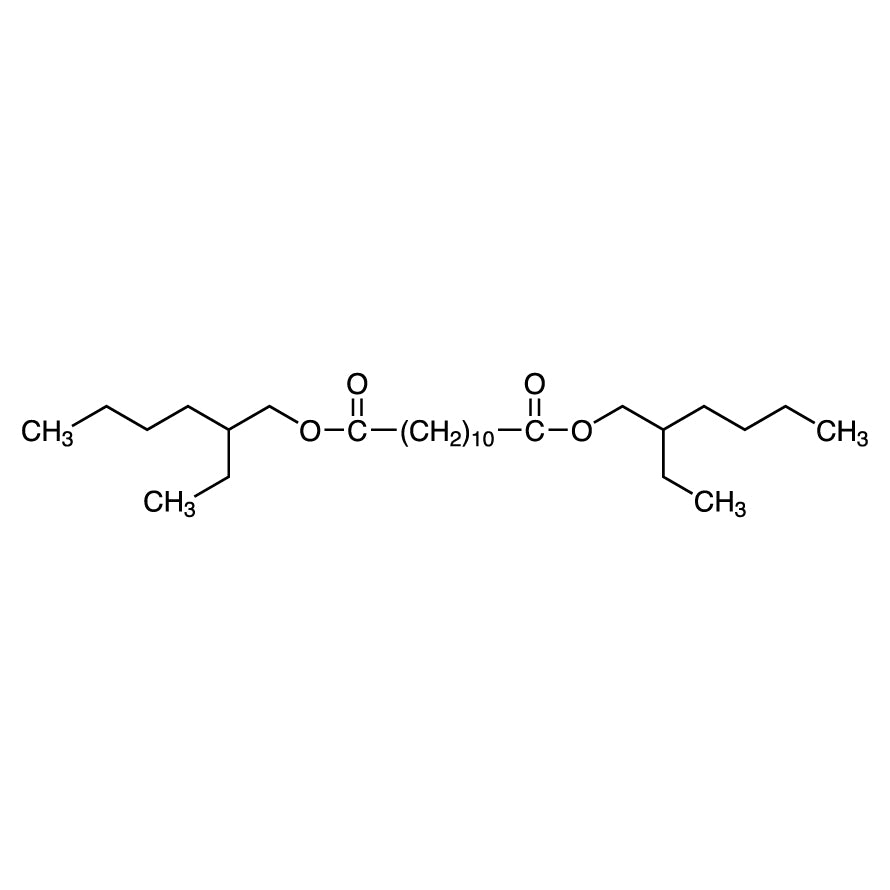
TCI D2092 Bis(2-ethylhexyl) Dodecanedioate is an aliphatic diester formed by combining dodecanedioic acid with branched 2-ethylhexyl alcohol. In materials science and polymer laboratories, this liquid compound serves as a polymer additive, primarily as a plasticizer and as a base component for synthetic lubricants. Its function is to insert itself between polymer chains, thereby reducing interchain forces, lowering the glass transition temperature, and making the material more flexible and easier to process. Researchers use it to adjust the mechanical properties of test formulations in a controlled manner without altering the chemical structure of the base polymer itself.
The properties that make it a preferred choice are the long, flexible twelve-carbon diacid chain combined with two branched alkyl groups. This combination delivers low volatility, good compatibility with many nonpolar and semipolar polymers, and performance at low temperatures that is known to be reliable, because the branched structure hinders crystallization. As a diester of relatively high molecular weight, the material tends not to evaporate readily from the matrix during thermal testing, so characterization results remain more stable. Its liquid form also makes it straightforward to dose and blend into formulations.
In Indonesian laboratories, this reagent is typically used in university and institutional polymer research groups, in materials science laboratories, and in industrial R&D and quality-control units working on flexible polymer compounds and synthetic lubricant formulations. It supports formulation trials where flexibility, processability, and low-temperature behaviour need to be tuned and compared across samples. Because it is supplied as a liquid, it fits ordinary bench workflows using standard volumetric and gravimetric dosing equipment.
- Polymer plasticization studies — the diester inserts between polymer chains, reduces interchain forces, and lowers the glass transition temperature, giving controlled flexibility changes.
- Synthetic lubricant base formulation — its aliphatic diester structure and low volatility make it suitable as a base component in synthetic lubricant development and evaluation work.
- Low-temperature performance testing — the branched 2-ethylhexyl groups hinder crystallization, so formulations retain flexible behaviour and reliable performance at reduced temperatures.
- Thermal characterization of compounds — the relatively high molecular weight means limited evaporation from the matrix during thermal testing, producing more stable characterization results.
- Polymer compatibility screening — good compatibility with many nonpolar and semipolar polymers allows researchers to compare additive uptake across different candidate polymer matrices.
| Brand | TCI |
|---|---|
| CAS number | 19074-24-9 |
| Molecular formula | — |
| Purity | — |
| Category | Materials Science > Polymer/Macromolecule Reagents > Polymer Additives |
| Pack sizes | available in standard TCI laboratory pack sizes; please confirm the currently offered packaging when ordering. |
| Physical form | liquid |
| Storage | store in a closed container in a cool, dry, well-ventilated place away from heat and ignition sources. |
Store this product in its original tightly closed container in a cool, dry, and well-ventilated area, away from direct sunlight, heat, and sources of ignition, and separated from strong oxidizing agents. Glass or chemically compatible plastic containers with secure caps are suitable for storage and for transferring working aliquots; keep containers closed when not in use to avoid contamination and moisture pickup. Handle the liquid in a fume hood or a well-ventilated workspace, and wear a laboratory coat, chemical-resistant gloves, and safety goggles. Use clean, dry glassware and dedicated pipettes or syringes when dosing into formulations. Wipe up spills promptly with absorbent material, since the liquid can leave slippery residues on bench surfaces and floors. Label all secondary containers clearly, and always consult the manufacturer's safety data sheet before first use.
—
Produk Terkait
-
DimethylDodecanedioate TCI D2835
Regular price From Rp 823.200,00Regular price -
DiethylDodecanedioate TCI D2486
Regular price Rp 1.353.450,00Regular price -
Bis(2-ethylhexyl)Adipate TCI A0163
Regular price Rp 452.550,00Regular price -
Bis(2-ethylhexyl)Isophthalate TCI B4302
Regular price Rp 584.850,00Regular price -
Tris(2-ethylhexyl)Trimellitate TCI B0881
Regular price From Rp 505.050,00Regular price -
Bis(2-ethylhexyl)Azelate TCI A1473
Regular price Rp 2.889.600,00Regular price -
Bis(2-ethylhexyl)Azelate TCI A0653
Regular price From Rp 477.750,00Regular price -
Bis(2-ethylhexyl)4-Cyclohexene-1,2-dicarboxylate TCI T0605
Regular price From Rp 477.750,00Regular price