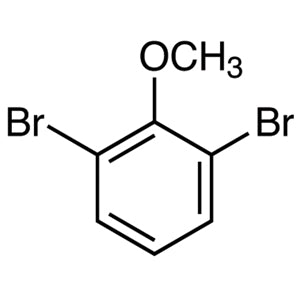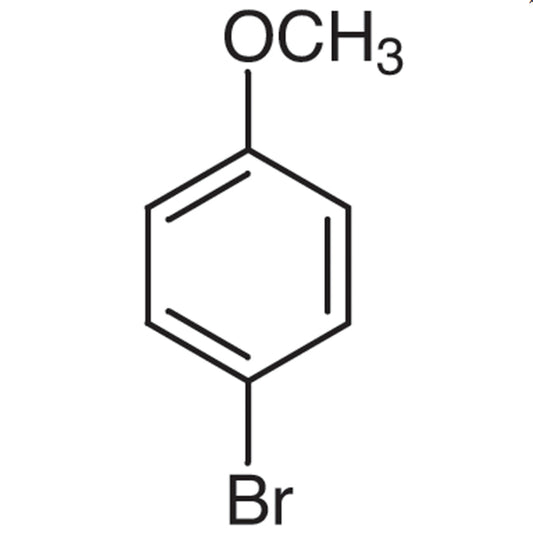


TCI D3364 3,5-Dibromoanisole is a derivative of anisole (methoxybenzene) with two bromine atoms at the 3- and 5-positions, both meta to the methoxy group. It is an important aryl halide building block in organic synthesis laboratories because one molecule offers two reactive sites for cross-coupling reactions. Researchers use it to build meta-substituted aromatic frameworks that are difficult to reach by direct electrophilic substitution on anisole, since the methoxy group normally directs incoming substituents to the ortho and para positions.
Chemists choose this compound because both bromine atoms take part in Suzuki-Miyaura, Sonogashira and Buchwald-Hartwig reactions as well as halogen-metal exchange. By adjusting stoichiometry and reaction conditions, researchers can run a double substitution to build symmetrical molecules or a stepwise substitution to install two different groups. The methoxy group has a distinctive electronic influence on the ring. When needed, it can be converted to a phenol by demethylation, which opens further routes for functionalization. The resulting 1,3,5 substitution pattern is especially useful for branched molecules and conjugated materials.
In Indonesia, 3,5-Dibromoanisole is relevant to laboratories working in synthetic organic chemistry, materials chemistry and medicinal chemistry. University research groups, postgraduate students and institutional laboratories use it to develop new synthetic routes, prepare substituted aromatic intermediates and explore structure-activity relationships. Because the material comes from TCI, a recognized reagent brand, laboratories can document its identity by CAS number 74137-36-3. That supports reproducible experimental records, thesis work and publication-quality research.
- Suzuki-Miyaura cross-coupling: the two aryl bromide positions react with boronic acids or esters, so researchers can attach one or two aryl groups to the meta-substituted anisole core.
- Sonogashira coupling: both bromine atoms can couple with terminal alkynes to form arylalkyne structures, which are useful for rigid, linear or branched conjugated frameworks in materials research.
- Buchwald-Hartwig amination: the aryl bromide sites allow carbon-nitrogen bond formation with amines, giving meta-substituted aniline derivatives for medicinal chemistry and ligand design.
- Halogen-metal exchange and further functionalization: the bromine atoms can be exchanged for a metal to generate reactive aryl intermediates, which can then be trapped with a range of electrophiles.
- Stepwise and symmetrical molecule construction: with controlled stoichiometry, one bromine can react before the other, so the compound serves both symmetrical 1,3,5-pattern targets and unsymmetrical, differently substituted products.
| Brand | TCI (product code D3364) |
|---|---|
| CAS number | 74137-36-3 |
| Molecular formula | — |
| Purity | — |
| Category | Chemistry > Building Blocks > Non-Heterocyclic Building Blocks |
| Pack sizes | see the available options on the product listing |
| Physical form | see the TCI label, certificate of analysis and Safety Data Sheet supplied with the product |
| Storage | — |
- Chemical name: 3,5-Dibromoanisole (3,5-dibromo-1-methoxybenzene)
Store 3,5-Dibromoanisole in its original, tightly closed container in a cool, dry, well-ventilated area. Keep it away from direct sunlight, heat sources and strong oxidizing agents. Follow the storage temperature on the TCI label and Safety Data Sheet. Handle the material in a fume hood and wear standard personal protective equipment: safety glasses, chemical-resistant gloves and a laboratory coat. Avoid inhaling vapors or dust and avoid contact with skin and eyes. Close containers promptly after use and label any transferred portions clearly. Dispose of halogenated organic waste according to institutional and local regulations, and do not pour it down the drain.
—
Produk Terkait
-
2,6-Dibromoanisole TCI D5279
Regular price From Rp 1.791.000,00Regular priceRp 1.218.000,00Sale price From Rp 1.791.000,00 -
2,4-Dibromoanisole TCI D1863
Regular price Rp 934.000,00Regular priceRp 636.000,00Sale price Rp 934.000,00 -
4-Bromoanisole TCI B0547
Regular price From Rp 520.000,00Regular priceRp 353.000,00Sale price From Rp 520.000,00 -
2-Bromoanisole TCI B0546
Regular price From Rp 987.000,00Regular priceRp 671.000,00Sale price From Rp 987.000,00 -
3-Bromoanisole TCI B0545
Regular price From Rp 1.220.000,00Regular priceRp 830.000,00Sale price From Rp 1.220.000,00 -
2-(1-Adamantyl)-4-bromoanisole TCI A2321
Regular price From Rp 1.298.000,00Regular priceRp 883.000,00Sale price From Rp 1.298.000,00 -
2,4,6-Tribromoanisole TCI T2301
Regular price From Rp 1.116.000,00Regular priceRp 759.000,00Sale price From Rp 1.116.000,00 -
2-Bromo-5-chloroanisole TCI B3646
Regular price From Rp 1.998.000,00Regular priceRp 1.359.000,00Sale price From Rp 1.998.000,00