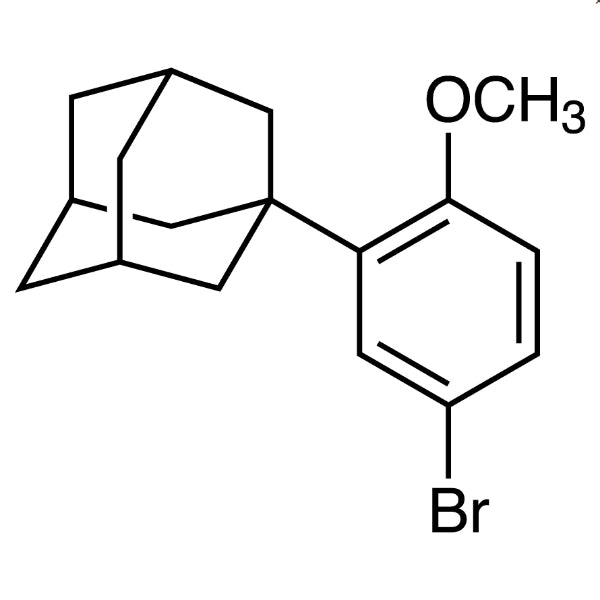
2-(1-Adamantyl)-4-bromoanisole is a chemical compound widely used as a building block in organic synthesis. It serves as a versatile intermediate in the creation of complex molecules, particularly in the development of heterocyclic compounds and other structurally intricate substances. Its unique molecular structure, featuring a bromo group and an anisole group, makes it a valuable resource for chemists seeking to design and synthesize new compounds. This compound plays a crucial role in both academic and industrial research settings, supporting the advancement of chemical science through its adaptability in various synthetic pathways.
The compound's chemical stability under controlled conditions, combined with its reactivity in specific chemical environments, makes it a preferred choice for synthetic chemists. Its ability to participate in substitution reactions, electrophilic reactions, and other relevant organic transformations enhances its utility in laboratory applications. The structural complexity of 2-(1-Adamantyl)-4-bromoanisole allows it to be a key player in the development of pharmaceuticals and other specialized chemical products. These properties contribute to its widespread use in both research and development processes.
In Indonesian laboratories, 2-(1-Adamantyl)-4-bromoanisole is commonly utilized in scientific research, particularly in the fields of organic chemistry and pharmaceutical development. It is frequently employed by educational institutions and research centers to explore new chemical structures and applications. Its role in the synthesis of compounds with potential applications in health and industry underscores its importance in the scientific community.
- Organic synthesis of heterocyclic compounds due to its reactive bromo and anisole groups.
- Development of pharmaceuticals through its role as a building block in complex molecule creation.
- Research in chemical engineering for the design of new materials and functional compounds.
- Academic studies in organic chemistry for teaching and experimental research purposes.
- Industrial applications in the production of specialty chemicals and advanced materials.
| Brand | TCI |
|---|---|
| CAS number | 104224-63-7 |
| Molecular formula | — |
| Purity | — |
| Category | Chemistry > Building Blocks > Non-Heterocyclic Building Blocks |
| Pack sizes | — |
| Physical form | — |
| Storage | Store in a cool, dry place away from light and incompatible materials |
This compound should be stored in a cool, dry environment, away from direct sunlight and sources of heat. It is recommended to use airtight containers made of materials that are chemically inert, such as glass or high-density polyethylene, to prevent contamination and degradation. Due to its reactivity, it should be handled in a well-ventilated laboratory setting, with appropriate personal protective equipment, including gloves and safety goggles, to ensure safety. Avoid contact with moisture and incompatible substances to maintain its stability and effectiveness. Proper storage and handling are essential to preserve its chemical integrity and ensure safe use in laboratory applications.
—
Produk Terkait
-
4-Bromoanisole TCI B0547
Regular price From Rp 530.250,00Regular price -
2-Bromoanisole TCI B0546
Regular price From Rp 1.008.000,00Regular price -
3-Bromoanisole TCI B0545
Regular price From Rp 1.246.350,00Regular price -
2,4,6-Tribromoanisole TCI T2301
Regular price From Rp 1.140.300,00Regular price -
2,6-Dibromoanisole TCI D5279
Regular price From Rp 1.829.100,00Regular price -
3,5-Dibromoanisole TCI D3364
Regular price From Rp 1.510.950,00Regular price -
2,4-Dibromoanisole TCI D1863
Regular price Rp 955.500,00Regular price -
4-(1-Adamantyl)phenol TCI A1392
Regular price From Rp 1.167.600,00Regular price