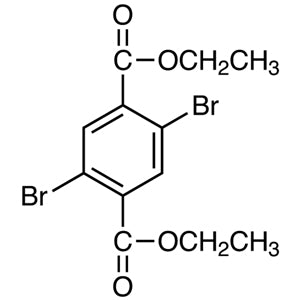
TCI D3995 Diethyl 2,5-Dibromoterephthalate (CAS 18013-97-3) is the diethyl ester form of 2,5-dibromoterephthalic acid: a symmetrical benzene core carrying two bromine atoms together with two ethyl ester groups in the para position. As a non-heterocyclic building block, this compound is widely used in organic synthesis and materials chemistry laboratories because its ester groups are already protected from the outset, allowing researchers to run reactions directly at the bromine atoms without interference from acidic protons. Once the target framework has been assembled, the ester groups can be hydrolysed back to the acid whenever that is required.
The advantages that make this ester form a frequent choice are solubility and reaction compatibility. Unlike its free acid counterpart, the diester dissolves more readily in organic solvents such as toluene, tetrahydrofuran and dichloromethane, which are precisely the media commonly used for palladium-catalysed coupling reactions. The absence of a free acid group also prevents the quenching of bases and metal catalysts, so reaction conditions are easier to control and results are more consistent. The molecular symmetry lends regularity to polymerisation products, while the two equivalent bromine atoms make both double and mono substitution reactions possible.
In Indonesian laboratories, this building block is typically handled in university research groups, materials chemistry laboratories and organic synthesis facilities that construct extended aromatic frameworks. Researchers generally receive it as a catalogue item within the Chemistry > Building Blocks > Non-Heterocyclic Building Blocks category and store it alongside other coupling substrates. It fits routine bench workflows where a symmetrical, pre-protected dihalide is needed as the starting point for a multi-step sequence.
- Palladium-catalysed cross-coupling chemistry: the two equivalent bromine atoms serve as reactive handles in solvents such as toluene and tetrahydrofuran, where the protected esters will not quench the metal catalyst.
- Conjugated polymer synthesis: molecular symmetry gives regularity to the resulting polymer chains, while the difunctional bromide pattern supports controlled step-growth polymerisation from a single monomer.
- Materials chemistry framework construction: the para-substituted benzene core acts as a rigid linear spacer, and the esters can later be hydrolysed back to the dicarboxylic acid when free acid groups are needed.
- Multi-step organic synthesis: pre-protected ester groups let researchers carry out bromine-site chemistry first and defer deprotection until the target skeleton has been fully assembled.
- Selective mono- versus di-substitution studies: the two equivalent bromine positions allow researchers to explore either single or double substitution under controlled conditions with a consistent, symmetrical substrate.
| Brand | TCI |
|---|---|
| CAS number | 18013-97-3 |
| Molecular formula | — |
| Purity | — |
| Category | Chemistry > Building Blocks > Non-Heterocyclic Building Blocks |
| Pack sizes | available in the standard catalogue pack sizes offered by TCI for this item; please confirm the pack size when ordering |
| Physical form | — |
| Storage | store as indicated on the manufacturer's product label and safety data sheet |
- Catalogue number: D3995
- Chemical name: Diethyl 2,5-Dibromoterephthalate
Store the container tightly closed in a cool, dry, well-ventilated place away from direct sunlight, moisture and incompatible materials, following the storage conditions stated on the manufacturer's label and safety data sheet. Keep the material in its original supplier container, or in a clean, well-sealed amber glass bottle if transfer is necessary, and label it clearly with the compound name and CAS number. Handle in a fume hood using standard laboratory personal protective equipment: safety goggles, chemical-resistant gloves and a laboratory coat. Avoid inhalation of dust and contact with skin and eyes. Weigh and transfer the solid with clean, dry spatulas to prevent contamination and moisture uptake, reseal the container promptly after use, and dispose of residues and contaminated materials in accordance with institutional chemical waste procedures. Always consult the current safety data sheet before first use.
—
Produk Terkait
-
2-HydroxyethylMethylTerephthalate TCI T1679
Regular price From Rp 1.803.900,00Regular price -
Bis(2-hydroxyethyl)Terephthalate TCI B3429
Regular price From Rp 928.200,00Regular price -
DisodiumTerephthalate TCI T1097
Regular price From Rp 1.510.950,00Regular price -
DimethylTerephthalate TCI T0015
Regular price From Rp 505.050,00Regular price -
DiethylTerephthalate TCI T0014
Regular price From Rp 1.881.600,00Regular price -
DibutylTerephthalate TCI D6074
Regular price Rp 2.227.050,00Regular price -
DiphenylTerephthalate TCI D5995
Regular price From Rp 2.094.750,00Regular price -
DimethylBromoterephthalate TCI D5003
Regular price From Rp 3.392.550,00Regular price