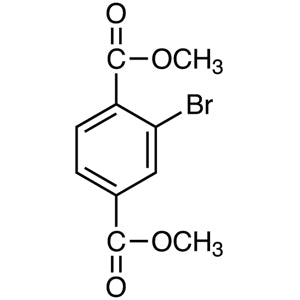
Dimethyl Bromoterephthalate (DMBT), with CAS number 18643-86-2, is a chemical compound widely used as a building block in organic synthesis. It serves as a key intermediate in the development of various organic compounds, particularly in pharmaceutical and material science research. Its unique molecular structure, featuring a bromo group on the terephthalate ring and two methyl groups at the ends, makes it highly versatile for chemical modifications. In laboratory settings, DMBT is valued for its ability to participate in substitution reactions and other synthetic processes, enabling the creation of complex molecules.
The chemical stability of DMBT, combined with its reactivity in a variety of reaction conditions, makes it a preferred choice for synthetic chemists. Its ability to act as a bridging molecule in the formation of more complex structures is particularly advantageous. The compound’s predictable behavior under different reaction conditions ensures consistency in synthetic outcomes, which is crucial for research and development. These properties contribute to its widespread use in both academic and industrial laboratory environments.
In Indonesian laboratories, DMBT is commonly utilized in organic chemistry research, especially in projects involving the synthesis of pharmacological compounds and polymers. It is also frequently used in higher education settings to teach students about complex synthesis processes and reaction mechanisms. Its role in both research and education underscores its importance in the chemical sciences within the region.
- Organic Synthesis: DMBT is ideal for creating complex organic molecules due to its reactivity and structural versatility.
- Pharmaceutical Research: It serves as a precursor in the development of new drugs, supporting the synthesis of pharmacologically active compounds.
- Polymer Science: DMBT is used in the production of specialty polymers, contributing to the development of advanced materials.
- Academic Teaching: It is a valuable tool in educational settings for demonstrating synthetic methods and reaction mechanisms.
- Material Development: Its chemical properties make it suitable for the creation of new materials with specific functional characteristics.
| Brand | TCI |
|---|---|
| CAS number | 18643-86-2 |
| Molecular formula | — |
| Purity | — |
| Category | Chemistry > Building Blocks > Non-Heterocyclic Building Blocks |
| Pack sizes | Available in various quantities as per supplier specifications |
| Physical form | Solid |
| Storage | Store in a cool, dry place away from moisture and direct sunlight |
Dimethyl Bromoterephthalate should be stored in a cool, dry environment to maintain its chemical integrity. It is recommended to keep it in a tightly sealed container to prevent exposure to moisture and air. Due to its chemical nature, it should be handled in a well-ventilated area, and appropriate personal protective equipment should be worn when working with it. Avoid contact with skin and eyes, and ensure that it is stored away from incompatible substances. Regular monitoring of storage conditions is advised to ensure the compound remains stable and safe for use in laboratory applications.
—
Product Categories
Produk Terkait
-
DimethylHomoterephthalate TCI D5266
Regular price Rp 1.618.050,00Regular price -
2-HydroxyethylMethylTerephthalate TCI T1679
Regular price From Rp 1.803.900,00Regular price -
Bis(2-hydroxyethyl)Terephthalate TCI B3429
Regular price From Rp 928.200,00Regular price -
DisodiumTerephthalate TCI T1097
Regular price From Rp 1.510.950,00Regular price -
DimethylTerephthalate TCI T0015
Regular price From Rp 505.050,00Regular price -
DiethylTerephthalate TCI T0014
Regular price From Rp 1.881.600,00Regular price -
DibutylTerephthalate TCI D6074
Regular price Rp 2.227.050,00Regular price -
DiphenylTerephthalate TCI D5995
Regular price From Rp 2.094.750,00Regular price