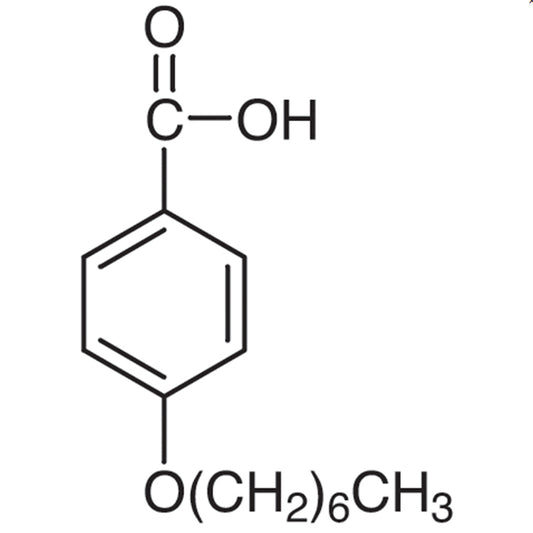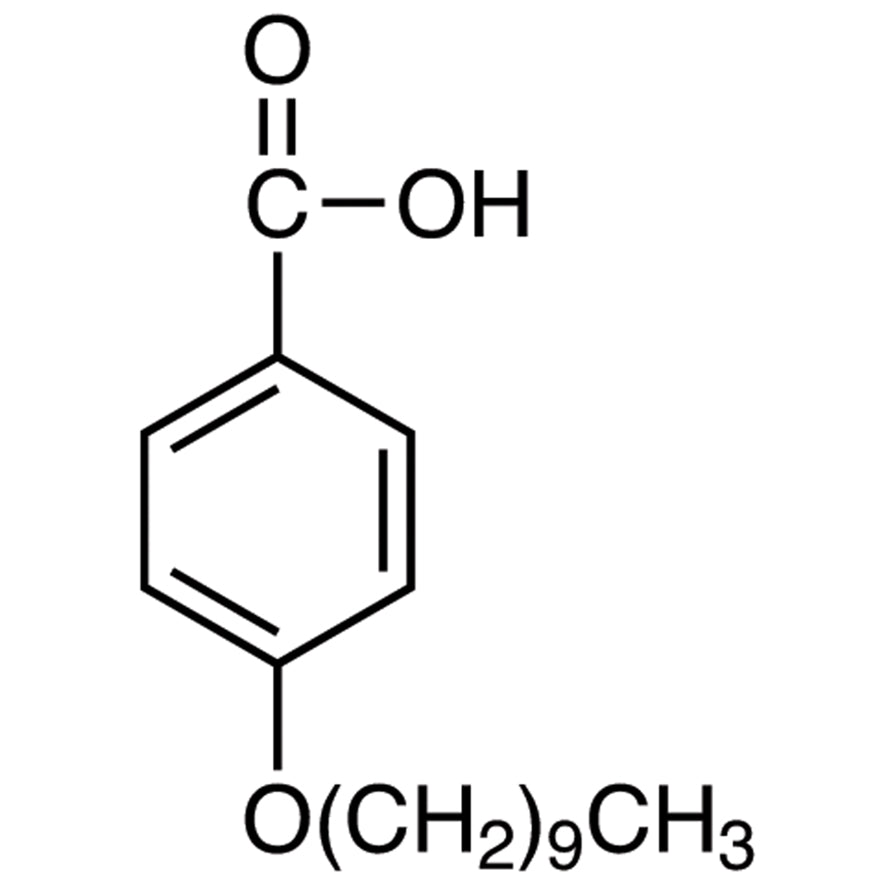
TCI D4176 is 4-(Decyloxy)benzoic Acid, a benzoic acid derivative carrying a ten-carbon alkoxy chain at the para position. The compound belongs to the family of material building blocks for liquid crystals and is one of the classic substances used in the study of mesophases. Its role in the laboratory is to serve as a constituent of thermotropic liquid crystal systems, used either directly as a mesogen or reacted further into esters, amides, or hydrogen-bonded complexes with pyridine bases and their derivatives to form supramolecular materials.
The principal characteristic that makes this compound a preferred choice is its distinctly calamitic mesogenic architecture: a rigid, aromatic benzene core, a polar carboxyl group at one end, and a long, flexible decyloxy tail at the other. The carboxyl group is able to form dimers through double hydrogen bonding, so that two molecules combine into a single elongated unit that drives the formation of a liquid crystalline phase. The length of the alkoxy chain governs the transition temperatures and the type of mesophase that appears, which is why the homologous series of 4-alkoxybenzoic acids is so often used to study structure–property relationships in mesomorphic behaviour.
In Indonesian laboratories, this material is typically found in university and institutional research groups working on materials chemistry, organic synthesis, and soft matter. It is commonly used in postgraduate and final-year research projects on liquid crystal formation, in synthetic work that builds larger mesogenic molecules from a functional acid starting point, and in supramolecular chemistry studies where hydrogen-bonded assemblies are prepared and characterised using thermal and optical methods.
Related TCI products
- TCI B5318 83626-35-1 4-(trans-4-Butylcyclohexyl)benzoic Acid
- TCI B1585 115595-27-2 4-(3-Butenyloxy)benzoic Acid
- TCI A3322 83883-26-5 4-[[6-(Acryloyloxy)hexyl]oxy]benzoic Acid
- TCI A2593 65355-30-8 4-(trans-4-Amylcyclohexyl)benzoic Acid
- TCI H1629 83883-25-4 4-(6-Hydroxyhexyloxy)benzoic Acid
- TCI H0642 500-76-5 4-(4-Hydroxyphenoxy)benzoic Acid
- Thermotropic liquid crystal preparation — the rigid aromatic core with a long flexible decyloxy tail gives the elongated molecular shape required for mesophase formation on heating and cooling.
- Supramolecular hydrogen-bonded complexes — the terminal carboxyl group pairs readily with pyridine bases and their derivatives, allowing assembly of non-covalent mesogenic complexes without additional synthetic steps.
- Synthesis of mesogenic esters and amides — the carboxylic acid function serves as a reactive handle for building larger liquid crystal molecules through standard esterification or amidation chemistry.
- Structure–property relationship studies — as a member of the 4-alkoxybenzoic acid homologous series, it lets researchers correlate alkoxy chain length with transition temperature and mesophase type.
- Dimerisation and self-assembly research — the double hydrogen bonding between two carboxyl groups produces an extended dimer unit useful for investigating how molecular association generates ordered fluid phases.
| Brand | TCI (Tokyo Chemical Industry) |
|---|---|
| CAS number | 5519-23-3 |
| Molecular formula | — |
| Purity | — |
| Category | Materials Science > Material Building Blocks > Liquid Crystal (LC) Building Blocks |
| Pack sizes | available in standard TCI research-scale packaging; please confirm the size options when ordering |
| Physical form | — |
| Storage | keep in a tightly closed original container, in a cool, dry place away from light and moisture |
- Chemical name: 4-(Decyloxy)benzoic Acid
Store the material in its original tightly closed container in a cool, dry, well-ventilated area, protected from light, moisture, and sources of ignition, and keep it separated from strong oxidising agents and strong bases. Amber glass or the supplier's original packaging is suitable for both storage and any repackaging. Handle the compound inside a fume hood, wearing a laboratory coat, safety goggles, and chemical-resistant gloves, and avoid generating or inhaling dust during weighing and transfer. Close the container promptly after use, label all secondary containers clearly, and consult the manufacturer's safety data sheet before first use and before disposal of any residues.
—
Produk Terkait
-
4-(trans-4-Butylcyclohexyl)benzoicAcid TCI B5318
Regular price Rp 1.246.350,00Regular price -
4-(3-Butenyloxy)benzoicAcid TCI B1585
Regular price Rp 5.698.350,00Regular price -
4-[[6-(Acryloyloxy)hexyl]oxy]benzoicAcid TCI A3322
Regular price From Rp 875.700,00Regular price -
4-(trans-4-Amylcyclohexyl)benzoicAcid TCI A2593
Regular price From Rp 1.035.300,00Regular price -
4-(6-Hydroxyhexyloxy)benzoicAcid TCI H1629
Regular price From Rp 1.538.250,00Regular price -
4-(4-Hydroxyphenoxy)benzoicAcid TCI H0642
Regular price From Rp 3.710.700,00Regular price -
4-(Heptyloxy)benzoicAcid TCI H0248
Regular price From Rp 2.016.000,00Regular price -
4-(Hexyloxy)benzoicAcid TCI H0247
Regular price From Rp 610.050,00Regular price


![83883-26-5 4-[[6-(Acryloyloxy)hexyl]oxy]benzoic Acid - AMI Scientific](http://amiscientific.com/cdn/shop/files/TCI2510A3322.jpg?v=1768358883&width=533)