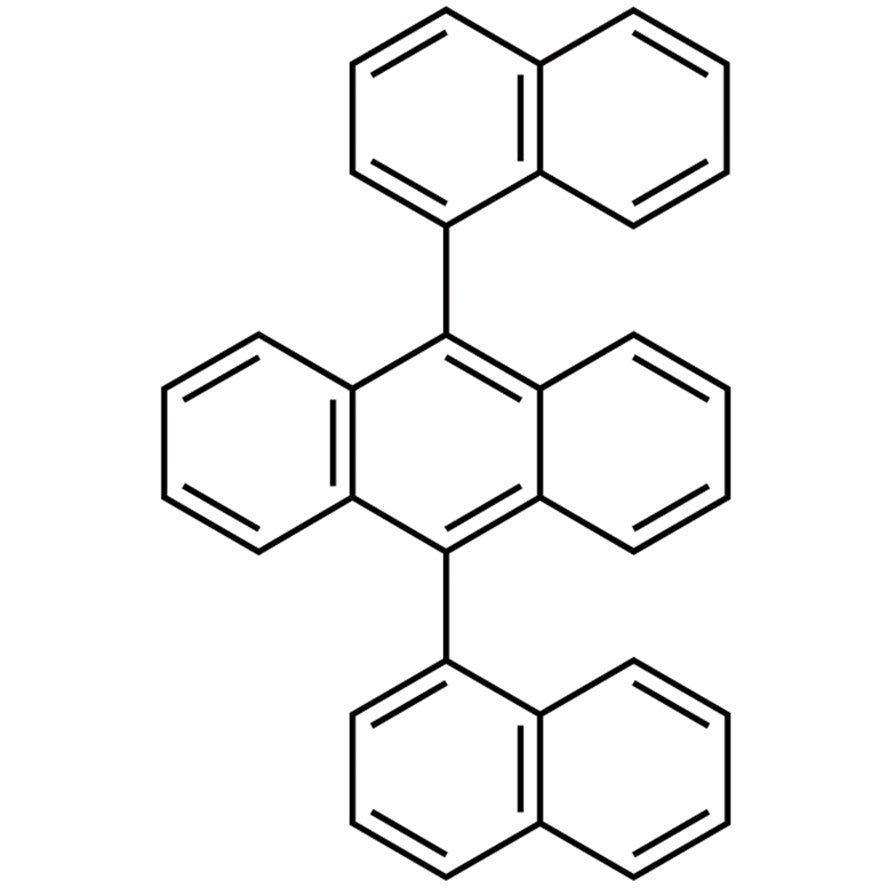
9,10-Di(1-naphthyl)anthracene (purified by sublimation) is a high-purity organic compound widely used in optoelectronic material research, especially in the development of Organic Light-Emitting Diodes (OLEDs). This compound plays a crucial role in the fabrication of OLED layers, where it contributes to efficient and stable light emission. Its molecular structure allows for effective interaction with both light and electrons, making it a key component in the design of advanced display technologies. As a result, it is a fundamental material in the field of electronic materials, supporting innovation in lighting and display applications.
The compound's high purity, achieved through sublimation, ensures minimal impurities that could interfere with the performance of OLED devices. Its optical and electrical properties make it a preferred choice for researchers aiming to develop high-performance materials. The ability to maintain stability under various conditions further enhances its reliability in laboratory settings. These characteristics make it a valuable resource for scientists working on next-generation optoelectronic devices.
In Indonesian laboratories, this material is commonly used in research and development projects focused on optoelectronic applications. It is particularly favored in academic and industrial settings where the development of OLED-based technologies is a priority. Researchers in both educational institutions and research centers rely on this compound for experiments involving optical and conductive properties of organic materials. Its application extends to the creation of modern display technologies, contributing to the advancement of electronic materials in Indonesia.
- OLED Material Development: This compound is essential for creating efficient and stable OLED layers, supporting the development of next-generation display technologies.
- Optical Property Studies: Researchers use it to investigate the optical behavior of organic materials, aiding in the design of advanced lighting solutions.
- Conductive Material Research: Its electrical properties make it ideal for studying the conductivity of organic compounds in electronic applications.
- Display Technology Innovation: It plays a key role in the development of modern display devices, contributing to the advancement of optoelectronic systems.
- Academic Research Projects: Universities and research institutions use it for experimental studies focused on material science and electronic device engineering.
| Brand | TCI |
|---|---|
| CAS number | 26979-27-1 |
| Molecular formula | — |
| Purity | — |
| Category | Materials Science > Electronic Materials > Organic Light-Emitting Diode (OLED) Materials |
| Pack sizes | Available in various quantities as per standard laboratory requirements |
| Physical form | Solid |
| Storage | Store in a cool, dry place away from light and moisture |
This compound should be stored in a cool, dry environment, away from direct light and moisture to maintain its purity and stability. It is recommended to use airtight containers made of glass or high-density polyethylene to prevent contamination and degradation. Due to its organic nature, it should be handled with care to avoid exposure to air and moisture, which could affect its performance. Laboratory personnel should wear appropriate personal protective equipment, such as gloves and safety goggles, when handling the material. Proper labeling and storage conditions are essential to ensure the material remains suitable for research applications. Regular monitoring of storage conditions is advised to maintain the integrity of the compound throughout its shelf life.
—
Produk Terkait
-
9-([1,1'-Biphenyl]-4-yl)anthracene TCI B5717
Regular price From Rp 1.220.100,00Regular price -
4-(3-Buten-1-yl)-4'-methylbiphenyl TCI B5872
Regular price Rp 2.094.750,00Regular price -
4,4'-Bis(trans-4-propylcyclohexyl)biphenyl TCI B5881
Regular price Rp 1.565.550,00Regular price -
Biphenylene TCI B6284
Regular price From Rp 2.782.500,00Regular price -
Benzo[k]fluoranthene TCI B6317
Regular price From Rp 3.180.450,00Regular price -
Benzo[j]fluoranthene TCI B6424
Regular price From Rp 2.916.900,00Regular price -
Benzo[c]phenanthrene TCI B6541
Regular price From Rp 1.829.100,00Regular price -
1-Benzyl-4-methylbenzene TCI B6623
Regular price From Rp 2.386.650,00Regular price
![9-([1,1'-Biphenyl]-4-yl)anthracene (CAS 323195-31-9) - TCI B5717 - AMI Scientific](http://amiscientific.com/cdn/shop/files/TCI2510B5717.jpg?v=1768815871&width=533)


![Benzo[k]fluoranthene (CAS 207-08-9) - TCI B6317 - AMI Scientific](http://amiscientific.com/cdn/shop/files/TCI2510B6317_9797284f-a326-4c13-8c48-43bc162551a1.jpg?v=1767865252&width=533)
![Benzo[j]fluoranthene (CAS 205-82-3) - TCI B6424 - AMI Scientific](http://amiscientific.com/cdn/shop/files/TCI2510B6424.jpg?v=1768193711&width=533)
![Benzo[c]phenanthrene (CAS 195-19-7) - TCI B6541 - AMI Scientific](http://amiscientific.com/cdn/shop/files/TCI2510B6541.jpg?v=1767093862&width=533)