

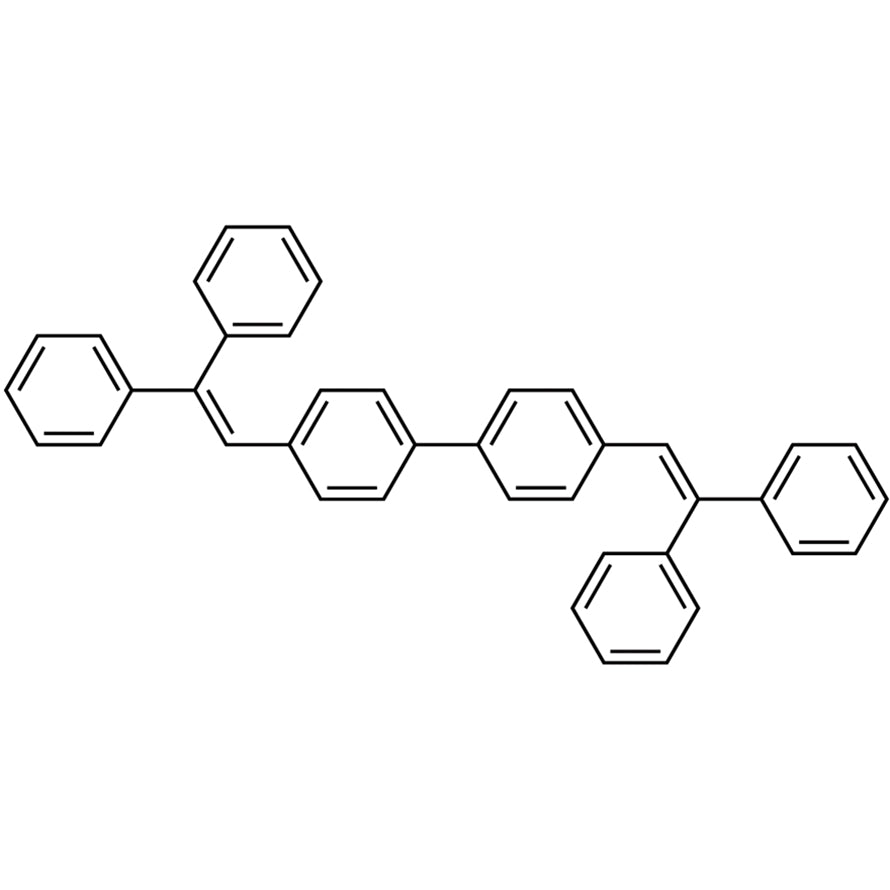
4,4'-Bis(2,2-diphenylvinyl)biphenyl is an organic compound widely utilized in optoelectronic material research, particularly in the development of Organic Light-Emitting Diode (OLED) devices. This compound functions as a light-emitting layer in OLEDs, where it facilitates the production of light through the recombination of electrons and holes. Its role in the laboratory is critical for testing the efficiency, stability, and optical performance of various OLED configurations. As a key component in the fabrication of OLEDs, it supports the advancement of display technologies and lighting solutions.
The compound’s complex molecular structure allows for precise tuning of optical and electronic properties, making it a preferred choice for researchers aiming to optimize device performance. Its high purity, achieved through sublimation, ensures consistent results and reliability in experimental outcomes. This level of purity is essential for applications requiring high accuracy and reproducibility. The material’s optical and electronic characteristics make it suitable for advanced material research and development in the field of organic electronics.
In Indonesian laboratories, this compound is commonly used in research related to light technology and electronics, particularly in higher education institutions and research organizations. It serves as a foundational material for the development of OLED devices, which have significant potential in modern display and lighting applications. Researchers rely on its properties to explore new possibilities in optoelectronic innovation and sustainable lighting solutions.
TCI brochures (PDF)
- Chemical Compounds Purified by Sublimation 2025-05-07 · p. 3
- Organic Light-Emitting Diode (OLED) Materials 2026-08-18 · p. 3
Related TCI products
- TCI B4219 58328-31-7 4,4'-Bis(9H-carbazol-9-yl)biphenyl (purified by sublimation)
- TCI T2274 139092-78-7 4,4',4''-Tri-9-carbazolyltriphenylamine (purified by sublimation)
- TCI T2238 2085-33-8 Tris(8-quinolinolato)aluminum (purified by sublimation)
- TCI T1934 148044-07-9 1,3,5-Tri(9H-carbazol-9-yl)benzene (purified by sublimation)
- TCI D5066 122648-99-1 9,10-Di(2-naphthyl)anthracene (purified by sublimation)
- TCI D5065 26979-27-1 9,10-Di(1-naphthyl)anthracene (purified by sublimation)
- OLED device development for high-efficiency light-emitting technologies requiring precise optical properties.
- Research on light emission mechanisms in organic semiconductors for improved display performance.
- Testing of material stability and performance under various environmental conditions in optoelectronic studies.
- Fabrication of thin-film layers for use in advanced lighting and display systems.
- Investigation of molecular structure effects on electronic behavior in organic electronic materials.
| Brand | TCI |
|---|---|
| CAS number | 142289-08-5 |
| Molecular formula | — |
| Purity | — |
| Category | Materials Science > Electronic Materials > Organic Light-Emitting Diode (OLED) Materials |
| Pack sizes | — |
| Physical form | Solid |
| Storage | Store in a cool, dry place away from light and moisture. |
This compound should be stored in a cool, dry environment, away from direct light and moisture to maintain its purity and stability. It is recommended to use airtight containers to prevent contamination and degradation. Due to its organic nature, it should be handled with care in a well-ventilated area to avoid inhalation of vapors. Proper personal protective equipment, such as gloves and safety goggles, should be worn during handling. The material is not classified as hazardous under standard laboratory conditions, but standard safety protocols should still be followed to ensure safe usage and storage.
—
Produk Terkait
-
4,4'-Bis(9H-carbazol-9-yl)biphenyl(purifiedbysublimation) TCI B4219
Regular price Rp 3.922.800,00Regular priceRp 2.758.350,00Sale price Rp 3.922.800,00 -
4,4',4''-Tri-9-carbazolyltriphenylamine(purifiedbysublimation) TCI T2274
Regular price From Rp 2.147.250,00Regular priceRp 1.517.250,00Sale price From Rp 2.147.250,00 -
Tris(8-quinolinolato)aluminum(purifiedbysublimation) TCI T2238
Regular price Rp 5.460.000,00Regular priceRp 3.833.550,00Sale price Rp 5.460.000,00 -
1,3,5-Tri(9H-carbazol-9-yl)benzene(purifiedbysublimation) TCI T1934
Regular price Rp 5.062.050,00Regular priceRp 3.555.300,00Sale price Rp 5.062.050,00 -
9,10-Di(2-naphthyl)anthracene(purifiedbysublimation) TCI D5066
Regular price Rp 1.881.600,00Regular priceRp 1.315.650,00Sale price Rp 1.881.600,00 -
9,10-Di(1-naphthyl)anthracene(purifiedbysublimation) TCI D5065
Regular price Rp 3.498.600,00Regular priceRp 2.446.500,00Sale price Rp 3.498.600,00 -
9,10-Diphenylanthracene(purifiedbysublimation) TCI D4401
Regular price Rp 4.347.000,00Regular priceRp 3.039.750,00Sale price Rp 4.347.000,00 -
1,3-Di-9-carbazolylbenzene(purifiedbysublimation) TCI D4087
Regular price Rp 3.603.600,00Regular priceRp 2.535.750,00Sale price Rp 3.603.600,00


