

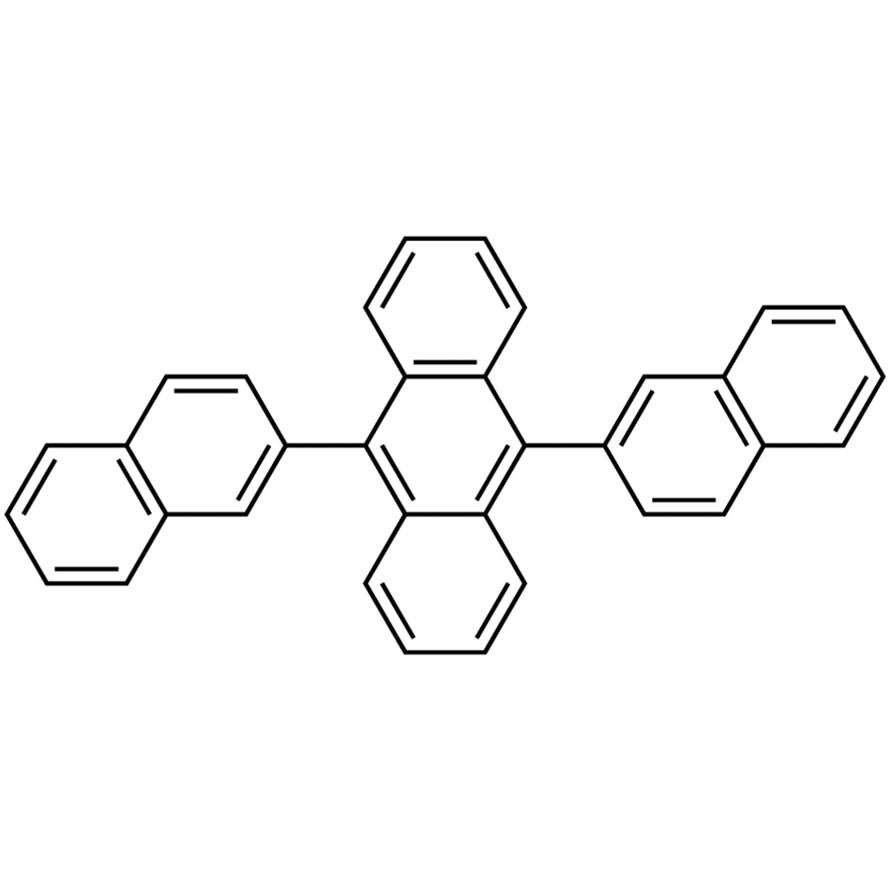
9,10-Di(2-naphthyl)anthracene (purified by sublimation) is a high-purity organic compound widely used in material science research, particularly in the development of optoelectronic devices such as OLEDs (Organic Light-Emitting Diodes). This compound is essential in laboratory settings where the performance of light-emitting materials is critical. Its unique molecular structure enables efficient light emission, making it a key component in the fabrication of OLED devices. Researchers rely on this material for its ability to emit light through the recombination of electrons and holes, a process fundamental to the operation of OLED technology.
The compound’s high purity, achieved through sublimation, ensures consistent performance in experimental applications. It exhibits excellent electron conductivity and adequate thermal stability, making it ideal for use in high-precision laboratory environments. Additionally, its symmetrical molecular structure contributes to the stability of thin film formation, a crucial factor in OLED manufacturing. These properties make it a preferred choice for scientists working on advanced optoelectronic materials.
In Indonesian laboratories, 9,10-Di(2-naphthyl)anthracene is commonly used in material science and optoelectronic technology research. Local researchers frequently employ this compound in the development of new OLED materials and in studies aimed at improving the efficiency and longevity of light-emitting devices. Its reliability and performance in controlled laboratory conditions make it a valuable resource for scientific innovation.
TCI brochures (PDF)
- Chemical Compounds Purified by Sublimation 2025-05-07 · p. 3
- Organic Light-Emitting Diode (OLED) Materials 2026-08-18 · p. 3
Related TCI products
- TCI D5065 26979-27-1 9,10-Di(1-naphthyl)anthracene (purified by sublimation)
- TCI D3970 123847-85-8 N,N'-Di-1-naphthyl-N,N'-diphenylbenzidine (purified by sublimation)
- TCI T2274 139092-78-7 4,4',4''-Tri-9-carbazolyltriphenylamine (purified by sublimation)
- TCI T2238 2085-33-8 Tris(8-quinolinolato)aluminum (purified by sublimation)
- TCI T1934 148044-07-9 1,3,5-Tri(9H-carbazol-9-yl)benzene (purified by sublimation)
- TCI B5139 142289-08-5 4,4'-Bis(2,2-diphenylvinyl)biphenyl (purified by sublimation)
- OLED material development for high-efficiency light-emitting devices due to its superior light emission properties.
- Thin film formation studies because of its symmetrical molecular structure and stability during film deposition.
- Electron conductivity testing in optoelectronic applications where reliable charge transport is essential.
- Thermal stability analysis for materials used in high-temperature environments within optoelectronic devices.
- Research into organic semiconductor properties for use in next-generation display technologies.
| Brand | TCI |
|---|---|
| CAS number | 122648-99-1 |
| Molecular formula | — |
| Purity | — |
| Category | Materials Science > Electronic Materials > Organic Light-Emitting Diode (OLED) Materials |
| Pack sizes | Available in standard laboratory quantities as per supplier specifications |
| Physical form | Solid |
| Storage | Store in a cool, dry, and dark place away from moisture and light |
This compound should be stored in a cool, dry, and dark environment to maintain its chemical integrity and prevent degradation. It is recommended to use airtight containers made of materials that do not react with the compound, such as glass or high-density polyethylene. Due to its organic nature, it should be kept away from sources of heat and direct sunlight. In laboratory settings, it is important to handle the compound with appropriate personal protective equipment, including gloves and safety goggles, to ensure safe handling. Proper ventilation should be maintained when working with this material to minimize exposure risks. Always follow standard laboratory safety protocols when handling and storing chemical substances.
—
Produk Terkait
-
9,10-Di(1-naphthyl)anthracene(purifiedbysublimation) TCI D5065
Regular price Rp 3.498.600,00Regular priceRp 2.446.500,00Sale price Rp 3.498.600,00 -
N,N'-Di-1-naphthyl-N,N'-diphenylbenzidine(purifiedbysublimation) TCI D3970
Regular price Rp 3.232.950,00Regular priceRp 2.276.400,00Sale price Rp 3.232.950,00 -
4,4',4''-Tri-9-carbazolyltriphenylamine(purifiedbysublimation) TCI T2274
Regular price From Rp 2.147.250,00Regular priceRp 1.517.250,00Sale price From Rp 2.147.250,00 -
Tris(8-quinolinolato)aluminum(purifiedbysublimation) TCI T2238
Regular price Rp 5.460.000,00Regular priceRp 3.833.550,00Sale price Rp 5.460.000,00 -
1,3,5-Tri(9H-carbazol-9-yl)benzene(purifiedbysublimation) TCI T1934
Regular price Rp 5.062.050,00Regular priceRp 3.555.300,00Sale price Rp 5.062.050,00 -
4,4'-Bis(2,2-diphenylvinyl)biphenyl(purifiedbysublimation) TCI B5139
Regular price From Rp 1.644.300,00Regular priceRp 1.149.750,00Sale price From Rp 1.644.300,00 -
4,4'-Bis(9H-carbazol-9-yl)biphenyl(purifiedbysublimation) TCI B4219
Regular price Rp 3.922.800,00Regular priceRp 2.758.350,00Sale price Rp 3.922.800,00 -
9,10-Diphenylanthracene(purifiedbysublimation) TCI D4401
Regular price Rp 4.347.000,00Regular priceRp 3.039.750,00Sale price Rp 4.347.000,00


