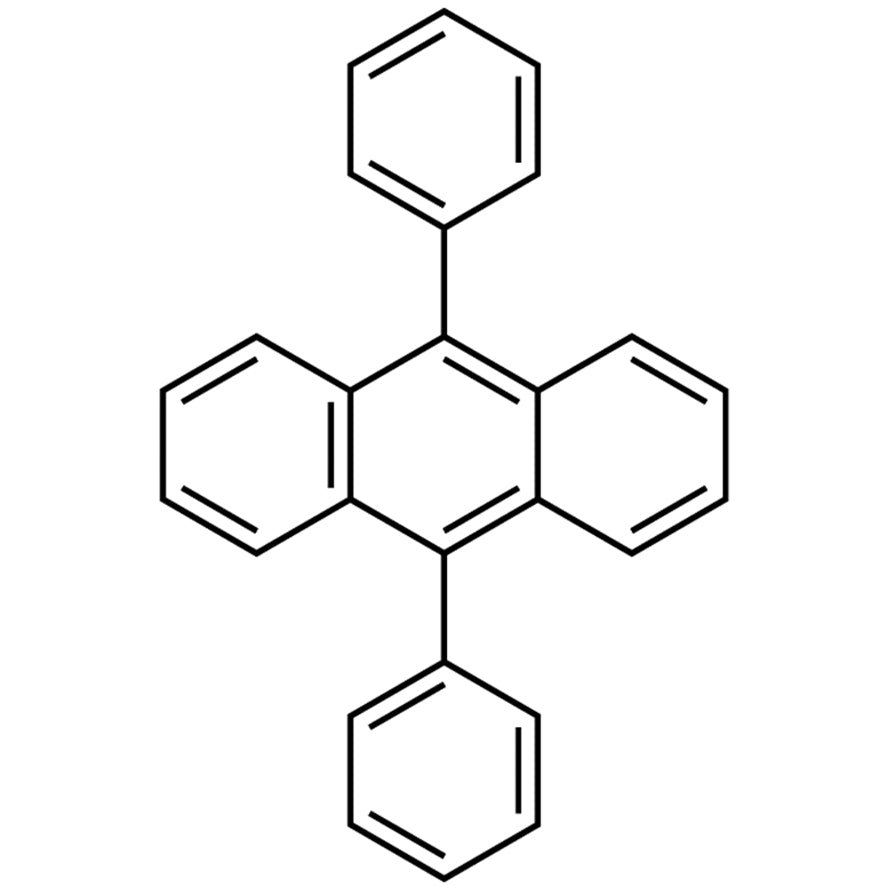
9,10-Diphenylanthracene (purified by sublimation) is an organic compound widely used in scientific research, particularly in the field of electronic materials. This compound plays a crucial role in laboratory settings where the development of optoelectronic devices is the focus. Its molecular structure is highly complex, making it a valuable component in the study of light-emitting materials. Due to its unique optical properties, it is often employed in experiments related to the performance and efficiency of organic light-emitting diodes (OLEDs). The compound’s role in scientific innovation is significant, especially in the advancement of display technologies and energy-efficient lighting solutions.
The compound is preferred for its high purity, achieved through sublimation, which ensures consistent and reliable experimental results. Its chemical and physical stability make it a reliable choice for researchers working on material characterization and device optimization. The well-ordered molecular structure also contributes to its excellent optical properties, including clear light emission and thermal stability. These characteristics make it a preferred material for applications requiring high performance and reproducibility in laboratory settings.
In Indonesian laboratories, this compound is highly relevant for research in material science and advanced technology. Many research institutions in Indonesia are focusing on the development of organic materials for use in lighting and display technologies. Its superior properties make it an essential component in the pursuit of innovative and sustainable solutions in the field of optoelectronics.
- Organic Light-Emitting Diode (OLED) Research – This material is ideal for studying the optical and electronic properties of OLEDs due to its stable molecular structure and efficient light emission.
- Material Characterization Studies – Its high purity and consistent performance make it suitable for detailed analysis of organic materials used in optoelectronic devices.
- Display Technology Development – The compound’s optical properties are crucial in the design and testing of next-generation display technologies.
- Thermal Stability Testing – Its thermal stability allows it to be used in experiments assessing the performance of materials under varying temperature conditions.
- Advanced Material Synthesis – Its complex molecular structure makes it a valuable component in the synthesis of new organic materials for electronic applications.
| Brand | TCI |
|---|---|
| CAS number | 1499-10-1 |
| Molecular formula | — |
| Purity | — |
| Category | Materials Science > Electronic Materials > Organic Light-Emitting Diode (OLED) Materials |
| Pack sizes | Available in standard laboratory quantities |
| Physical form | Solid |
| Storage | Store in a cool, dry place away from light and moisture |
This compound should be stored in a cool, dry environment, away from direct light and moisture to maintain its stability and purity. It is recommended to use airtight containers made of glass or inert plastic to prevent contamination and degradation. Due to its organic nature, it should be handled with appropriate personal protective equipment, such as gloves and safety goggles, to ensure laboratory safety. The compound is not flammable but should be kept away from incompatible materials. Proper labeling and storage conditions are essential to ensure the material remains suitable for use in scientific research. Regular monitoring of storage conditions is advised to maintain its integrity and effectiveness in laboratory applications.
—
Produk Terkait
-
9-([1,1'-Biphenyl]-4-yl)anthracene TCI B5717
Regular price From Rp 1.220.100,00Regular price -
4-(3-Buten-1-yl)-4'-methylbiphenyl TCI B5872
Regular price Rp 2.094.750,00Regular price -
4,4'-Bis(trans-4-propylcyclohexyl)biphenyl TCI B5881
Regular price Rp 1.565.550,00Regular price -
Biphenylene TCI B6284
Regular price From Rp 2.782.500,00Regular price -
Benzo[k]fluoranthene TCI B6317
Regular price From Rp 3.180.450,00Regular price -
Benzo[j]fluoranthene TCI B6424
Regular price From Rp 2.916.900,00Regular price -
Benzo[c]phenanthrene TCI B6541
Regular price From Rp 1.829.100,00Regular price -
1-Benzyl-4-methylbenzene TCI B6623
Regular price From Rp 2.386.650,00Regular price
![9-([1,1'-Biphenyl]-4-yl)anthracene (CAS 323195-31-9) - TCI B5717 - AMI Scientific](http://amiscientific.com/cdn/shop/files/TCI2510B5717.jpg?v=1768815871&width=533)


![Benzo[k]fluoranthene (CAS 207-08-9) - TCI B6317 - AMI Scientific](http://amiscientific.com/cdn/shop/files/TCI2510B6317_9797284f-a326-4c13-8c48-43bc162551a1.jpg?v=1767865252&width=533)
![Benzo[j]fluoranthene (CAS 205-82-3) - TCI B6424 - AMI Scientific](http://amiscientific.com/cdn/shop/files/TCI2510B6424.jpg?v=1768193711&width=533)
![Benzo[c]phenanthrene (CAS 195-19-7) - TCI B6541 - AMI Scientific](http://amiscientific.com/cdn/shop/files/TCI2510B6541.jpg?v=1767093862&width=533)