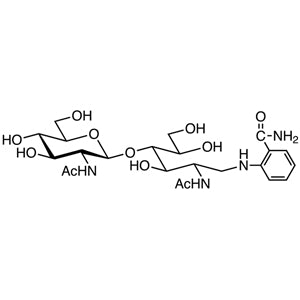
N,N'-Diacetylchitobiose 2AB is a chemical compound widely used in chemical biology and glycoscience research. It serves as a key substrate or inhibitor in enzymatic reactions related to glycosidases, making it essential for studying enzyme mechanisms and molecular interactions. This compound is derived from chitosan, a polysaccharide sourced from crustacean shells, and is valued for its role in carbohydrate metabolism research. Its application extends to understanding metabolic diseases and drug development, where precise molecular analysis is crucial.
The compound is known for its stable molecular structure and good solubility in organic solvents such as acetone and ethyl acetate. These properties facilitate chemical separation and analysis processes, making it a preferred choice for laboratory use. Its high reactivity also supports a wide range of biochemical experiments, ensuring reliable results in both qualitative and quantitative studies. The compound's unique characteristics make it an indispensable tool for researchers requiring precision in molecular analysis.
In Indonesian laboratories, N,N'-Diacetylchitobiose 2AB is commonly used in metabolic disease research, drug development, and enzyme mechanism studies. Its role in molecular-level investigations has made it a standard material for scientists working in glycoscience and chemical biology. Its availability and performance make it a reliable choice for academic and industrial research settings in Indonesia.
- Metabolic Disease Research: This compound is used to study carbohydrate metabolism and its impact on metabolic disorders, offering insights into disease mechanisms and potential therapeutic targets.
- Drug Development: It supports the development of enzyme-targeted therapies by providing a substrate for enzyme activity assays and inhibitor screening.
- Enzyme Mechanism Studies: Its role as a substrate or inhibitor makes it ideal for investigating the function and regulation of glycosidase enzymes in biochemical pathways.
- Glycoscience Research: It is essential for studies involving carbohydrate structures and their interactions, aiding in the understanding of glycosylation processes.
- Molecular Analysis: Its solubility and reactivity make it suitable for various analytical techniques, including chromatography and spectroscopy, in molecular-level research.
| Brand | TCI |
|---|---|
| CAS number | 1497-44-7 |
| Molecular formula | — |
| Purity | — |
| Category | Chemistry > Chemical Biology > Glycoscience |
| Pack sizes | 500pmol/vial |
| Physical form | Solid |
| Storage | Store at 2-8°C in a dry place, away from light |
This compound should be stored in a cool, dry place at a temperature range of 2-8°C to maintain its stability and prevent degradation. It is recommended to use airtight containers to protect it from moisture and light exposure. When handling, ensure proper laboratory safety practices are followed, including the use of gloves and protective eyewear. Due to its reactivity, it should be stored away from incompatible substances. Regular monitoring of storage conditions is advised to ensure the compound remains in optimal condition for use in research applications.
—
Produk Terkait
-
TCI B5774 5,10-Bis(4,4,5,5-tetramethyl-1,3,2-dioxaborolan-2-yl)naphtho[1,2-c:5,6-c']bis([1,2,5]oxadiazole)
Regular price Rp 10.255.350,00Regular price -
Dihydroiodide TCI B6569
Regular price From Rp 1.936.200,00Regular price -
Trifluoromethanesulfonate TCI B7003
Regular price From Rp 1.936.200,00Regular price
![5,10-Bis(4,4,5,5-tetramethyl-1,3,2-dioxaborolan-2-yl)naphtho[1,2-c:5,6-c']bis([1,2,5]oxadiazole) - TCI B5774 - AMI Scientific](http://amiscientific.com/cdn/shop/files/TCI2510B5774.jpg?v=1769180228&width=533)