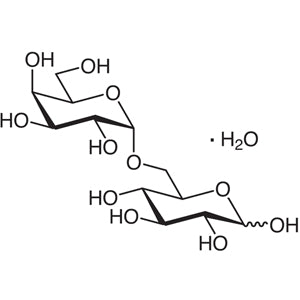
D-(+)-Melibiose Monohydrate is a carbohydrate compound widely used in chemical and biochemical experiments within laboratory settings. It belongs to the class of monosaccharides and is known for its unique molecular structure, which makes it a valuable tool in various scientific studies. This compound is commonly utilized as a building block in the synthesis of more complex molecules, as well as a substrate in enzymatic reactions. Its role extends to the study of carbohydrate metabolism, making it an essential component in both basic and applied research.
The chemical properties of D-(+)-Melibiose Monohydrate make it a preferred choice for laboratory applications. It exhibits chemical stability and good solubility in water, which ensures ease of use in a wide range of experimental conditions. Its physical consistency remains stable during proper storage, reducing the risk of degradation and ensuring reliable results. These characteristics contribute to its reliability in experiments that require precision and consistency, making it a trusted material for researchers.
In Indonesian laboratories, D-(+)-Melibiose Monohydrate is commonly used in biochemical, pharmacological, and organic chemistry research. It plays a key role in enzyme activity studies and carbohydrate metabolism investigations, particularly in institutions focused on health and biotechnology. Its versatility and reliability make it a standard material in both academic and industrial research environments.
TCI brochures (PDF)
- Biochemical research utilizes D-(+)-Melibiose Monohydrate for studying enzyme kinetics and substrate interactions due to its stable molecular structure and solubility.
- Pharmacological studies benefit from its use as a model compound to investigate metabolic pathways and drug interactions in biological systems.
- Organic chemistry experiments rely on this compound as a building block for synthesizing more complex carbohydrates and glycosides.
- Enzymatic reaction studies employ it as a substrate to evaluate the activity and specificity of various glycosidases and other carbohydrate-metabolizing enzymes.
- Metabolic pathway analysis uses it to understand how carbohydrates are processed in cellular environments, supporting research in biotechnology and health sciences.
| Brand | TCI |
|---|---|
| CAS number | 66009-10-7 |
| Molecular formula | — |
| Purity | — |
| Category | Chemistry > Chemical Biology > Glycoscience |
| Pack sizes | Available in various quantities as per standard laboratory supply options |
| Physical form | White crystalline powder |
| Storage | Store in a cool, dry place away from moisture and direct sunlight |
D-(+)-Melibiose Monohydrate should be stored in a cool, dry environment to maintain its chemical stability and prevent degradation. It is recommended to keep the compound in a sealed container to avoid exposure to moisture, which can affect its solubility and purity. Laboratory personnel should handle the material with care, using appropriate personal protective equipment such as gloves and safety goggles to ensure safety during handling. The compound is generally non-hazardous but should be stored away from incompatible substances to prevent any potential chemical interactions. Proper storage conditions ensure the material remains effective for use in a wide range of experimental applications.
—
Product Categories
- GlycoscienceApplications Using Glyco-materialsGlyco-utilization [Applications Using Glyco-materials]
- GlycoscienceApplications Using Glyco-materialsGlyco-chemical Analysis [Applications Using Glyco-materials]
- GlycoscienceDisaccharides [Glycoscience]
- GlycoscienceFunctional OligosaccharidesNatural Oligosaccharides [Functional Oligosaccharides]
- GlycoscienceOligosaccharides by Component SugarGalactose [Oligosaccharides by Component Sugar]
- Biochemicals and ReagentsCarbohydrates
Produk Terkait
-
Lactulose TCI L0140
Regular price Rp 2.016.000,00Regular price -
D-(+)-LactoseMonohydrate TCI L0008
Regular price Rp 584.850,00Regular price -
D-(+)-TrehaloseDihydrate TCI T0331
Regular price From Rp 505.050,00Regular price -
MonoammoniumGlycyrrhizinate TCI G0151
Regular price Rp 717.150,00Regular price -
Xylobiose TCI X0067
Regular price From Rp 4.268.250,00Regular price -
Xylosucrose TCI X0065
Regular price From Rp 2.041.200,00Regular price -
D-(+)-TrehaloseAnhydrous TCI T0832
Regular price From Rp 1.115.100,00Regular price -
6'-SialyllactoseSodiumSalt TCI S0886
Regular price From Rp 5.432.700,00Regular price