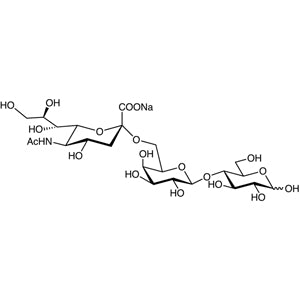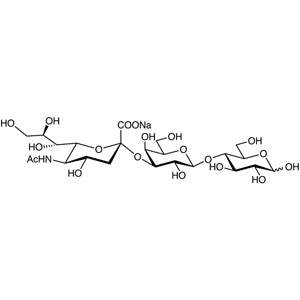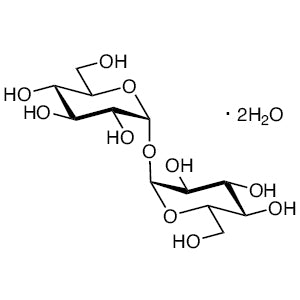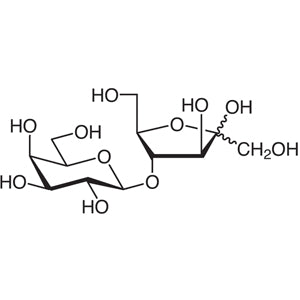
Lactulose is a semi-synthetic disaccharide composed of a galactose unit and a fructose unit. It is not broken down by human digestive enzymes, so it reaches the large intestine intact. In the laboratory, this compound serves as an important substrate in microbiota and glycoscience studies, as a comparison material in carbohydrate analysis, and as a test substance in gastrointestinal physiology research. Its distinctive role lies in its ability to be fermented by certain intestinal bacteria, making it a tool for studying the relationship between carbohydrates and microbial populations.
The property that makes this material a preferred choice is the glycosidic bond between galactose and fructose, which is not recognised by enzymes of the human small intestine, so the compound acts as a selective prebiotic. As a sugar, the material dissolves readily in water, is hygroscopic in character, and can undergo browning reactions when heated together with amine compounds. Its well-defined structure and high solubility make it straightforward to prepare test solutions at measured concentrations, whether for microbial growth media or for standard solutions used in instrumental analysis.
In Indonesian laboratories, this material is encountered in research work that follows the lines described above: studies of the gut microbiota and of carbohydrate fermentation, carbohydrate analysis where a defined disaccharide is needed as a comparison material, and investigations in digestive tract physiology. Its ready solubility and clear structure suit the routine preparation of growth media and measured standard solutions in such settings.
TCI brochures (PDF)
- Gut microbiota fermentation studies — the compound passes undigested to the large intestine, where selected bacteria ferment it, allowing researchers to observe how a defined carbohydrate shapes microbial populations.
- Glycoscience research on disaccharide structure — the clearly defined galactose-fructose linkage gives a well-characterised model substrate for examining how glycosidic bonds resist or accept enzymatic recognition.
- Carbohydrate analysis as a comparison material — its defined structure and high water solubility allow preparation of standard solutions at measured concentrations for instrumental analysis of sugars.
- Gastrointestinal physiology testing — because human digestive enzymes do not act on it, the material serves as a test substance for studying transit and function along the digestive tract.
- Preparation of microbial growth media — ready solubility in water makes it convenient to incorporate at measured concentrations as a selective carbohydrate source in culture media formulations.
| Brand | TCI |
|---|---|
| CAS number | 4618-18-2 |
| Molecular formula | — |
| Purity | — |
| Category | Chemistry > Chemical Biology > Glycoscience |
| Pack sizes | available in the pack sizes listed on the product page |
| Physical form | solid sugar (disaccharide), readily soluble in water |
| Storage | keep in a tightly closed container, protected from moisture |
Because this material is hygroscopic, it should be kept in a tightly closed container that limits contact with atmospheric moisture, and the container should be reclosed promptly after each use to keep the contents free-flowing and of consistent composition. Glass or chemically compatible plastic containers with well-fitting closures are suitable. Handle the material in a clean, dry work area using clean, dry spatulas to avoid introducing water or contaminants into the stock. Avoid heating it in the presence of amine compounds, since browning reactions can occur under those conditions. Observe general laboratory practice: wear a lab coat, gloves, and eye protection, avoid generating dust, and follow the supplier's safety data sheet for the specific batch in use.
—
Product Categories
- GlycoscienceApplications Using Glyco-materialsGlyco-chemical Analysis [Applications Using Glyco-materials]
- GlycoscienceDisaccharides [Glycoscience]
- GlycoscienceFunctional OligosaccharidesMilk Oligosaccharides [Functional Oligosaccharides]
- GlycoscienceFunctional OligosaccharidesNatural Oligosaccharides [Functional Oligosaccharides]
- GlycoscienceOligosaccharides by Component SugarGalactose [Oligosaccharides by Component Sugar]
- Biochemicals and ReagentsCarbohydrates
- Biochemicals and ReagentsPharmaceutical Research Reagents (for Experimental Use)Anti-Constipation Ingredients (for Research and Experimental Use)
- Biochemicals and Reagents
- Pharmaceutical Development and Drug Discovery ResearchPharmaceutical Research Reagents (for Experimental Use)Anti-Constipation Ingredients (for Research and Experimental Use)
Produk Terkait
-
D-(+)-LactoseMonohydrate TCI L0008
Regular price Rp 637.350,00Regular priceRp 460.950,00Sale price Rp 637.350,00 -
D-(+)-MelibioseMonohydrate TCI M0050
Regular price From Rp 557.550,00Regular priceRp 405.300,00Sale price From Rp 557.550,00 -
6'-SialyllactoseSodiumSalt TCI S0886
Regular price From Rp 5.485.200,00Regular priceRp 3.851.400,00Sale price From Rp 5.485.200,00 -
3'-SialyllactoseSodiumSalt TCI S0885
Regular price From Rp 4.399.500,00Regular priceRp 3.092.250,00Sale price From Rp 4.399.500,00 -
Xylobiose TCI X0067
Regular price From Rp 4.320.750,00Regular priceRp 3.036.600,00Sale price From Rp 4.320.750,00 -
Xylosucrose TCI X0065
Regular price From Rp 2.093.700,00Regular priceRp 1.479.450,00Sale price From Rp 2.093.700,00 -
D-(+)-TrehaloseAnhydrous TCI T0832
Regular price From Rp 1.167.600,00Regular priceRp 831.600,00Sale price From Rp 1.167.600,00 -
D-(+)-TrehaloseDihydrate TCI T0331
Regular price From Rp 557.550,00Regular priceRp 405.300,00Sale price From Rp 557.550,00