1,3-Dimesitylimidazolium-2-carboxylate is a chemical compound widely used in catalytic reactions and organic synthesis. It plays a crucial role in laboratory settings where efficient and selective catalysts are required. This compound is particularly valuable in heterogeneous catalysis and metal activation processes due to its ability to interact strongly with transition metals. Its unique molecular structure enables it to act as a versatile ligand, making it an essential component in various chemical research applications.
The compound is known for its chemical stability under controlled conditions, which makes it reliable for use in laboratory experiments. However, it is highly sensitive to moisture and air exposure, necessitating careful handling and storage. These properties make it a preferred choice for researchers seeking a stable yet reactive material. Its ability to form complexes with metals further enhances its utility in coordination chemistry and catalytic systems.
In Indonesian laboratories, 1,3-Dimesitylimidazolium-2-carboxylate is commonly used in both fundamental and applied chemical research. It is a favored material for experiments requiring efficient and specific catalysts. Its availability in the local market supports ongoing research efforts, enabling scientists to conduct experiments with reliable and high-quality reagents. This compound is integral to advancing chemical processes in academic and industrial research environments.
Related TCI products
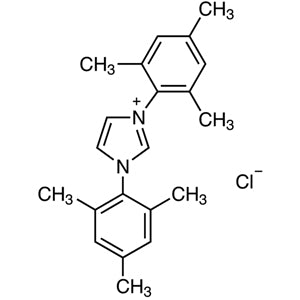
- TCI D3446 141556-45-8 1,3-Dimesitylimidazolium Chloride
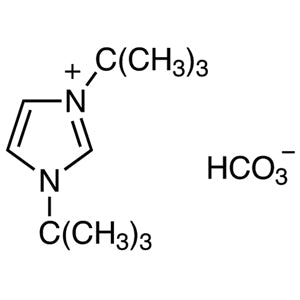
- TCI D5513 2893755-25-2 1,3-Di-tert-butylimidazolium Hydrogencarbonate (contains varying amounts of 1,3-Di-tert-butylimidazolium-2-carboxylate)
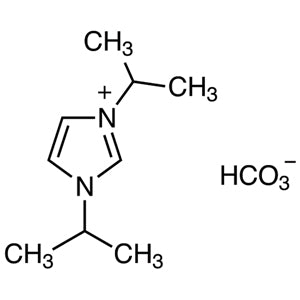
- TCI D5498 1372124-90-7 1,3-Diisopropylimidazolium Hydrogencarbonate (contains varying amounts of 1,3-Diisopropylimidazolium-2-carboxylate)
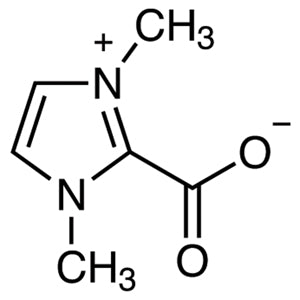
- TCI D5396 536755-29-0 1,3-Dimethylimidazolium-2-carboxylate
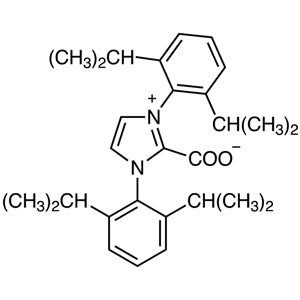
- TCI B5603 917604-39-8 1,3-Bis(2,6-diisopropylphenyl)imidazolium-2-carboxylate
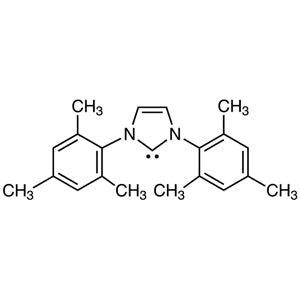
- TCI D3870 141556-42-5 1,3-Dimesitylimidazol-2-ylidene
- Organic synthesis reactions benefit from this compound due to its ability to activate transition metals and enhance reaction efficiency.
- Heterogeneous catalysis applications rely on its strong interaction with metal surfaces, improving reaction rates and selectivity.
- Coordination chemistry studies use it as a ligand to form stable metal complexes, aiding in the investigation of bonding and reactivity.
- Metal activation processes utilize its structural properties to facilitate electron transfer and catalytic activity.
- Research in green chemistry leverages its efficiency in reducing energy consumption and waste production during chemical transformations.
| Brand | TCI |
|---|---|
| CAS number | 675877-56-2 |
| Molecular formula | — |
| Purity | — |
| Category | Chemistry > Catalysis and Inorganic Chemistry > Carbon-Donor Ligands [Catalysis] |
| Pack sizes | — |
| Physical form | — |
| Storage | Keep in a dry, cool place away from moisture and air exposure. |
This compound should be stored in a dry, cool environment to prevent moisture and air exposure, which can degrade its properties. It is recommended to use airtight containers made of inert materials such as glass or polyethylene to maintain its stability. Due to its sensitivity, it should be handled in a controlled laboratory setting with appropriate ventilation. Researchers should avoid prolonged exposure to air and moisture during storage and use. Proper labeling and storage conditions are essential to ensure the compound remains effective for its intended applications. Always follow standard laboratory safety protocols when working with this material.
—
Product Categories
- Catalysis and Inorganic ChemistryCarbon-Donor Ligands [Catalysis]N-Heterocyclic Carbene (NHC)-CO2 Adducts and NHC-HCO3 Salts [Carbon-Donor Ligands]
- Catalysis and Inorganic ChemistryCross-coupling Reaction using Transition Metal Catalysts [C-C Bond Formation]N-Heterocyclic Carbene (NHC) Ligands [Cross-coupling Reaction using Transition Metal Catalysts]
- Synthetic ReagentsC-C Bond Formation [Synthetic Reagents]Cross-coupling Reaction using Transition Metal Catalysts [C-C Bond Formation]
Produk Terkait
-
1,3-DimesitylimidazoliumChloride TCI D3446
Regular price From Rp 1.936.200,00Regular price -
1,3-Di-tert-butylimidazoliumHydrogencarbonate(containsvaryingamountsof1,3-Di-tert-butylimidazolium-2-carboxylate) TCI D5513
Regular price Rp 3.738.000,00Regular price -
1,3-DiisopropylimidazoliumHydrogencarbonate(containsvaryingamountsof1,3-Diisopropylimidazolium-2-carboxylate) TCI D5498
Regular price Rp 6.996.150,00Regular price -
1,3-Dimethylimidazolium-2-carboxylate TCI D5396
Regular price From Rp 1.749.300,00Regular price -
1,3-Bis(2,6-diisopropylphenyl)imidazolium-2-carboxylate TCI B5603
Regular price Rp 2.625.000,00Regular price -
1,3-Dimesitylimidazol-2-ylidene TCI D3870
Regular price From Rp 4.161.150,00Regular price -
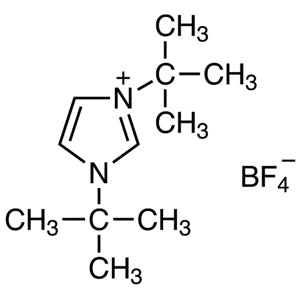
1,3-Di-tert-butylimidazoliumTetrafluoroborate TCI D3711
Regular price From Rp 1.273.650,00Regular price -
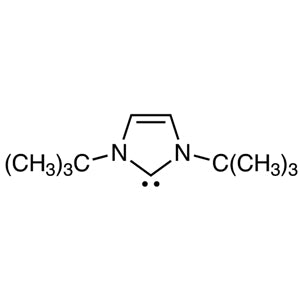
1,3-Di-tert-butylimidazol-2-ylidene TCI D3472
Regular price From Rp 5.300.400,00Regular price