1,3-Dimethylimidazolium-2-carboxylate is a chemical compound widely used in catalytic reactions and organic synthesis within laboratory settings. It belongs to the class of carbon-donor ligands, playing a crucial role in activation processes involving electron or hydride transfer. This compound is particularly valued for its ability to act as both a catalyst and a ligand, enhancing reaction efficiency in various synthetic pathways. Its unique ionic structure allows for strong interactions with substrates, making it a versatile tool in modern chemical research.
The compound's preference in laboratory applications stems from its high reactivity and stability under controlled conditions. Its ionic nature enables it to interact effectively with metal centers or organic compounds, facilitating complex reaction mechanisms. The specific chemical properties of 1,3-Dimethylimidazolium-2-carboxylate make it ideal for use in catalysis and inorganic chemistry, where precise control over reaction pathways is essential. Its ability to modulate reaction conditions without being consumed makes it a reliable choice for researchers.
In Indonesian laboratories, this compound is commonly used in organic chemistry and catalysis research. It is a key reagent in experiments aimed at developing new technologies and advancing scientific understanding. Many research institutions and universities rely on this material as a fundamental component in their experimental setups, supporting both academic and industrial applications.
Advantages (TCI brochure)
- NHC ligands and catalysts are preparable by heating.
- No salt generated during preparation.
- Applicable under neutral conditions.
- NHC-CO2 adducts release CO2.
TCI brochures (PDF)
- Easily-preparable N-Heterocyclic Carbene (NHC) Precursors 2021-09-14 · p. 1
- Ligands 2025-12-01 · p. 8
- Suzuki-Miyaura Cross Coupling Reaction 2025-12-01 · p. 26
Related TCI products
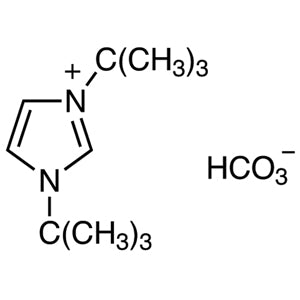
- TCI D5513 2893755-25-2 1,3-Di-tert-butylimidazolium Hydrogencarbonate (contains varying amounts of 1,3-Di-tert-butylimidazolium-2-carboxylate)
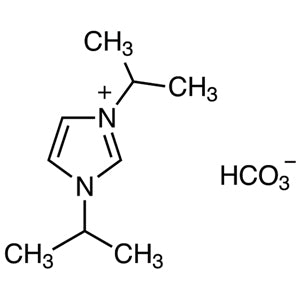
- TCI D5498 1372124-90-7 1,3-Diisopropylimidazolium Hydrogencarbonate (contains varying amounts of 1,3-Diisopropylimidazolium-2-carboxylate)
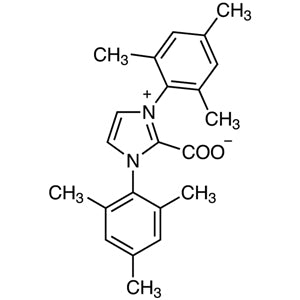
- TCI D5401 675877-56-2 1,3-Dimesitylimidazolium-2-carboxylate
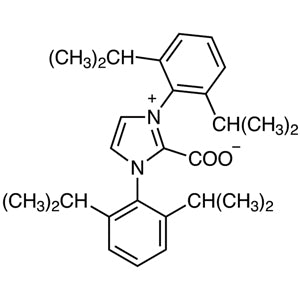
- TCI B5603 917604-39-8 1,3-Bis(2,6-diisopropylphenyl)imidazolium-2-carboxylate
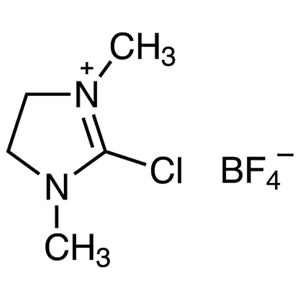
- TCI C3444 153433-26-2 2-Chloro-1,3-dimethylimidazolinium Tetrafluoroborate
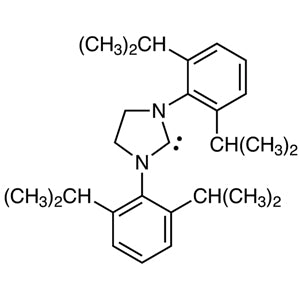
- TCI B3506 258278-28-3 1,3-Bis(2,6-diisopropylphenyl)imidazolidin-2-ylidene
- Organic synthesis reactions benefit from this compound's ability to activate carbon atoms, enhancing reaction efficiency and selectivity.
- Catalytic processes involving electron transfer are optimized due to its ionic structure, which facilitates interaction with metal catalysts.
- Inorganic chemistry experiments utilize its unique properties to study ligand-metal interactions and coordination chemistry.
- Research on hydride transfer mechanisms often incorporates this compound as a key reagent for controlled reaction conditions.
- Advanced chemical synthesis projects leverage its stability and reactivity for developing novel compounds and materials.
From the TCI brochure
- Transition metal/NHC complex catalyst preparation
| Brand | TCI |
|---|---|
| CAS number | 536755-29-0 |
| Molecular formula | — |
| Purity | — |
| Category | Chemistry > Catalysis and Inorganic Chemistry > Carbon-Donor Ligands [Catalysis] |
| Pack sizes | Available in various quantities as per supplier offerings |
| Physical form | Solid or powder, depending on packaging |
| Storage | Store in a cool, dry place away from moisture and direct sunlight |
This compound should be stored in a cool, dry environment to maintain its chemical integrity. It is recommended to use airtight containers to prevent moisture absorption, which could affect its reactivity. Due to its ionic nature, it should be kept away from incompatible substances to avoid unwanted reactions. Proper labeling and storage conditions are essential to ensure safety in the laboratory. General laboratory precautions include using appropriate personal protective equipment when handling the compound and ensuring good ventilation during use. Always follow standard safety protocols to minimize exposure and maintain a safe working environment.
References cited in the TCI brochure
- Adelina M. Voutchkova. Disubstituted Imidazolium-2-Carboxylates as Efficient Precursors to N-Heterocyclic Carbene Complexes of Rh, Ru, Ir, and Pd Journal of the American Chemical Society, 2005. doi:10.1021/ja056625k
Product Categories
- Catalysis and Inorganic ChemistryCarbon-Donor Ligands [Catalysis]N-Heterocyclic Carbene (NHC)-CO2 Adducts and NHC-HCO3 Salts [Carbon-Donor Ligands]
- Catalysis and Inorganic ChemistryCross-coupling Reaction using Transition Metal Catalysts [C-C Bond Formation]N-Heterocyclic Carbene (NHC) Ligands [Cross-coupling Reaction using Transition Metal Catalysts]
- Synthetic ReagentsC-C Bond Formation [Synthetic Reagents]Cross-coupling Reaction using Transition Metal Catalysts [C-C Bond Formation]
Produk Terkait
-
1,3-Di-tert-butylimidazoliumHydrogencarbonate(containsvaryingamountsof1,3-Di-tert-butylimidazolium-2-carboxylate) TCI D5513
Regular price Rp 3.790.500,00Regular priceRp 2.665.950,00Sale price Rp 3.790.500,00 -
1,3-DiisopropylimidazoliumHydrogencarbonate(containsvaryingamountsof1,3-Diisopropylimidazolium-2-carboxylate) TCI D5498
Regular price Rp 7.048.650,00Regular priceRp 4.944.450,00Sale price Rp 7.048.650,00 -
1,3-Dimesitylimidazolium-2-carboxylate TCI D5401
Regular price Rp 2.544.150,00Regular priceRp 1.794.450,00Sale price Rp 2.544.150,00 -
1,3-Bis(2,6-diisopropylphenyl)imidazolium-2-carboxylate TCI B5603
Regular price Rp 2.677.500,00Regular priceRp 1.887.900,00Sale price Rp 2.677.500,00 -
2-Chloro-1,3-dimethylimidazoliniumTetrafluoroborate TCI C3444
Regular price From Rp 822.150,00Regular priceRp 590.100,00Sale price From Rp 822.150,00 -
1,3-Bis(2,6-diisopropylphenyl)imidazolidin-2-ylidene TCI B3506
Regular price Rp 7.844.550,00Regular priceRp 5.500.950,00Sale price Rp 7.844.550,00 -
1,3-Bis(2,6-diisopropylphenyl)imidazol-2-ylidene TCI B3465
Regular price From Rp 3.630.900,00Regular priceRp 2.554.650,00Sale price From Rp 3.630.900,00 -
1,3-Bis(2,4,6-trimethylphenyl)imidazoliniumChloride TCI B3158
Regular price From Rp 2.147.250,00Regular priceRp 1.517.250,00Sale price From Rp 2.147.250,00