1,3-Diisopropylimidazolium Hydrogencarbonate is a chemical compound widely used in catalytic reactions and organic synthesis within laboratory settings. This compound plays a crucial role as a carbon-donor ligand, facilitating interactions with various substrates and ligands to enhance reaction efficiency. Its unique ionic structure enables it to act as both an electron donor and acceptor, making it versatile in different chemical environments. This compound is particularly valuable in research where precise control over reaction pathways is essential.
The compound’s chemical properties, including its ability to vary in the presence of 1,3-Diisopropylimidazolium-2-carboxylate, contribute to its adaptability in different synthetic applications. This variability allows for tailored reactivity, making it suitable for a wide range of chemical processes. Its stability under specific conditions ensures reliable performance in laboratory experiments, while its solid form simplifies handling and measurement. These characteristics make it a preferred choice for chemists seeking consistent and controllable results.
In Indonesian laboratories, this compound is commonly used in organic chemistry research, catalytic processes, and the synthesis of complex compounds. Its availability in a solid form and its compatibility with various reaction conditions make it a practical choice for both academic and industrial research. The compound supports a broad spectrum of chemical investigations, contributing to advancements in chemical science and technology within the region.
Advantages (TCI brochure)
- NHC ligands and catalysts are preparable by heating.
- No salt generated during preparation.
- Applicable under neutral conditions.
- NHC hydrogencarbonate salts release H2O and CO2.
TCI brochures (PDF)
- Easily-preparable N-Heterocyclic Carbene (NHC) Precursors 2021-09-14 · p. 1
- Ligands 2025-12-01 · p. 8
- Suzuki-Miyaura Cross Coupling Reaction 2025-12-01 · p. 26
Related TCI products
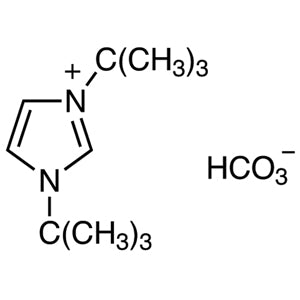
- TCI D5513 2893755-25-2 1,3-Di-tert-butylimidazolium Hydrogencarbonate (contains varying amounts of 1,3-Di-tert-butylimidazolium-2-carboxylate)
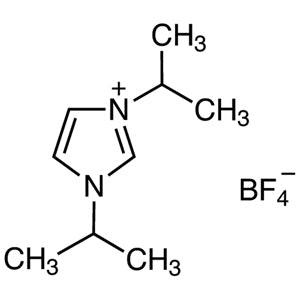
- TCI D3623 286014-34-4 1,3-Diisopropylimidazolium Tetrafluoroborate
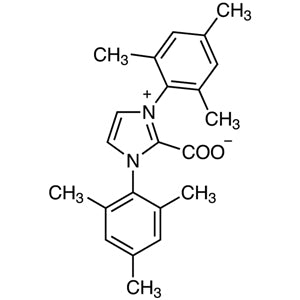
- TCI D5401 675877-56-2 1,3-Dimesitylimidazolium-2-carboxylate
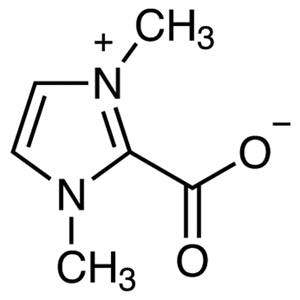
- TCI D5396 536755-29-0 1,3-Dimethylimidazolium-2-carboxylate
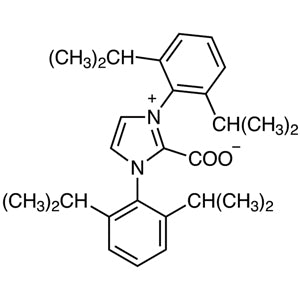
- TCI B5603 917604-39-8 1,3-Bis(2,6-diisopropylphenyl)imidazolium-2-carboxylate
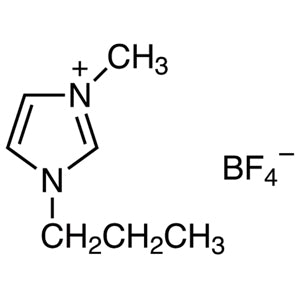
- TCI M3036 244193-48-4 1-Methyl-3-propylimidazolium Tetrafluoroborate
- Organic synthesis reactions benefit from this compound's ability to act as a carbon-donor ligand, enhancing catalytic efficiency and selectivity in complex molecule formation.
- Catalytic processes in the laboratory rely on its unique ionic structure to facilitate interactions with substrates, improving reaction rates and yield.
- Research on electrochemical systems utilizes its electron-donating and accepting properties for studying redox reactions and charge transfer mechanisms.
- Industrial-scale chemical processes incorporate this compound for its stability and reactivity, supporting large-scale production of organic compounds.
- Analytical chemistry applications use its chemical versatility to develop new methodologies for compound characterization and reaction monitoring.
From the TCI brochure
- Transition metal/NHC complex catalyst preparation
- NHC-catalyzed benzoin condensations
| Brand | TCI |
|---|---|
| CAS number | 1372124-90-7 |
| Molecular formula | — |
| Purity | — |
| Category | Chemistry > Catalysis and Inorganic Chemistry > Carbon-Donor Ligands [Catalysis] |
| Pack sizes | Available in various quantities suitable for laboratory use |
| Physical form | Solid |
| Storage | Store in a cool, dry place away from moisture and direct sunlight |
Data from the TCI brochure
| Catalyst loading | 10 mol % (Benzoin condensation of benzaldehyde, THF, 60 °C, MS3A) |
|---|---|
| Yield Au-NHC complex | 95% ((CH3)2SAuCl, 1.2 eq. NHC hydrogencarbonate salt, THF 0.7 mL, 50 °C, 1 h, air) |
Source: TCI brochure RR119 (2021-09-14)
This compound should be stored in a cool, dry environment to maintain its chemical stability and prevent degradation. It is recommended to use airtight containers to minimize exposure to moisture and air, which could affect its performance. Laboratory personnel should handle the material with care, using appropriate personal protective equipment such as gloves and safety goggles to ensure safety. Due to its chemical nature, it is important to avoid contact with incompatible substances and to follow standard laboratory safety protocols. Proper labeling and storage conditions help ensure the compound remains effective for its intended applications.
References cited in the TCI brochure
- Maréva Fèvre. Imidazol(in)ium Hydrogen Carbonates as a Genuine Source of N-Heterocyclic Carbenes (NHCs): Applications to the Facile Preparation of NHC Metal Complexes and to NHC-Organocatalyzed Molecular and Macromolecular Syntheses Journal of the American Chemical Society, 2012. doi:10.1021/ja3005804
Product Categories
- Catalysis and Inorganic ChemistryCarbon-Donor Ligands [Catalysis]N-Heterocyclic Carbene (NHC)-CO2 Adducts and NHC-HCO3 Salts [Carbon-Donor Ligands]
- Catalysis and Inorganic ChemistryCross-coupling Reaction using Transition Metal Catalysts [C-C Bond Formation]N-Heterocyclic Carbene (NHC) Ligands [Cross-coupling Reaction using Transition Metal Catalysts]
- Synthetic ReagentsC-C Bond Formation [Synthetic Reagents]Cross-coupling Reaction using Transition Metal Catalysts [C-C Bond Formation]
Produk Terkait
-
1,3-Di-tert-butylimidazoliumHydrogencarbonate(containsvaryingamountsof1,3-Di-tert-butylimidazolium-2-carboxylate) TCI D5513
Regular price Rp 3.790.500,00Regular priceRp 2.665.950,00Sale price Rp 3.790.500,00 -
1,3-DiisopropylimidazoliumTetrafluoroborate TCI D3623
Regular price Rp 1.801.800,00Regular priceRp 1.275.750,00Sale price Rp 1.801.800,00 -
1,3-Dimesitylimidazolium-2-carboxylate TCI D5401
Regular price Rp 2.544.150,00Regular priceRp 1.794.450,00Sale price Rp 2.544.150,00 -
1,3-Dimethylimidazolium-2-carboxylate TCI D5396
Regular price From Rp 1.801.800,00Regular priceRp 1.275.750,00Sale price From Rp 1.801.800,00 -
1,3-Bis(2,6-diisopropylphenyl)imidazolium-2-carboxylate TCI B5603
Regular price Rp 2.677.500,00Regular priceRp 1.887.900,00Sale price Rp 2.677.500,00 -
1-Methyl-3-propylimidazoliumTetrafluoroborate TCI M3036
Regular price From Rp 1.167.600,00Regular priceRp 831.600,00Sale price From Rp 1.167.600,00 -
1,3-DiisopropylimidazoliniumTetrafluoroborate TCI D3622
Regular price Rp 3.365.250,00Regular priceRp 2.368.800,00Sale price Rp 3.365.250,00 -
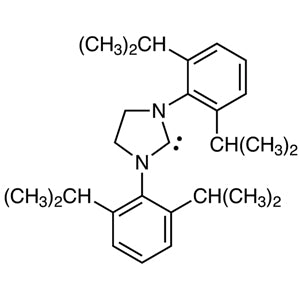
1,3-Bis(2,6-diisopropylphenyl)imidazolidin-2-ylidene TCI B3506
Regular price Rp 7.844.550,00Regular priceRp 5.500.950,00Sale price Rp 7.844.550,00