
![10-[4-[4,6-Di(adamantan-1-yl)-1,3,5-triazin-2-yl]phenyl]-9,9-dimethyl-9,10-dihydroacridine (purified by sublimation) (CAS 2250187-15-4) - TCI D5745 - AMI Scientific](http://amiscientific.com/cdn/shop/files/TCI2510D5745.jpg?v=1771058203&width=1946)
![10-[4-[4,6-Di(adamantan-1-yl)-1,3,5-triazin-2-yl]phenyl]-9,9-dimethyl-9,10-dihydroacridine (purified by sublimation) (CAS 2250187-15-4) - TCI D5745 - AMI Scientific](http://amiscientific.com/cdn/shop/files/TCI2510D5745.jpg?v=1771058203&width=1445)
This compound is a complex organic material with a sophisticated molecular structure, widely used in laboratory research related to OLED (Organic Light-Emitting Diode) materials. As a key component in OLED devices, it functions as an emissive layer, playing a critical role in the light-emitting process. Its unique molecular design enables efficient light emission while minimizing energy loss, making it essential for the development of high-performance OLEDs. In scientific research, this compound is a vital tool for exploring new material properties and improving device performance.
The compound is highly stable chemically, with a molecular structure specifically engineered to enhance light emission efficiency and prolong device lifespan. Its purification through sublimation ensures a high level of purity, which is crucial for achieving consistent and reliable experimental results. The complex molecular architecture also allows for effective interaction with other OLED layers, such as electron transport and hole injection layers, contributing to the overall functionality of the device. This stability and purity make it a preferred choice for researchers seeking precision in their experiments.
In Indonesian laboratories, this compound is commonly used in electro-optic and organic material research. It supports studies aimed at improving the efficiency and durability of OLED devices, which are critical for applications in display technology and lighting. Researchers in educational and research institutions rely on this material to advance their understanding of organic electronics and develop next-generation display technologies.
- OLED Emissive Layer Development: This compound is ideal for creating efficient light-emitting layers in OLEDs, enhancing brightness and energy efficiency.
- Material Performance Testing: It is used to evaluate the optical and electrical properties of OLED materials under various conditions.
- Device Fabrication Research: Its stable structure makes it suitable for integrating into OLED device structures for consistent performance.
- Electro-Optic Material Innovation: It supports the development of new organic materials with improved light emission characteristics.
- Layer Compatibility Studies: Its molecular design allows for compatibility testing with other OLED layers, such as electron and hole transport layers.
| Brand | TCI |
|---|---|
| CAS number | 2250187-15-4 |
| Molecular formula | — |
| Purity | — |
| Category | Materials Science > Electronic Materials > Organic Light-Emitting Diode (OLED) Materials |
| Pack sizes | — |
| Physical form | — |
| Storage | Store in a cool, dry place away from light and moisture |
This compound should be stored in a cool, dry environment, away from direct light and moisture to maintain its chemical stability and purity. It is recommended to use airtight containers to prevent exposure to air and contaminants. Due to its complex molecular structure, it is important to handle it with care to avoid any physical damage that may affect its performance. Laboratory personnel should follow standard safety protocols when handling this material, including the use of appropriate personal protective equipment. Proper storage ensures that the compound remains suitable for use in OLED research and maintains its effectiveness in experimental applications.
—
Produk Terkait
-
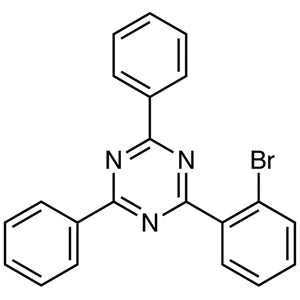
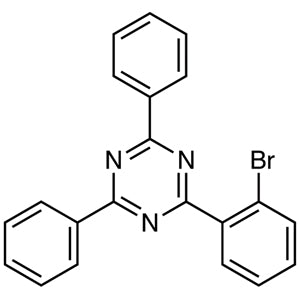
2-(2-Bromophenyl)-4,6-diphenyl-1,3,5-triazine TCI B5663
Regular price From Rp 1.856.400,00Regular price -
2-([1,1'-Biphenyl]-4-yl)-4-chloro-6-phenyl-1,3,5-triazine TCI B5792
Regular price From Rp 1.670.550,00Regular price -
2-([1,1'-Biphenyl]-3-yl)-4,6-dichloro-1,3,5-triazine TCI B5796
Regular price Rp 2.704.800,00Regular price -
2-([1,1'-Biphenyl]-3-yl)-4-chloro-6-phenyl-1,3,5-triazine TCI B5803
Regular price From Rp 717.150,00Regular price -
2,4-Bis[4-(tert-butyl)phenyl]-6-chloro-1,3,5-triazine TCI B5804
Regular price From Rp 2.279.550,00Regular price -
2-[3'-Bromo[1,1'-biphenyl]-3-yl]-4,6-diphenyl-1,3,5-triazine TCI B5895
Regular price From Rp 2.809.800,00Regular price -
4-[[4,6-Bis(n-octylthio)-1,3,5-triazin-2-yl]amino]-2,6-di-tert-butylphenol TCI B5977
Regular price From Rp 1.565.550,00Regular price -
Bemotrizinol TCI B6145
Regular price From Rp 1.431.150,00Regular price
![2-([1,1'-Biphenyl]-3-yl)-4,6-dichloro-1,3,5-triazine (CAS 1402225-89-1) - TCI B5796 - AMI Scientific](http://amiscientific.com/cdn/shop/files/TCI2510B5796.jpg?v=1768815898&width=533)
![2-([1,1'-Biphenyl]-3-yl)-4-chloro-6-phenyl-1,3,5-triazine (CAS 1689576-03-1) - TCI B5803 - AMI Scientific](http://amiscientific.com/cdn/shop/files/TCI2510B5803_dbb6d0f3-4eff-4744-81be-d259549ad9cd.jpg?v=1767863399&width=533)
![2,4-Bis[4-(tert-butyl)phenyl]-6-chloro-1,3,5-triazine (CAS 253158-13-3) - TCI B5804 - AMI Scientific](http://amiscientific.com/cdn/shop/files/TCI2510B5804.jpg?v=1769180232&width=533)
![2-[3'-Bromo[1,1'-biphenyl]-3-yl]-4,6-diphenyl-1,3,5-triazine (CAS 1606981-69-4) - TCI B5895 - AMI Scientific](http://amiscientific.com/cdn/shop/files/TCI2510B5895_c69d52a5-fe12-40ac-bc68-6adcf4ff2e0f.jpg?v=1767863771&width=533)
![2-[3'-Bromo[1,1'-biphenyl]-3-yl]-4,6-diphenyl-1,3,5-triazine (CAS 1606981-69-4) - TCI B5895 - AMI Scientific](http://amiscientific.com/cdn/shop/files/TCI2510B5895.jpg?v=1768815919&width=533)
![4-[[4,6-Bis(n-octylthio)-1,3,5-triazin-2-yl]amino]-2,6-di-tert-butylphenol (CAS 991-84-4) - TCI B5977 - AMI Scientific](http://amiscientific.com/cdn/shop/files/TCI2510B5977.jpg?v=1768815943&width=533)
