
![10-[4-[4,6-Di(1-adamantyl)-1,3,5-triazin-2-yl]phenyl]-10H-spiro[acridine-9,9'-fluorene] (purified by sublimation) (CAS 2250187-16-5) - TCI D5747 - AMI Scientific](http://amiscientific.com/cdn/shop/files/TCI2510D5747.jpg?v=1768818505&width=1946)
![10-[4-[4,6-Di(1-adamantyl)-1,3,5-triazin-2-yl]phenyl]-10H-spiro[acridine-9,9'-fluorene] (purified by sublimation) (CAS 2250187-16-5) - TCI D5747 - AMI Scientific](http://amiscientific.com/cdn/shop/files/TCI2510D5747.jpg?v=1768818505&width=1445)
TCI D5747, CAS 2250187-16-5, is 10-[4-[4,6-Di(1-adamantyl)-1,3,5-triazin-2-yl]phenyl]-10H-spiro[acridine-9,9'-fluorene], purified by sublimation. The molecule combines a spiro unit that joins an acridine framework and a fluorene framework at a single quaternary carbon atom, connected through a phenylene bridge to an adamantyl-substituted 1,3,5-triazine ring. A structure of this kind is a characteristic design for organic light-emitting diode materials, in which the donor portion and the acceptor portion are deliberately arranged perpendicular to one another. In the laboratory, this material is used for fabricating test devices and for research into molecular photophysics.
The property that makes this compound stand out is the presence of the spiro centre, a motif long recognised as effective for producing amorphous solids with good thermal stability. The perpendicular arrangement of the two aromatic systems at the spiro centre hinders close molecular packing, thereby suppressing aggregate formation and preserving thin-film quality. Combined with the bulky adamantyl groups on the acceptor side, the molecule possesses layered steric protection. The spatial separation of the frontier orbitals arising from the donor–acceptor twist is nevertheless retained, which is the reason this architecture is chosen for emitter and host research.
In Indonesian laboratories, material of this type is typically handled within university and institutional research groups working on organic electronics and optoelectronic thin films. It is used for preparing small test devices, for evaporation and film-deposition trials, and for photophysical measurements on the molecule itself. Because the material is supplied purified by sublimation, it is generally reserved for experiments in which film quality and reproducibility of the measurement matter, rather than for routine bulk work.
- Organic light-emitting diode test device fabrication — the donor–acceptor architecture and sublimation-purified form suit the small evaporated devices used to evaluate emissive layer behaviour under controlled laboratory conditions.
- Molecular photophysics research — the deliberate perpendicular donor–acceptor arrangement and resulting frontier orbital separation make this compound a useful subject for studying emission behaviour in solution and in film.
- Amorphous thin-film deposition studies — the spiro centre discourages close molecular packing, so the material is well suited to work examining film morphology, film uniformity and resistance to crystallisation.
- Emitter and host material screening — the layered steric protection from the spiro unit and bulky adamantyl groups makes this a representative candidate when comparing molecular designs for organic electronic layers.
- Aggregation and packing behaviour investigations — because the perpendicular aromatic systems suppress aggregate formation, the compound serves as a reference structure in studies of how molecular shape governs solid-state assembly.
| Brand | TCI |
|---|---|
| CAS number | 2250187-16-5 |
| Molecular formula | — |
| Purity | — |
| Category | Materials Science > Electronic Materials > Organic Light-Emitting Diode (OLED) Materials |
| Pack sizes | available in the pack sizes listed by the manufacturer for this catalogue number |
| Physical form | — |
| Storage | — |
- Chemical name: 10-[4-[4,6-Di(1-adamantyl)-1,3,5-triazin-2-yl]phenyl]-10H-spiro[acridine-9,9'-fluorene]
- Grade: purified by sublimation
Store the material in its original tightly closed container, protected from light, moisture and heat, and follow the storage conditions stated on the manufacturer's label and safety data sheet for this catalogue number. Amber glass or the supplied vial is appropriate; transfer under dry conditions where possible, since sublimation-purified material is intended for work where contamination directly affects film quality. Handle in a fume hood using gloves, safety glasses and a laboratory coat, avoid generating dust when weighing fine solids, and keep the container closed when not in use. Consult the safety data sheet before first use and dispose of residues through the laboratory's chemical waste route.
—
Produk Terkait
-
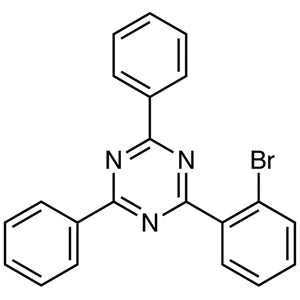
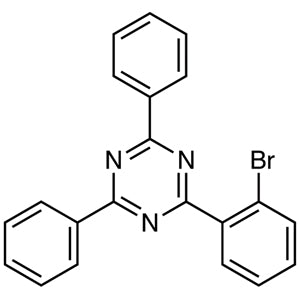
2-(2-Bromophenyl)-4,6-diphenyl-1,3,5-triazine TCI B5663
Regular price From Rp 1.856.400,00Regular price -
2-([1,1'-Biphenyl]-4-yl)-4-chloro-6-phenyl-1,3,5-triazine TCI B5792
Regular price From Rp 1.670.550,00Regular price -
2-([1,1'-Biphenyl]-3-yl)-4,6-dichloro-1,3,5-triazine TCI B5796
Regular price Rp 2.704.800,00Regular price -
2-([1,1'-Biphenyl]-3-yl)-4-chloro-6-phenyl-1,3,5-triazine TCI B5803
Regular price From Rp 717.150,00Regular price -
2,4-Bis[4-(tert-butyl)phenyl]-6-chloro-1,3,5-triazine TCI B5804
Regular price From Rp 2.279.550,00Regular price -
2-[3'-Bromo[1,1'-biphenyl]-3-yl]-4,6-diphenyl-1,3,5-triazine TCI B5895
Regular price From Rp 2.809.800,00Regular price -
4-[[4,6-Bis(n-octylthio)-1,3,5-triazin-2-yl]amino]-2,6-di-tert-butylphenol TCI B5977
Regular price From Rp 1.565.550,00Regular price -
Bemotrizinol TCI B6145
Regular price From Rp 1.431.150,00Regular price
![2-([1,1'-Biphenyl]-3-yl)-4,6-dichloro-1,3,5-triazine (CAS 1402225-89-1) - TCI B5796 - AMI Scientific](http://amiscientific.com/cdn/shop/files/TCI2510B5796.jpg?v=1768815898&width=533)
![2-([1,1'-Biphenyl]-3-yl)-4-chloro-6-phenyl-1,3,5-triazine (CAS 1689576-03-1) - TCI B5803 - AMI Scientific](http://amiscientific.com/cdn/shop/files/TCI2510B5803_dbb6d0f3-4eff-4744-81be-d259549ad9cd.jpg?v=1767863399&width=533)
![2,4-Bis[4-(tert-butyl)phenyl]-6-chloro-1,3,5-triazine (CAS 253158-13-3) - TCI B5804 - AMI Scientific](http://amiscientific.com/cdn/shop/files/TCI2510B5804.jpg?v=1769180232&width=533)
![2-[3'-Bromo[1,1'-biphenyl]-3-yl]-4,6-diphenyl-1,3,5-triazine (CAS 1606981-69-4) - TCI B5895 - AMI Scientific](http://amiscientific.com/cdn/shop/files/TCI2510B5895_c69d52a5-fe12-40ac-bc68-6adcf4ff2e0f.jpg?v=1767863771&width=533)
![2-[3'-Bromo[1,1'-biphenyl]-3-yl]-4,6-diphenyl-1,3,5-triazine (CAS 1606981-69-4) - TCI B5895 - AMI Scientific](http://amiscientific.com/cdn/shop/files/TCI2510B5895.jpg?v=1768815919&width=533)
![4-[[4,6-Bis(n-octylthio)-1,3,5-triazin-2-yl]amino]-2,6-di-tert-butylphenol (CAS 991-84-4) - TCI B5977 - AMI Scientific](http://amiscientific.com/cdn/shop/files/TCI2510B5977.jpg?v=1768815943&width=533)
