TCI D6507 1-(tert-Butoxycarbonyl)-3-fluoropyrrolidine-3-carboxylic Acid is a fluorinated building block that places a fluorine atom and a carboxylic acid group on the same quaternary carbon within a pyrrolidine ring, while the ring nitrogen is protected as a Boc carbamate. In medicinal chemistry laboratories, this compound functions as a non-natural cyclic amino acid that is ready to be joined onward through amide coupling reactions. The presence of a fluorinated quaternary centre gives researchers direct access to a motif that is synthetically demanding to construct from scratch, saving both laboratory time and resources.
The property that makes this material particularly valuable is the electronic influence of the fluorine atom. Fluorine is strongly electronegative, so it lowers the pKa of the adjacent carboxylic acid group, shifting the ionisation balance under physiological conditions, and it likewise reduces the basicity of the pyrrolidine nitrogen once the Boc group has been removed. These changes are frequently exploited to tune the physicochemical profile of candidate compounds. In addition, the strong carbon–fluorine bond blocks that position against metabolic oxidation, a strategy commonly applied to improve metabolic stability. The quaternary centre also adds conformational rigidity to the ring system.
In Indonesian laboratories, this building block is typically used by pharmaceutical discovery groups, university research teams, and contract synthesis laboratories working on small-molecule programmes. It is normally handled at milligram to gram scale on a synthetic bench, where the Boc protecting group allows the nitrogen to be carried safely through coupling steps and released later under acidic conditions. Researchers generally order it as a catalogue intermediate rather than preparing it in house, since the fluorinated quaternary centre is difficult to build reliably.
Related TCI products
- TCI F1346 136725-55-8 (R)-3-Fluoropyrrolidine Hydrochloride
- TCI F1344 136725-53-6 (S)-3-Fluoropyrrolidine Hydrochloride
- TCI T2342 1810-13-5 3,3,4,4-Tetrafluoropyrrolidine Hydrochloride
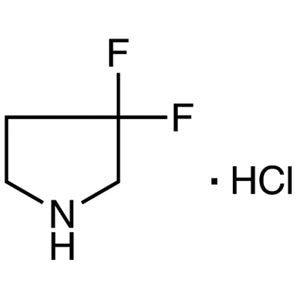
- TCI D4315 163457-23-6 3,3-Difluoropyrrolidine Hydrochloride
- TCI B4237 362670-07-3 N2-(tert-Butoxycarbonyl)-4-fluoro-1,2-phenylenediamine
- TCI B4236 579474-47-8 N1-(tert-Butoxycarbonyl)-4-fluoro-1,2-phenylenediamine
- Amide coupling and peptidomimetic assembly — the free carboxylic acid is ready for activation with standard coupling reagents, letting researchers install the fluorinated pyrrolidine fragment directly into a growing molecular framework.
- Medicinal chemistry lead optimisation — the fluorine atom modulates pKa, basicity, and lipophilicity of the scaffold, giving chemists a practical handle for adjusting the physicochemical behaviour of candidate compounds.
- Metabolic stability studies — the strong carbon–fluorine bond blocks oxidative metabolism at that ring position, so the compound supports structure–activity work aimed at extending metabolic lifetime.
- Conformationally constrained scaffold construction — the quaternary fluorinated carbon rigidifies the pyrrolidine ring, which helps research teams investigate how restricted geometry affects target binding and selectivity.
- Protected intermediate workflows — the Boc carbamate masks the ring nitrogen throughout multi-step synthesis and is cleaved under acidic conditions when the free secondary amine is required for later functionalisation.
| Brand | TCI (Tokyo Chemical Industry) |
|---|---|
| CAS number | 1001754-59-1 |
| Molecular formula | — |
| Purity | — |
| Category | Chemistry > Building Blocks > Fluorinated Building Blocks |
| Pack sizes | available in standard research-scale catalogue pack sizes; please refer to the current TCI packaging options |
| Physical form | — |
| Storage | store according to the conditions stated on the manufacturer label and Safety Data Sheet |
- Product code: D6507
- Chemical name: 1-(tert-Butoxycarbonyl)-3-fluoropyrrolidine-3-carboxylic Acid
Store the container tightly closed in a cool, dry, and well-ventilated area, away from direct sunlight, moisture, and sources of ignition, and follow the storage conditions printed on the manufacturer label and Safety Data Sheet. Keep the material in its original supplier packaging or in a clean, chemically compatible container that is clearly labelled with the product name and CAS number. Handle the compound inside a fume hood while wearing safety glasses, chemically resistant gloves, and a laboratory coat. Avoid inhalation of dust and contact with skin or eyes, and allow cold containers to warm to room temperature before opening to limit moisture condensation. Dispose of residues and contaminated materials in accordance with applicable chemical waste procedures.
—
Produk Terkait
-
(R)-3-FluoropyrrolidineHydrochloride TCI F1346
Regular price From Rp 2.359.350,00Regular price -
(S)-3-FluoropyrrolidineHydrochloride TCI F1344
Regular price Rp 2.782.500,00Regular price -
3,3,4,4-TetrafluoropyrrolidineHydrochloride TCI T2342
Regular price From Rp 2.862.300,00Regular price -
3,3-DifluoropyrrolidineHydrochloride TCI D4315
Regular price From Rp 1.590.750,00Regular price -
N2-(tert-Butoxycarbonyl)-4-fluoro-1,2-phenylenediamine TCI B4237
Regular price From Rp 980.700,00Regular price -
N1-(tert-Butoxycarbonyl)-4-fluoro-1,2-phenylenediamine TCI B4236
Regular price From Rp 1.326.150,00Regular price -
1-(Trifluoromethyl)cyclopropane-1-carboxylicAcid TCI T3765
Regular price From Rp 743.400,00Regular price -
4'-(Trifluoromethyl)biphenyl-2-carboxylicAcid TCI T3231
Regular price From Rp 717.150,00Regular price