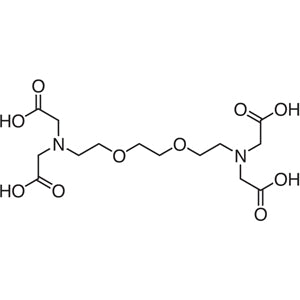
Ethylene Glycol Bis(2-aminoethyl Ether)-N,N,N',N'-tetraacetic Acid from TCI, catalogue code E0106, is more commonly known by its abbreviation EGTA. This compound is an aminopolycarboxylic chelating agent that is structurally similar to EDTA but carries a longer ether bridge between its two nitrogen atoms. That structural difference produces a highly distinctive property profile and makes EGTA a key reagent in biochemistry and cell physiology laboratories: it binds calcium ions very strongly while its binding to magnesium is far weaker. EGTA is therefore used to control free calcium levels without simultaneously disturbing the magnesium that many enzymes require.
That selectivity is the principal characteristic that leads researchers to choose EGTA even though EDTA is cheaper and more readily soluble. In biological experiments magnesium is needed as a cofactor for kinases, polymerases, and many other enzymes, so a chelator that binds both ions at once would shut down the very activity the experiment is meant to observe. EGTA allows researchers to lower free calcium to very low levels, and even to construct calcium buffering systems with controlled values. Users should note that complex stability is a factor to be taken into account when planning such systems.
In Indonesian laboratories, TCI E0106 is used in the same way as in laboratories elsewhere: as a working reagent wherever free calcium must be suppressed or held at a defined level while magnesium-dependent enzyme activity is preserved. It appears in biochemistry, cell physiology, and molecular biology work in university research groups, government research institutes, and analytical and quality control laboratories that prepare buffers and reaction media in-house.
- Selective calcium chelation in enzyme assays — EGTA suppresses free calcium while leaving magnesium available as a cofactor, so kinase and polymerase activity continues undisturbed during measurement.
- Calcium buffer system preparation — the strong, well-defined calcium binding of EGTA allows researchers to hold free calcium at controlled low concentrations rather than merely removing it entirely.
- Cell physiology studies of calcium signalling — because calcium can be lowered without depleting magnesium, EGTA is suited to experiments that isolate calcium-dependent responses from other ionic effects.
- Biochemical buffer and reaction medium formulation — EGTA is added to lysis, extraction, and incubation buffers to control calcium-dependent processes while preserving magnesium-requiring enzymatic steps.
- General aminopolycarboxylic chelation and complexation work — as an EDTA analogue with a longer ether bridge, EGTA serves where EDTA's non-selective binding of both calcium and magnesium is unacceptable.
| Brand | TCI (catalogue code E0106) |
|---|---|
| CAS number | 67-42-5 |
| Molecular formula | — |
| Purity | — |
| Category | Chemistry > Synthetic Reagents > Chelation/Complexation Compounds |
| Pack sizes | available in the pack sizes offered by TCI for this catalogue code; please confirm the required size when ordering |
| Physical form | — |
| Storage | store in a closed container under the conditions stated on the manufacturer's label and safety data sheet |
- Chemical class: aminopolycarboxylic acid chelating agent, structural analogue of EDTA with a longer ether bridge between the two nitrogen atoms
- Common abbreviation: EGTA
Store TCI E0106 in a tightly closed original container in a cool, dry, well-ventilated place, protected from moisture and away from incompatible materials, following the conditions stated on the manufacturer's label and safety data sheet. Chemically resistant, clearly labelled containers should be used for any working solutions, and the container should be reclosed promptly after each use to limit moisture uptake. Handle the material in a laboratory setting with appropriate personal protective equipment, including a lab coat, safety glasses, and gloves, and weigh out powder in a way that minimises dust generation. Note that EGTA is less readily soluble than EDTA, which should be taken into account when preparing solutions. Consult the manufacturer's safety data sheet before first use and dispose of residues in accordance with applicable laboratory waste procedures.
—
Produk Terkait
-
BromfenacSodiumSesquihydrate TCI B5971
Regular price Rp 3.870.300,00Regular price -
5-Chloro-2-methoxyaniline TCI C0118
Regular price From Rp 1.115.100,00Regular price -
H-Tyr(3-Cl)-OH TCI C3770
Regular price From Rp 2.386.650,00Regular price -
3,5-Dibromo-L-tyrosine TCI D0213
Regular price Rp 1.405.950,00Regular price -
3-(3,4-Dihydroxyphenyl)-DL-alanine TCI D0599
Regular price Rp 1.140.300,00Regular price -
3-(3,4-Dihydroxyphenyl)-L-alanine TCI D0600
Regular price From Rp 717.150,00Regular price -
3,5-Diiodo-L-tyrosineDihydrate TCI D0612
Regular price From Rp 928.200,00Regular price