

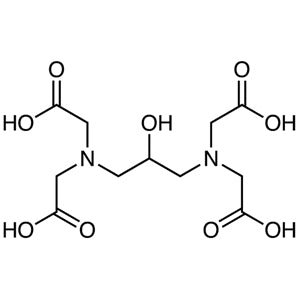
TCI D1330 1,3-Diamino-2-propanol-N,N,N',N'-tetraacetic Acid is an aminopolycarboxylate chelating agent built on a 1,3-diamino-2-propanol backbone that carries a hydroxyl group on the central carbon. Like other members of the EDTA family, this compound offers two amine nitrogen atoms and four carboxylate groups as coordination points for metal ions. The distance between the two nitrogen atoms, however, is longer, so the chelate ring that forms around a bound metal centre is six-membered rather than the five-membered ring familiar from EDTA itself.
The distinguishing characteristics of this reagent are the free hydroxyl group at the central position and the chelate ring size that differs from EDTA. The hydroxyl group adds hydrophilic character, so both the ligand and its metal complexes tend to dissolve more readily in water, and it simultaneously provides an additional chemical handle that can be functionalised when the ligand is to be modified further. The change in chelate ring size gives the compound a distinctive affinity pattern across different metal ions, which is precisely what makes it valuable when researchers need a chelator whose selectivity profile is not identical to the standard EDTA option.
In Indonesian laboratories, this reagent is used to bind metal ions in analytical applications, in masking procedures, and in the preparation of chelated metal solutions. It also serves coordination chemistry research that compares how ligand geometry influences complex stability. University research groups, analytical service laboratories, and industrial quality control units working with metal ion determination are the typical users, drawing on TCI reagents for synthetic and coordination work.
TCI brochures (PDF)
- Titration Reagents and TLC Stains 2026-05-07 · p. 8
Related TCI products
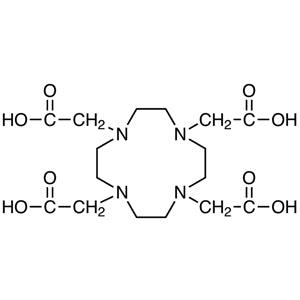
- TCI T1875 60239-18-1 1,4,7,10-Tetraazacyclododecane-1,4,7,10-tetraacetic Acid
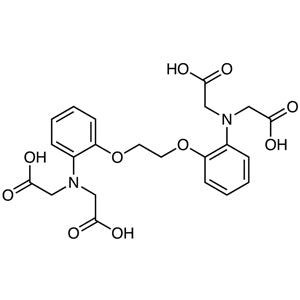
- TCI B3895 85233-19-8 1,2-Bis(2-aminophenoxy)ethane-N,N,N',N'-tetraacetic Acid
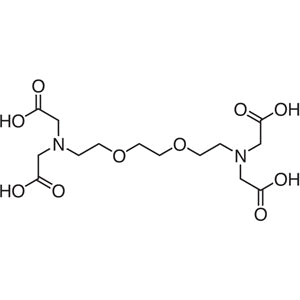
- TCI E0106 67-42-5 Ethylene Glycol Bis(2-aminoethyl Ether)-N,N,N',N'-tetraacetic Acid
- TCI D3195 304675-80-7 Diammonium Ethylenediaminetetraacetate Monohydrate
- TCI E0805 67-42-5 Ethylene Glycol Bis(2-aminoethyl Ether)-N,N,N',N'-tetraacetic Acid [for Biochemical Research]
- TCI V0057 3194-70-5 2-Vinyl-4,6-diamino-1,3,5-triazine
- Complexometric and analytical work: the four carboxylate groups and two amine nitrogens bind metal ions firmly, giving reproducible complexation behaviour for quantitative determinations involving metal cations.
- Masking of interfering metal ions: the compound sequesters cations that would otherwise disturb a determination, and its affinity pattern differs from EDTA, offering an alternative selectivity when EDTA masks too broadly.
- Preparation of chelated metal solutions: the hydroxyl group raises hydrophilicity so the ligand and its metal complexes dissolve more readily in water, simplifying preparation of aqueous chelated metal stock solutions.
- Coordination chemistry research: the six-membered chelate ring lets researchers compare directly how ligand geometry and ring size influence the stability of metal complexes against EDTA analogues.
- Ligand synthesis and modification studies: the free hydroxyl at the central carbon provides an additional chemical handle for functionalisation when a modified chelating ligand is the synthetic target.
| Brand | TCI (Tokyo Chemical Industry), catalogue number D1330 |
|---|---|
| CAS number | 3148-72-9 |
| Molecular formula | — |
| Purity | — |
| Category | Chemistry > Synthetic Reagents > Chelation/Complexation Compounds |
| Pack sizes | available in the catalogue pack sizes offered by TCI for this item |
| Physical form | — |
| Storage | keep in the original tightly closed container, in a cool, dry place away from moisture |
- Chemical name: 1,3-Diamino-2-propanol-N,N,N',N'-tetraacetic Acid
Store the reagent in its original tightly closed container in a cool, dry, well-ventilated place, protected from moisture and away from incompatible materials. Amber or opaque containers with secure closures are suitable for any working portions transferred from the primary container, and every container should be clearly labelled with the compound name and CAS number. Handle the solid in a well-ventilated area or a fume hood, using a laboratory coat, safety glasses, and chemically resistant gloves. Avoid generating dust during weighing and transfer, use clean dry spatulas to prevent contamination of the bulk material, and close the container promptly after use. Consult the manufacturer's safety data sheet before first use and follow institutional procedures for chemical waste disposal.
—
Produk Terkait
-
1,4,7,10-Tetraazacyclododecane-1,4,7,10-tetraaceticAcid TCI T1875
Regular price From Rp 4.347.000,00Regular price -
1,2-Bis(2-aminophenoxy)ethane-N,N,N',N'-tetraaceticAcid TCI B3895
Regular price From Rp 1.008.000,00Regular price -
EthyleneGlycolBis(2-aminoethylEther)-N,N,N',N'-tetraaceticAcid TCI E0106
Regular price Rp 3.048.150,00Regular price -
DiammoniumEthylenediaminetetraacetateMonohydrate TCI D3195
Regular price From Rp 637.350,00Regular price -
EthyleneGlycolBis(2-aminoethylEther)-N,N,N',N'-tetraaceticAcid[forBiochemicalResearch] TCI E0805
Regular price From Rp 1.167.600,00Regular price -
2-Vinyl-4,6-diamino-1,3,5-triazine TCI V0057
Regular price Rp 10.362.450,00Regular price -
3,7-Diamino-2,8-dimethyldibenzothiopheneSulfone(contains2,6-Dimethylisomer) TCI T1419
Regular price Rp 5.274.150,00Regular price -
N-(1R,8S,9s)-Bicyclo[6.1.0]non-4-yn-9-ylmethyloxycarbonyl-1,8-diamino-3,6-dioxaoctane TCI B4062
Regular price From Rp 4.399.500,00Regular price
![Ethylene Glycol Bis(2-aminoethyl Ether)-N,N,N',N'-tetraacetic Acid [for Biochemical Research] (CAS 67-42-5) - TCI E0805 - AMI Scientific](http://amiscientific.com/cdn/shop/files/TCI2510E0805.jpg?v=1768818736&width=533)


![1263166-93-3 N-(1R,8S,9s)-Bicyclo[6.1.0]non-4-yn-9-ylmethyloxycarbonyl-1,8-diamino-3,6-dioxaoctane - AMI Scientific](http://amiscientific.com/cdn/shop/files/TCI2510B4062_d8124249-9a3f-43c3-aba1-176f03bda357.jpg?v=1767435179&width=533)