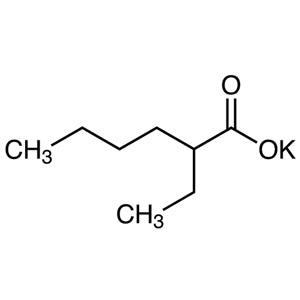
TCI E0121 Potassium 2-Ethylhexanoate is the potassium salt of 2-ethylhexanoic acid, an alkali metal carboxylate that pairs a potassium cation with a branched carboxylate anion. This combination produces a weakly basic material that is far more soluble in organic media than ordinary inorganic potassium salts. In the laboratory its principal role is as a catalyst — specifically as an isocyanate trimerisation catalyst in polyisocyanurate and polyurethane foam research — and as a source of potassium compatible with water-free reaction systems.
The property that makes this compound a preferred choice is the moderate, controlled basicity of the carboxylate anion, which allows it to initiate catalytic reactions without the aggressiveness of potassium hydroxide. The branched 2-ethylhexanoate tail lets the salt be dispersed or dissolved in polyols and organic solvents, so the catalyst distributes evenly throughout the reaction mixture. In coordination chemistry and materials synthesis, the carboxylate anion also acts as a bridging ligand and as a potassium source for preparing metal oxide precursors through controlled thermal decomposition routes.
In Indonesia, this material is used chiefly by research laboratories and product development groups. It supports work where a soluble, organically compatible potassium carboxylate is needed rather than an inorganic base, and where the catalytic behaviour of the carboxylate anion is the point of the experiment. Its role sits in formulation studies, catalysis screening, and precursor preparation carried out under laboratory-scale conditions.
TCI brochures (PDF)
- Lipids 2025-12-17 · p. 6
Related TCI products
- TCI S0862 19766-89-3 Sodium 2-Ethylhexanoate
- TCI E1609 7425-14-1 2-Ethylhexyl 2-Ethylhexanoate
- TCI E0404 94-04-2 Vinyl 2-Ethylhexanoate (stabilized with MEHQ)
- TCI C1133 53148-32-6 1,4-Cyclohexanedimethanol Bis(2-ethylhexanoate) (cis- and trans- mixture)
- TCI E0336 760-67-8 2-Ethylhexanoyl Chloride
- TCI E0120 149-57-5 2-Ethylhexanoic Acid
- Isocyanate trimerisation catalysis — the carboxylate anion promotes ring formation from isocyanate groups, making this salt a direct catalyst choice for polyisocyanurate chemistry studies.
- Polyisocyanurate and polyurethane foam research — its solubility in polyols allows even catalyst dispersion throughout the formulation, giving reproducible reaction behaviour across trial batches.
- Anhydrous potassium source — supplies potassium to reaction systems that must remain free of water, where inorganic potassium salts would introduce unwanted moisture or poor solubility.
- Coordination chemistry studies — the 2-ethylhexanoate anion serves as a bridging ligand between metal centres, supporting the preparation and investigation of carboxylate-bridged complexes.
- Metal oxide precursor preparation — acts as the potassium-bearing component in precursor formulations converted to oxides by controlled thermal decomposition routes.
| Brand | TCI |
|---|---|
| CAS number | 3164-85-0 |
| Molecular formula | — |
| Purity | — |
| Category | Chemistry > Building Blocks > Non-Heterocyclic Building Blocks |
| Pack sizes | available in standard TCI laboratory pack sizes; please confirm the required size when ordering |
| Physical form | — |
| Storage | keep in a tightly closed container, protected from moisture |
- Product Code: E0121
Store the container tightly closed in a cool, dry, well-ventilated place away from moisture, since alkali metal carboxylates readily take up water from the air. Use containers that seal reliably and are chemically compatible with a basic salt; keep the original packaging closed when the material is not in use. Handle in a fume hood or a well-ventilated laboratory area, and wear appropriate personal protective equipment including gloves, safety goggles, and a laboratory coat. Avoid contact with skin and eyes and avoid generating dust during weighing and transfer. Where anhydrous conditions matter to the experiment, transfer under dry conditions to preserve the material's performance. Keep the substance separate from strong acids, and consult the manufacturer's safety data sheet before use.
—
Produk Terkait
-
Sodium2-Ethylhexanoate TCI S0862
Regular price Rp 452.550,00Regular price -
2-Ethylhexyl2-Ethylhexanoate TCI E1609
Regular price Rp 3.498.600,00Regular price -
Vinyl2-Ethylhexanoate(stabilizedwithMEHQ) TCI E0404
Regular price Rp 1.167.600,00Regular price -
1,4-CyclohexanedimethanolBis(2-ethylhexanoate)(cis-andtrans-mixture) TCI C1133
Regular price Rp 2.809.800,00Regular price -
2-EthylhexanoylChloride TCI E0336
Regular price From Rp 875.700,00Regular price -
2-EthylhexanoicAcid TCI E0120
Regular price From Rp 477.750,00Regular price -
Triethylhexanoin TCI T4161
Regular price From Rp 743.400,00Regular price -
3,5,5-TrimethylhexanoylChloride TCI T0951
Regular price Rp 795.900,00Regular price