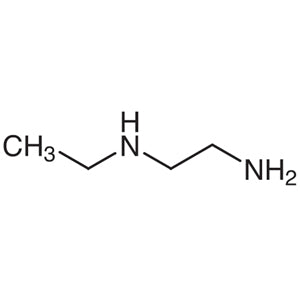
N-Ethylethylenediamine (CAS 110-72-5), also known as TCI E0294, is a chemical compound widely used in laboratory settings as a building block for various synthetic reactions. It belongs to the category of non-heterocyclic building blocks and is valued for its ability to act as an electron donor and carry a positive charge. This property makes it a versatile reagent in organic synthesis, where it can participate in multiple reaction types. Its role in the laboratory is critical in the development of complex chemical structures, particularly in the field of organic chemistry.
The reactivity of N-Ethylethylenediamine is one of its key attributes, allowing it to engage in nucleophilic reactions, substitution reactions, and polymerization processes. Its ability to form bonds with various functional groups makes it an essential component in the synthesis of new compounds. This reactivity, combined with its chemical stability under controlled conditions, makes it a preferred choice for chemists working on diverse synthetic pathways. Its versatility supports a wide range of applications, from pharmaceutical research to material science.
In Indonesian laboratories, N-Ethylethylenediamine is commonly used in organic chemistry research, particularly in academic and research institutions. It plays a vital role in the development of new compounds with applications in pharmaceuticals, materials, and chemical industries. Its importance in laboratory settings is reflected in its frequent use in synthesis processes, where it contributes to the creation of complex molecular structures.
- Organic Synthesis: N-Ethylethylenediamine is widely used in organic synthesis due to its ability to act as a nucleophile and participate in various reaction mechanisms.
- Polymerization Reactions: Its reactivity makes it suitable for polymerization processes, where it can act as a monomer or initiator.
- Functional Group Modification: The compound is ideal for modifying functional groups in organic molecules, enabling the creation of new chemical structures.
- Pharmaceutical Research: It is frequently used in the development of new pharmaceutical compounds due to its ability to form stable bonds with various functional groups.
- Material Science Applications: Its chemical versatility supports the synthesis of new materials with specific properties required for industrial applications.
| Brand | TCI |
|---|---|
| CAS number | 110-72-5 |
| Molecular formula | — |
| Purity | — |
| Category | Chemistry > Building Blocks > Non-Heterocyclic Building Blocks |
| Pack sizes | Available in various quantities as per standard laboratory supply |
| Physical form | Liquid |
| Storage | Store in a cool, dry place away from direct sunlight and incompatible materials |
N-Ethylethylenediamine should be stored in a cool, dry place, away from direct sunlight and sources of heat. It is recommended to use airtight containers made of materials compatible with its chemical properties, such as glass or high-density polyethylene. Due to its reactivity, it should be kept away from strong oxidizers and acids. In laboratory settings, proper ventilation is essential to prevent inhalation of vapors. Personal protective equipment, including gloves and safety goggles, should always be worn when handling this compound. Regular monitoring of storage conditions ensures the compound remains stable and safe for use in chemical experiments.
—
Produk Terkait
-
N,N,N',N'-Tetramethylethylenediamine[forElectrophoresis] TCI T2515
Regular price From Rp 477.750,00Regular price -
N-Benzyl-N,N'-dimethylethylenediamine TCI B3246
Regular price From Rp 3.232.950,00Regular price -
N,N,N'-Triethylethylenediamine TCI T0743
Regular price From Rp 2.094.750,00Regular price -
N,N,N'-Trimethylethylenediamine TCI T0742
Regular price From Rp 1.220.100,00Regular price -
N,N,N',N'-Tetramethylethylenediamine TCI T0147
Regular price From Rp 505.050,00Regular price -
N-Methylethylenediamine TCI M0518
Regular price From Rp 1.908.900,00Regular price -
N,N-DimethylethylenediamineDihydroiodide TCI D5616
Regular price From Rp 795.900,00Regular price -
N,N-DimethylethylenediamineDihydrobromide TCI D5615
Regular price From Rp 505.050,00Regular price
![110-18-9 N,N,N',N'-Tetramethylethylenediamine [for Electrophoresis] - AMI Scientific](http://amiscientific.com/cdn/shop/files/TCI2510T2515.jpg?v=1767142980&width=533)