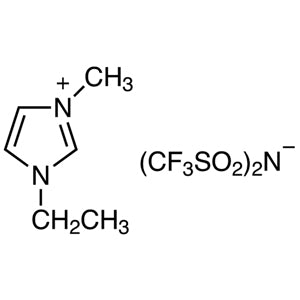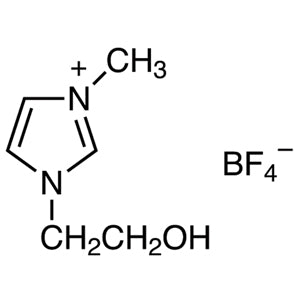


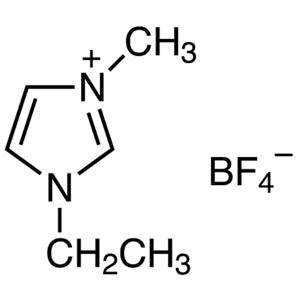
1-Ethyl-3-methylimidazolium Tetrafluoroborate is an ionic liquid widely used in various chemical reactions and synthesis processes. As a stable ionic compound, it serves as a versatile medium for chemical reactions, offering unique properties that make it suitable for a range of laboratory applications. Its non-volatile nature and low toxicity make it an ideal alternative to traditional organic solvents, especially in environments where safety and environmental impact are critical considerations. This ionic liquid is particularly valued for its ability to remain stable under a variety of reaction conditions, allowing researchers to conduct experiments with greater control and reliability.
The properties of 1-Ethyl-3-methylimidazolium Tetrafluoroborate, including its non-volatility, non-toxicity, and reusability, make it a preferred choice for modern chemical research. Unlike many conventional solvents, it does not evaporate easily, reducing the risk of exposure and environmental contamination. Its ability to be reused multiple times also helps minimize the consumption of hazardous materials and reduces chemical waste, aligning with sustainable laboratory practices. These characteristics not only enhance safety but also support the development of greener and more efficient chemical processes.
In Indonesian laboratories, this ionic liquid is commonly used in organic synthesis and catalytic processes. It is particularly favored in research focused on environmentally friendly and sustainable methods. Its role in facilitating chemical reactions under diverse conditions makes it a valuable tool for scientists working in both academic and industrial settings. Its widespread use in chemical research underscores its importance in advancing modern laboratory practices in Indonesia.
Advantages (TCI brochure)
- Aldol II condensation: selectivity to product 3 of 69% reported in the ionic liquid
- Reduction of aldehydes with trialkylboranes reported in this solvent
TCI brochures (PDF)
- Ionic Liquids for Battery Research 2026-04-13 · p. 1
- Ionic Liquids 2026-06-08 · p. 8
- Solar Cell Materials 2026-04-21 · p. 10
- Boron Compounds 2025-10-07 · p. 25
Related TCI products
- TCI B2195 174501-65-6 1-Butyl-3-methylimidazolium Tetrafluoroborate
- TCI B2477 174899-83-3 1-Butyl-3-methylimidazolium Bis(trifluoromethanesulfonyl)imide
- TCI E0599 174899-82-2 1-Ethyl-3-methylimidazolium Bis(trifluoromethanesulfonyl)imide
- TCI H1492 374564-83-7 1-(2-Hydroxyethyl)-3-methylimidazolium Tetrafluoroborate
- TCI H1099 244193-50-8 1-Hexyl-3-methylimidazolium Tetrafluoroborate
- TCI D5373 244193-56-4 1-Decyl-3-methylimidazolium Tetrafluoroborate
- Organic synthesis reactions benefit from this ionic liquid as a non-volatile and non-toxic solvent, enhancing reaction control and safety.
- Catalytic processes often utilize this material due to its stability and ability to support diverse reaction conditions without degradation.
- Green chemistry research relies on this ionic liquid to reduce hazardous solvent use and promote sustainable chemical practices.
- Analytical chemistry applications benefit from its inert nature, allowing accurate and reproducible experimental results.
- Industrial process development uses this material as a medium for reactions requiring high thermal stability and minimal environmental impact.
From the TCI brochure
- Aldol condensation
- Reduction of aldehydes with trialkylboranes
| Brand | TCI |
|---|---|
| CAS number | 143314-16-3 |
| Molecular formula | — |
| Purity | — |
| Category | Chemistry > Specialty Synthesis > Ionic Liquids |
| Pack sizes | Available in various quantities as per supplier specifications |
| Physical form | Liquid |
| Storage | Store in a cool, dry place away from direct sunlight and incompatible materials |
Data from the TCI brochure
| Selectivity to product 3 (Aldol II) | 69 % (NaOH aq., solvent, reflux, 3 h, conv. 100 %) |
|---|---|
| Y (%) benzaldehyde reduction by Bu3B | 90 (Bu3B 1 eq., 100 °C, 16 h) |
Source: TCI brochure R5058 (2026-06-08)
This ionic liquid should be stored in a cool, dry environment to maintain its stability and prevent degradation. It is recommended to use airtight containers made of materials compatible with ionic liquids, such as glass or high-density polyethylene. Due to its non-volatile nature, it does not require special containment for vapor control, but general laboratory safety protocols should still be followed. Avoid exposure to heat, moisture, and incompatible substances to ensure long-term usability. Always handle with care, using appropriate personal protective equipment when necessary. Proper storage and handling help preserve the material's effectiveness and ensure safe laboratory operations.
—
Product Categories
Produk Terkait
-
1-Butyl-3-methylimidazoliumTetrafluoroborate TCI B2195
Regular price From Rp 1.037.000,00Regular priceRp 721.000,00Sale price From Rp 1.037.000,00 -
1-Butyl-3-methylimidazoliumBis(trifluoromethanesulfonyl)imide TCI B2477
Regular price From Rp 1.322.000,00Regular priceRp 915.000,00Sale price From Rp 1.322.000,00 -
1-Ethyl-3-methylimidazoliumBis(trifluoromethanesulfonyl)imide TCI E0599
Regular price From Rp 2.022.000,00Regular priceRp 1.392.000,00Sale price From Rp 2.022.000,00 -
1-(2-Hydroxyethyl)-3-methylimidazoliumTetrafluoroborate TCI H1492
Regular price From Rp 1.375.000,00Regular priceRp 951.000,00Sale price From Rp 1.375.000,00 -
1-Hexyl-3-methylimidazoliumTetrafluoroborate TCI H1099
Regular price From Rp 1.219.000,00Regular priceRp 845.000,00Sale price From Rp 1.219.000,00 -
1-Decyl-3-methylimidazoliumTetrafluoroborate TCI D5373
Regular price From Rp 2.100.000,00Regular priceRp 1.445.000,00Sale price From Rp 2.100.000,00 -
1-Benzyl-3-methylimidazoliumTetrafluoroborate TCI B5725
Regular price Rp 751.000,00Regular priceRp 527.000,00Sale price Rp 751.000,00 -
1-Butyl-3-methylimidazoliumTricyanomethanide TCI B5487
Regular price From Rp 1.815.000,00Regular priceRp 1.251.000,00Sale price From Rp 1.815.000,00