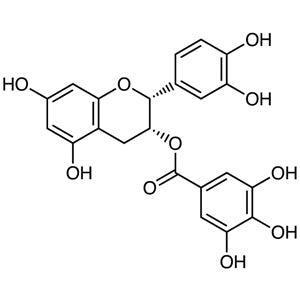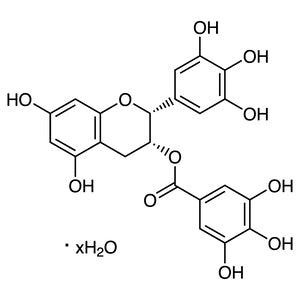
TCI E0694 (-)-Epigallocatechin Gallate Hydrate, more widely known by the abbreviation EGCG, is a gallated catechin that occurs naturally in tea leaves and is supplied by TCI in hydrate form for research purposes. The material belongs to the group of natural-product reagents prepared specifically for research and experimental activities, and is not intended for consumption or clinical use. In the laboratory, EGCG serves as a test and comparison compound in biochemical studies, particularly when researchers wish to examine antioxidant activity, the interaction of polyphenolic compounds with proteins, and the influence of plant secondary metabolites on model biological systems.
The property that makes EGCG so frequently chosen is its polyphenolic structure, which is rich in phenolic hydroxyl groups and therefore highly active in radical-scavenging reactions and in the formation of hydrogen bonds with biomolecules. The additional gallate group strengthens the compound's electron-donating capacity and broadens its ability to interact with enzymes, membranes, and nucleic acids. Its defined stereochemical form matters because the biological activity of catechins depends strongly on molecular configuration. As a consequence of this same reactivity, the compound is also relatively sensitive and must be handled with care so that its condition is preserved throughout a study.
In Indonesian laboratories, this reagent is typically used in university research groups, natural-product and phytochemistry laboratories, and biochemistry facilities that study plant-derived compounds. It is commonly employed as a reference standard alongside locally sourced tea extracts, as a positive control in antioxidant assay development, and as a defined test compound in experiments where a well-characterised catechin is needed rather than a crude extract of variable composition.
TCI brochures (PDF)
- Epigenetics Research Reagents 2024-11-22 · p. 1
- Antioxidants for Research and Experimental Use 2026-07-29 · p. 1
- Polyphenols 2024-12-05 · p. 1
- Phytochemicals 2025-12-17 · p. 10
- Reagents for Biological Research 2025-03-11 · p. 41
- Antioxidant activity studies — EGCG's abundant phenolic hydroxyl groups make it highly active in radical-scavenging reactions, so it works well as a test or comparison compound in antioxidant investigations.
- Polyphenol–protein interaction research — the compound readily forms hydrogen bonds with biomolecules, allowing researchers to examine how polyphenolic compounds associate with proteins under controlled conditions.
- Plant secondary metabolite research — as a natural-product reagent from tea leaves, it supports studies of how plant secondary metabolites influence model biological systems in the laboratory.
- Enzyme and membrane interaction experiments — the additional gallate group broadens the compound's ability to interact with enzymes, membranes, and nucleic acids, supporting a wide range of biochemical interaction work.
- Stereochemistry-dependent activity studies — because catechin biological activity depends strongly on molecular configuration, this defined stereochemical form is suitable for experiments comparing configuration with measured activity.
| Brand | TCI (Tokyo Chemical Industry) |
|---|---|
| CAS number | 989-51-5 |
| Molecular formula | — |
| Purity | — |
| Category | Life Science > Biochemicals and Reagents > Crude Medicine Ingredients for Research and Experimental Use |
| Pack sizes | available in research-scale packaging; please contact AMI Scientific for currently offered sizes |
| Physical form | — |
| Storage | store as directed on the manufacturer's label; the compound is reactive and requires careful handling to preserve its condition |
- Product code: TCI E0694
- Chemical form: hydrate of (-)-epigallocatechin gallate, a gallated catechin
- Intended use: research and experimental use only — not for consumption or clinical use
Because EGCG is a reactive polyphenol, it should be stored under the conditions stated on the manufacturer's label and kept in its original tightly closed container, protected from air, light, and moisture. Transfer the material into clean, dry, well-sealed glass or otherwise chemically compatible containers, and allow refrigerated stock to reach room temperature before opening in order to limit condensation. Weigh and handle the reagent in a well-ventilated area or fume hood, wearing a laboratory coat, gloves, and eye protection, and avoid unnecessary exposure to skin, eyes, and dust inhalation. Prepare solutions fresh where possible, label all aliquots clearly, and consult the manufacturer's safety data sheet before use. This material is intended for research and experimental use only and must not be used for consumption or clinical purposes.
—
Product Categories
- Biochemicals and ReagentsCrude Medicine Ingredients for Research and Experimental Use
- Cell BiologyCancer ResearchAntitumor Agents for Research
- Cell BiologyCancer ResearchCancer Metabolism
- Cell BiologyCancer ResearchChemopreventive Agents [Cancer Research]
- Cell BiologyNutrition ResearchPhytochemicals
- Cell BiologyStem Cell BiologyRegenerative Medicine Research Reagents
- MicrobiologyEfflux Pump ResearchEfflux Pump Inhibitors
- MicrobiologyQuorum Sensing ResearchQuorum Sensing Inhibitors and Antagonists, etc.
- Molecular BiologyRegenerative Medicine Research Reagents
- Molecular BiologyEpigeneticsBioactive Small Molecules for Epigenetic Research
- Molecular BiologyAntioxidants [Life Science]
- Pharmaceutical Development and Drug Discovery ResearchCrude Medicine Ingredients for Research and Experimental Use
Produk Terkait
-
(-)-EpicatechinGallate TCI E0890
Regular price From Rp 5.803.350,00Regular priceRp 4.074.000,00Sale price From Rp 5.803.350,00 -
Curcumin(Synthetic) TCI C2302
Regular price From Rp 1.246.350,00Regular priceRp 887.250,00Sale price From Rp 1.246.350,00 -
Curcumin(Natural) TCI C0434
Regular price From Rp 637.350,00Regular priceRp 445.200,00Sale price From Rp 637.350,00 -
3',4',5,7-Tetrahydroxyflavone TCI T2682
Regular price From Rp 1.618.050,00Regular priceRp 1.146.600,00Sale price From Rp 1.618.050,00 -
PhenethylCaffeate TCI P2088
Regular price From Rp 1.087.800,00Regular priceRp 775.950,00Sale price From Rp 1.087.800,00 -
(-)-Epigallocatechin TCI E1084
Regular price From Rp 2.623.950,00Regular priceRp 1.850.100,00Sale price From Rp 2.623.950,00 -
Butein TCI B3803
Regular price From Rp 3.100.650,00Regular priceRp 2.184.000,00Sale price From Rp 3.100.650,00 -
QuercetinHydrate TCI P0042
Regular price Rp 1.378.650,00Regular priceRp 979.650,00Sale price Rp 1.378.650,00