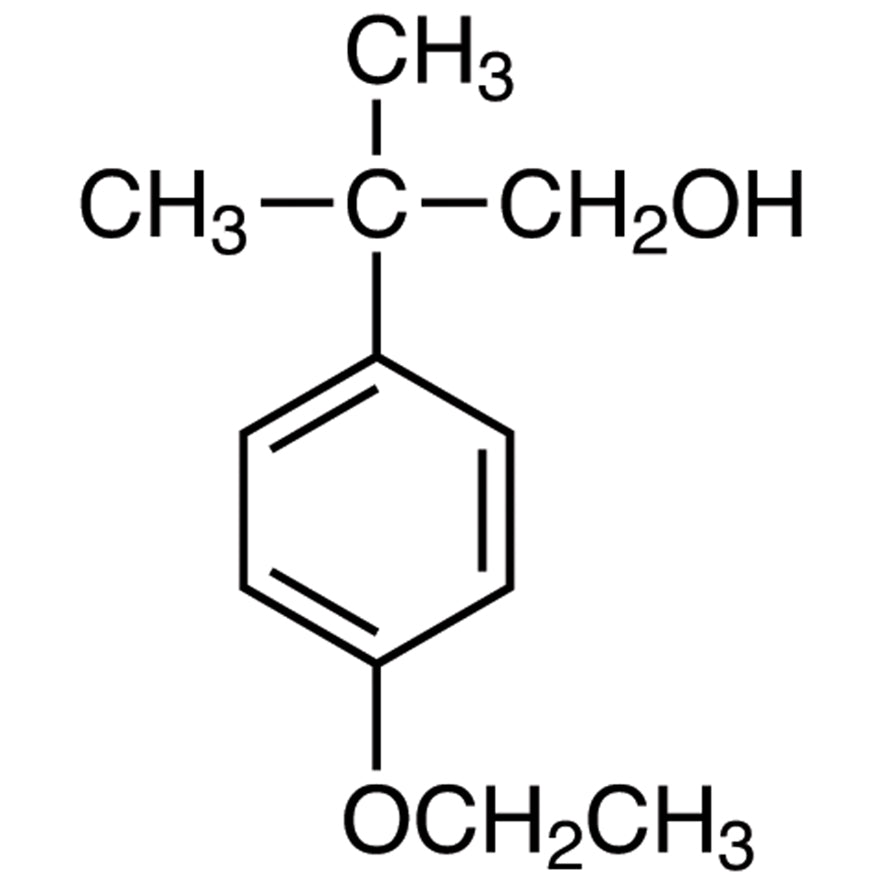
2-(4-Ethoxyphenyl)-2-methylpropanol is a chemical compound widely used in organic synthesis reactions. It serves as a versatile building block in the development of various organic compounds, playing a crucial role in laboratory research and development. This compound is particularly valuable in the synthesis of pharmaceuticals, materials, and other organic substances due to its ability to participate in multiple reaction types. Its molecular structure allows for modifications through substitution, coupling, or structural changes, making it an essential tool for chemists working in diverse fields.
The compound is chemically stable and exhibits reactivity in a range of reactions, including reduction, oxidation, and nucleophilic processes. These properties make it a preferred choice for researchers seeking a reliable and adaptable reagent. Its stability under various reaction conditions enhances its utility in both academic and industrial settings. The compound's ability to undergo chemical transformations under controlled environments ensures its effectiveness in complex synthetic pathways.
In Indonesian laboratories, this compound is commonly used for research and development of new compounds, particularly in the pharmaceutical and chemical industries. It is also utilized in educational settings to train students in organic synthesis techniques and analytical methods. Its availability in various packaging options supports its use in both small-scale and larger laboratory operations.
- Organic synthesis for the development of pharmaceutical compounds due to its reactivity and structural versatility.
- Structural modification studies in chemical research to explore new molecular configurations and functional groups.
- Educational purposes in chemistry laboratories to teach students about synthetic pathways and reaction mechanisms.
- Industrial applications in material science for the creation of advanced polymers and specialty chemicals.
- Research in catalytic processes where the compound serves as a key intermediate in reaction sequences.
| Brand | TCI |
|---|---|
| CAS number | 83493-63-4 |
| Molecular formula | — |
| Purity | — |
| Category | Chemistry > Building Blocks > Non-Heterocyclic Building Blocks |
| Pack sizes | Available in various quantities suitable for laboratory use |
| Physical form | Liquid |
| Storage | Store in a cool, dry place away from direct sunlight |
This compound should be stored in a cool, dry environment, away from direct sunlight and sources of heat. It is recommended to use airtight containers made of glass or high-density polyethylene to prevent contamination and maintain chemical integrity. Due to its reactivity, it should be handled in a well-ventilated area, and appropriate personal protective equipment, such as gloves and safety goggles, should be worn. Avoid exposure to incompatible substances, and ensure that storage areas are secure to prevent accidental spills or contamination. Proper labeling of containers is essential for safe handling and easy identification in laboratory settings.
—
Produk Terkait
-
2-(4-Chlorophenyl)-2-methylpropanol TCI C2176
Regular price Rp 2.094.750,00Regular price -
2-Methylpropane-1,2-diol TCI M3821
Regular price From Rp 2.386.650,00Regular price -
N1-(2-Ethoxyphenyl)-N2-(2-ethylphenyl)oxalamide TCI E1382
Regular price From Rp 1.246.350,00Regular price -
4-EthoxyphenylIsocyanate TCI E0770
Regular price Rp 1.565.550,00Regular price -
N,N,N-Trimethylprop-2-en-1-aminiumChloride TCI T4175
Regular price From Rp 1.485.750,00Regular price -
4-Ethoxyphenyl4-Butylbenzoate TCI B0375
Regular price Rp 6.015.450,00Regular price -
4-Ethoxyphenyltrans-4-Butylcyclohexanecarboxylate TCI E1396
Regular price From Rp 2.411.850,00Regular price -
4-Ethoxyphenyltrans-4-Propylcyclohexanecarboxylate TCI E1395
Regular price From Rp 1.856.400,00Regular price