

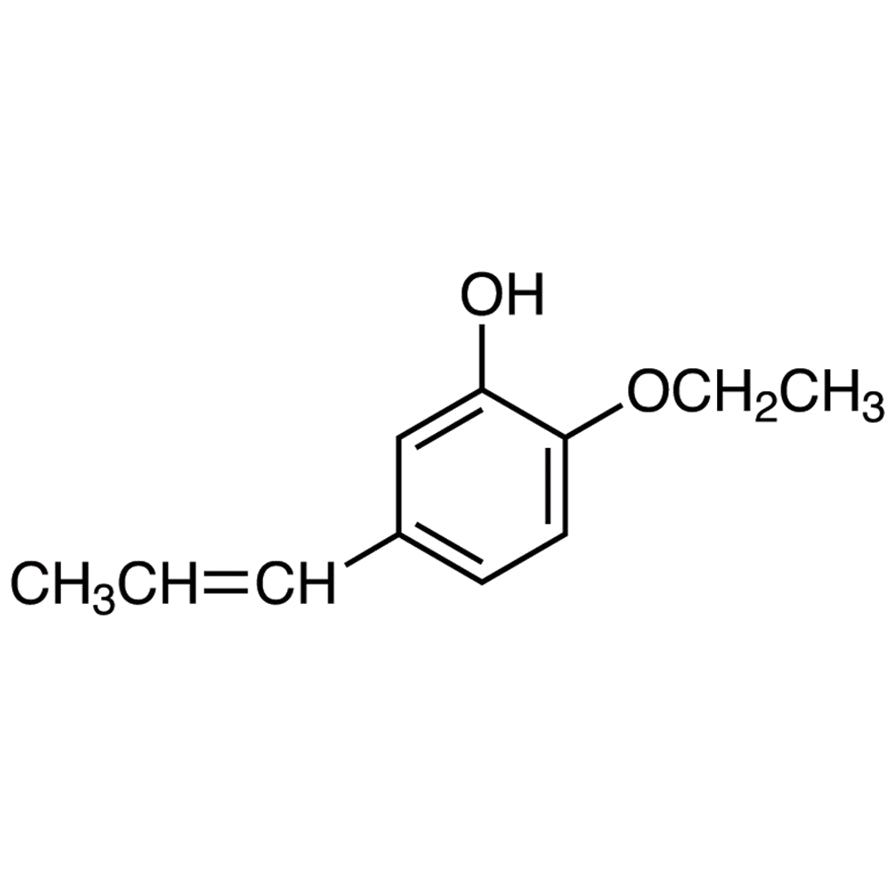
2-Ethoxy-5-(1-propenyl)phenol is a chemical compound widely used in laboratory settings for the synthesis of complex molecules. As a building block in organic chemistry, it plays a crucial role in the development of new compounds with specific functional properties. This compound is commonly employed in the production of aromatic compounds and their derivatives, which find applications in pharmaceuticals, materials science, and chemical industries. Its versatility makes it a valuable resource for researchers and students engaged in chemical synthesis and molecular design.
The compound's molecular structure, consisting of a phenolic group, an ethoxy group, and a propenyl group, contributes to its high reactivity. This reactivity allows it to participate in various chemical reactions, including substitution, addition, and catalytic processes. The presence of multiple functional groups enhances its utility in synthetic pathways, making it a preferred choice for laboratories requiring compounds with both reactivity and stability. Its chemical versatility supports a wide range of experimental applications, from basic research to advanced synthetic projects.
In Indonesian laboratories, 2-Ethoxy-5-(1-propenyl)phenol is utilized by researchers and students in organic chemistry and the synthesis of bioactive compounds. Its availability in the local market facilitates access for scientific research, supporting national efforts in chemical innovation and development. The compound's role in academic and industrial research underscores its importance in the scientific community.
TCI brochures (PDF)
- Polyphenols 2024-12-05 · p. 2
Related TCI products
- TCI P1103 93-16-3 4-(1-Propenyl)-1,2-dimethoxybenzene
- TCI A1184 5912-87-8 1-Acetoxy-2-methoxy-4-[(E)-1-propenyl]benzene
- TCI E1369 80944-44-1 1-Ethoxy-4-(trans-4-propylcyclohexyl)benzene
- TCI E1367 84540-32-9 1-Ethoxy-4-(trans-4-pentylcyclohexyl)benzene
- TCI E1029 79887-14-2 1-Ethoxy-4-ethynylbenzene
- TCI E0928 99469-99-5 2-(3-Ethoxy-4-ethoxycarbonylphenyl)acetic Acid
- Organic synthesis projects benefit from this compound due to its reactivity and structural versatility, enabling the creation of complex molecules with specific functional groups.
- Pharmaceutical research utilizes this compound as a building block for the development of bioactive compounds and drug candidates with therapeutic potential.
- Material science applications leverage its chemical properties to synthesize advanced materials with tailored characteristics for industrial use.
- Educational institutions incorporate it into laboratory courses to teach fundamental concepts of organic chemistry and synthetic methodologies.
- Industrial research and development teams use it to explore new chemical pathways for the production of specialty chemicals and functional materials.
| Brand | TCI |
|---|---|
| CAS number | 94-86-0 |
| Molecular formula | — |
| Purity | — |
| Category | Chemistry > Building Blocks > Non-Heterocyclic Building Blocks |
| Pack sizes | Available in standard laboratory quantities |
| Physical form | Liquid |
| Storage | Store in a cool, dry place away from light and incompatible substances |
This compound should be stored in a cool, dry place, away from direct sunlight and sources of heat. It is recommended to keep it in a sealed container to prevent exposure to air and moisture. Due to its chemical reactivity, it should be handled in a well-ventilated area, preferably under a fume hood. Avoid contact with incompatible materials such as strong oxidizing agents or acids. Always use appropriate personal protective equipment, including gloves and safety goggles, when handling this substance. Proper storage and handling ensure the compound remains stable and safe for use in laboratory environments.
—
Produk Terkait
-
4-(1-Propenyl)-1,2-dimethoxybenzene TCI P1103
Regular price From Rp 610.050,00Regular price -
1-Acetoxy-2-methoxy-4-[(E)-1-propenyl]benzene TCI A1184
Regular price Rp 505.050,00Regular price -
1-Ethoxy-4-(trans-4-propylcyclohexyl)benzene TCI E1369
Regular price From Rp 1.298.850,00Regular price -
1-Ethoxy-4-(trans-4-pentylcyclohexyl)benzene TCI E1367
Regular price From Rp 1.353.450,00Regular price -
1-Ethoxy-4-ethynylbenzene TCI E1029
Regular price From Rp 505.050,00Regular price -
2-(3-Ethoxy-4-ethoxycarbonylphenyl)aceticAcid TCI E0928
Regular price From Rp 1.590.750,00Regular price -
1-Ethoxy-2-propanol TCI E0446
Regular price From Rp 795.900,00Regular price -
2-[2-(2-Chloroethoxy)ethoxy]ethanol TCI C1416
Regular price From Rp 1.298.850,00Regular price

![5912-87-8 1-Acetoxy-2-methoxy-4-[(E)-1-propenyl]benzene - AMI Scientific](http://amiscientific.com/cdn/shop/files/TCI2510A1184.jpg?v=1769141370&width=533)


![2-[2-(2-Chloroethoxy)ethoxy]ethanol (CAS 5197-62-6) - TCI C1416 - AMI Scientific](http://amiscientific.com/cdn/shop/files/TCI2510C1416.jpg?v=1768816517&width=533)