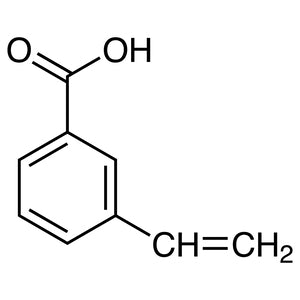
3-Vinylbenzoic Acid is a bifunctional aromatic compound carrying a vinyl group and a carboxylic acid group in the meta position relative to one another on the benzene ring. As a non-heterocyclic building block, this compound brings two distinct types of reactivity together in a single molecule: a double bond that can be polymerized or subjected to addition reactions, and an acid group that can be converted into esters, amides, or salts. This combination means it is frequently employed both as a functional monomer and as an intermediate in stepwise organic synthesis routes in research laboratories.
The property that makes this compound attractive is its ability to insert a carboxylic acid group into a polymer chain through radical polymerization at the vinyl group. The embedded acid group then serves as an anchoring point for further modification, imparts hydrophilic character, or functions as a coordination site in metal-based materials. The meta substitution pattern provides a geometry different from that of the para and ortho isomers, which in turn influences the bond angles and structural rigidity of the resulting framework — a consideration of real importance in polymer design and in the construction of directed molecular scaffolds. The carboxylate group also simplifies purification through salt formation.
In Indonesian laboratories, this building block is typically used in university and institutional research settings where polymer chemistry, materials synthesis, and multi-step organic preparation are carried out on a bench scale. It is ordinarily handled by researchers who require a monomer that introduces acid functionality directly into a growing chain, or by synthetic chemists who need an aromatic intermediate offering two independently addressable reactive handles within one structure.
TCI brochures (PDF)
- Monomers 2025-05-28 · p. 16
Related TCI products
- TCI V0188 27326-43-8 2-Vinylbenzoic Acid
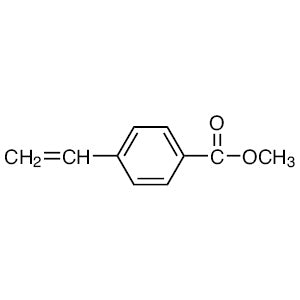
- TCI E1468 1076-96-6 Methyl 4-Vinylbenzoate
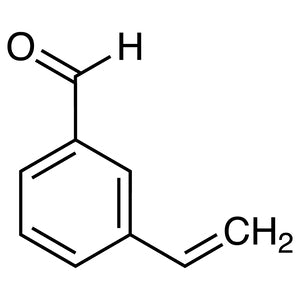
- TCI E1574 19955-99-8 3-Vinylbenzaldehyde (stabilized with TBC)
- TCI V0059 1075-49-6 4-Vinylbenzoic Acid (stabilized with BHT)
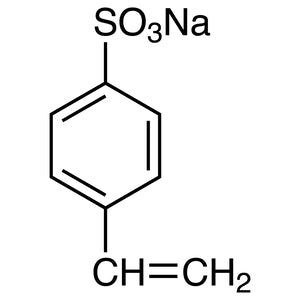
- TCI O0609 2695-37-6 Sodium 4-Vinylbenzenesulfonate
- TCI E1556 612-15-7 1-Methoxy-2-vinylbenzene (stabilized with HQ)
- Functional monomer in radical polymerization — the vinyl group participates directly in chain growth while the carboxylic acid is carried intact into the resulting polymer backbone.
- Preparation of carboxyl-functionalized polymers — the embedded acid groups act as anchoring points for subsequent modification or for imparting hydrophilic character to the material.
- Aromatic intermediate in stepwise organic synthesis — the acid group is readily converted into esters, amides, or salts at the appropriate stage of a synthetic sequence.
- Ligand precursor for metal-based materials — the carboxylate group can serve as a coordination site, while the meta geometry governs the bond angles of the framework formed.
- Design of directed molecular scaffolds — the meta arrangement gives structural rigidity distinct from the para and ortho isomers, which is useful when defined spatial geometry is required.
| Brand | TCI |
|---|---|
| CAS number | 28447-20-3 |
| Molecular formula | — |
| Purity | — |
| Category | Chemistry > Building Blocks > Non-Heterocyclic Building Blocks |
| Pack sizes | available in the standard research pack sizes supplied by TCI for this catalogue item |
| Physical form | — |
| Storage | store under the conditions stated on the manufacturer's label and accompanying documentation |
- Product code: E1569
Store the material in its original tightly closed container, kept in a cool, dry, and well-ventilated area away from heat sources, direct sunlight, and incompatible substances. As the compound carries a polymerizable vinyl group, containers should remain sealed and should not be left open to air for extended periods. Handle in a fume hood using appropriate personal protective equipment, including safety glasses, gloves, and a laboratory coat. Always consult the manufacturer's Safety Data Sheet before use, and follow institutional procedures for waste collection and disposal of both the compound and any contaminated materials.
—
Produk Terkait
-
2-VinylbenzoicAcid TCI V0188
Regular price From Rp 2.147.250,00Regular price -
Methyl4-Vinylbenzoate TCI E1468
Regular price From Rp 2.332.050,00Regular price -
3-Vinylbenzaldehyde(stabilizedwithTBC) TCI E1574
Regular price From Rp 2.227.050,00Regular price -
4-VinylbenzoicAcid(stabilizedwithBHT) TCI V0059
Regular price From Rp 769.650,00Regular price -
Sodium4-Vinylbenzenesulfonate TCI O0609
Regular price From Rp 980.700,00Regular price -
1-Methoxy-2-vinylbenzene(stabilizedwithHQ) TCI E1556
Regular price From Rp 3.817.800,00Regular price -
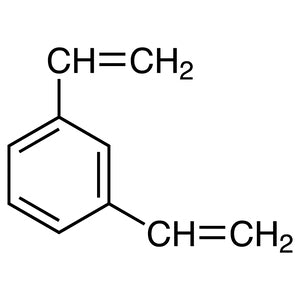
1,3-Divinylbenzene(stabilizedwithTBC) TCI D6174
Regular price From Rp 2.809.800,00Regular price -
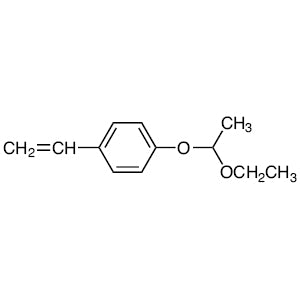
1-(1-Ethoxyethoxy)-4-vinylbenzene(stabilizedwithTBC) TCI E1441
Regular price From Rp 2.094.750,00Regular price