

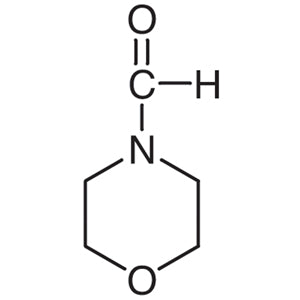
4-Formylmorpholine is a chemical compound widely used in laboratory settings for the synthesis of heterocyclic compounds and their derivatives. As a building block in organic chemistry, it plays a crucial role in the development of complex molecular structures. Its unique molecular structure, featuring a morpholine ring with an aldehyde group at the fourth position, makes it highly versatile for various chemical reactions. This compound is particularly valuable in the creation of bioactive molecules, industrial chemicals, and materials science applications due to its reactivity and functional group versatility.
The reactivity of 4-Formylmorpholine is a key factor in its popularity among chemists. The aldehyde group enables participation in substitution, redox, and cross-linking reactions, while the morpholine ring provides structural stability. These properties allow it to be used in the synthesis of a wide range of compounds, including pharmaceuticals and functional materials. Its ability to undergo further modifications through reduction, oxidation, or bond formation makes it an essential tool in synthetic chemistry.
In Indonesian laboratories, 4-Formylmorpholine is commonly used in organic chemistry research, especially in the development of bioactive compounds and functional materials. Its availability and chemical properties make it a preferred choice for researchers working on drug discovery, polymer synthesis, and advanced material development. The compound’s role in creating complex structures with high reactivity and stability is vital in both academic and industrial research settings.
- Organic synthesis of heterocyclic compounds due to its reactive aldehyde group and stable morpholine ring.
- Development of bioactive molecules for pharmaceutical research and drug discovery applications.
- Synthesis of functional materials used in polymer science and advanced material research.
- Preparation of intermediates for industrial chemical production requiring structural complexity.
- Use in redox and substitution reactions to create diverse chemical derivatives and molecular structures.
| Brand | TCI |
|---|---|
| CAS number | 4394-85-8 |
| Molecular formula | — |
| Purity | — |
| Category | Chemistry > Building Blocks > Heterocyclic Building Blocks |
| Pack sizes | Available in standard laboratory quantities as per supplier specifications |
| Physical form | Solid, crystalline or powder, depending on production |
| Storage | Store in a cool, dry place away from moisture and direct sunlight |
4-Formylmorpholine should be stored in a cool, dry environment to maintain its chemical integrity. It is recommended to keep it in a sealed container to prevent exposure to moisture and air, which can affect its reactivity. Due to its reactive nature, it should be handled in a well-ventilated laboratory setting, ideally with appropriate personal protective equipment. Avoid contact with incompatible substances such as strong oxidizing agents. Regular monitoring of storage conditions ensures the compound remains stable and suitable for use in chemical synthesis. Proper labeling and safe storage practices are essential to prevent accidental exposure and ensure laboratory safety.
—
Produk Terkait
-
5-Bromobenzoxazole TCI B5515
Regular price From Rp 1.696.800,00Regular price -
BMS-599626 TCI B5520
Regular price From Rp 3.525.900,00Regular price -
6-Bromobenzo[b]thiophene TCI B5523
Regular price Rp 3.392.550,00Regular price -
3-tert-Butyl4-Methyl(4R,5S)-2,2,5-Trimethyloxazolidine-3,4-dicarboxylate TCI B5538
Regular price Rp 2.969.400,00Regular price -
Biotin-PEG4-Azide TCI B5546
Regular price Rp 7.897.050,00Regular price -
Benzo[b]benzo[4,5]thieno[2,3-d]thiophene TCI B5551
Regular price From Rp 903.000,00Regular price -
2-Bromo-5-(4-hexylphenyl)thiophene TCI B5553
Regular price Rp 3.207.750,00Regular price -
Biotin-PEG4-Amine TCI B5560
Regular price From Rp 1.510.950,00Regular price


![6-Bromobenzo[b]thiophene (CAS 17347-32-9) - TCI B5523 - AMI Scientific](http://amiscientific.com/cdn/shop/files/TCI2510B5523.jpg?v=1767092466&width=533)


![Benzo[b]benzo[4,5]thieno[2,3-d]thiophene (CAS 248-70-4) - TCI B5551 - AMI Scientific](http://amiscientific.com/cdn/shop/files/TCI2510B5551.jpg?v=1768815817&width=533)

