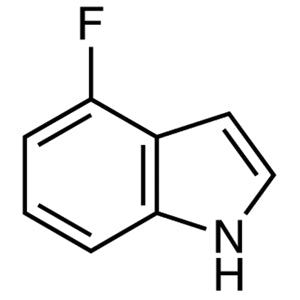
4-Fluoroindole is a chemical compound that belongs to the fluorinated building blocks category, widely used as a foundational material in the synthesis of complex compounds. This compound features an indole structure modified with a fluorine group at the fourth position, which imparts unique chemical properties. Its presence allows for more specific and efficient chemical reactions, making it a valuable resource in organic chemistry research. In the laboratory, it serves as a key reagent for the development of pharmaceuticals and industrial chemicals, offering versatility in various synthetic pathways.
The fluorine group significantly alters the polarity and reactivity of the molecule compared to standard indole. These properties make 4-Fluoroindole a preferred choice in substitution and cross-coupling reactions. Its fluorinated structure also enhances stability, simplifying synthesis processes and enabling its use under diverse laboratory conditions. This stability and reactivity make it particularly useful for researchers aiming to create novel compounds with tailored properties.
In Indonesian laboratories, 4-Fluoroindole is commonly used in scientific research across universities and research institutions. It plays a crucial role in the fields of pharmacy, organic chemistry, and material science. Local researchers frequently utilize this compound for the development of new substances with specific functionalities, contributing to advancements in both academic and industrial applications.
TCI brochures (PDF)
- Fluorination Reagents, Fluorinated Building Blocks 2026-03-18 · p. 50
- Organic synthesis applications benefit from 4-Fluoroindole due to its reactivity and ability to participate in cross-coupling reactions, enabling the creation of complex molecular structures.
- Pharmaceutical research relies on this compound for the development of new drug molecules, as its fluorinated structure can enhance bioavailability and metabolic stability.
- Industrial chemical synthesis uses 4-Fluoroindole as a building block for the production of specialty chemicals, offering improved reactivity and functional group versatility.
- Material science applications leverage its unique properties for the development of advanced polymers and functional materials with tailored characteristics.
- Academic research in Indonesian universities employs 4-Fluoroindole to explore new synthetic methodologies and understand the impact of fluorination on molecular behavior.
| Brand | TCI |
|---|---|
| CAS number | 387-43-9 |
| Molecular formula | — |
| Purity | — |
| Category | Chemistry > Building Blocks > Fluorinated Building Blocks |
| Pack sizes | Available in various quantities as per supplier specifications |
| Physical form | Solid |
| Storage | Store in a cool, dry place away from light and moisture |
4-Fluoroindole should be stored in a cool, dry environment, away from direct light and moisture to maintain its chemical integrity. It is recommended to use airtight containers to prevent exposure to air and moisture, which could affect its stability. In laboratory settings, it should be handled with appropriate personal protective equipment, such as gloves and safety goggles, to ensure safe handling. Due to its chemical nature, it should be stored separately from incompatible materials to avoid any potential reactions. Proper labeling and storage conditions are essential to ensure the safety of laboratory personnel and the integrity of the compound. Regular monitoring of storage conditions is advised to maintain optimal performance and safety standards.
—
Produk Terkait
-
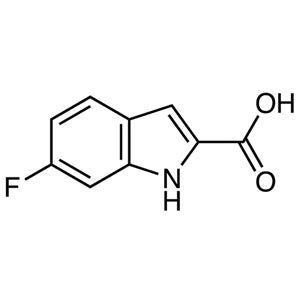
6-Fluoroindole-2-carboxylicAcid TCI F0835
Regular price Rp 1.192.800,00Regular priceRp 849.450,00Sale price Rp 1.192.800,00 -
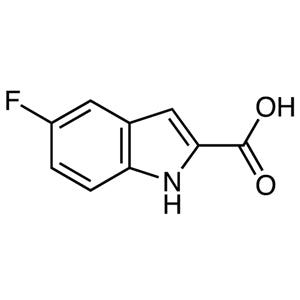
5-Fluoroindole-2-carboxylicAcid TCI F0716
Regular price Rp 1.192.800,00Regular priceRp 849.450,00Sale price Rp 1.192.800,00 -
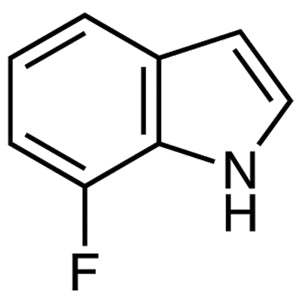
7-Fluoroindole TCI F0555
Regular price Rp 2.730.000,00Regular priceRp 1.924.650,00Sale price Rp 2.730.000,00 -
5-Fluoroindole TCI F0369
Regular price Rp 900.900,00Regular priceRp 645.750,00Sale price Rp 900.900,00 -
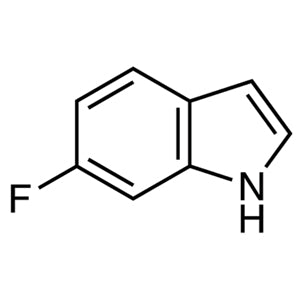
6-Fluoroindole TCI F0352
Regular price Rp 822.150,00Regular priceRp 590.100,00Sale price Rp 822.150,00 -
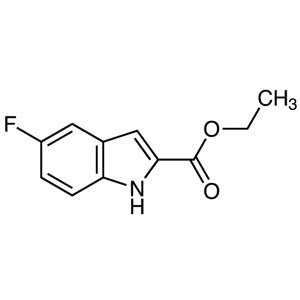
Ethyl5-Fluoroindole-2-carboxylate TCI E1035
Regular price Rp 2.173.500,00Regular priceRp 1.535.100,00Sale price Rp 2.173.500,00 -
4-Fluoroindazole TCI F1037
Regular price Rp 1.961.400,00Regular priceRp 1.387.050,00Sale price Rp 1.961.400,00 -
ShoyakuGreen(=TFMAQ-8Ph) TCI T3935
Regular price Rp 4.399.500,00Regular priceRp 3.092.250,00Sale price Rp 4.399.500,00