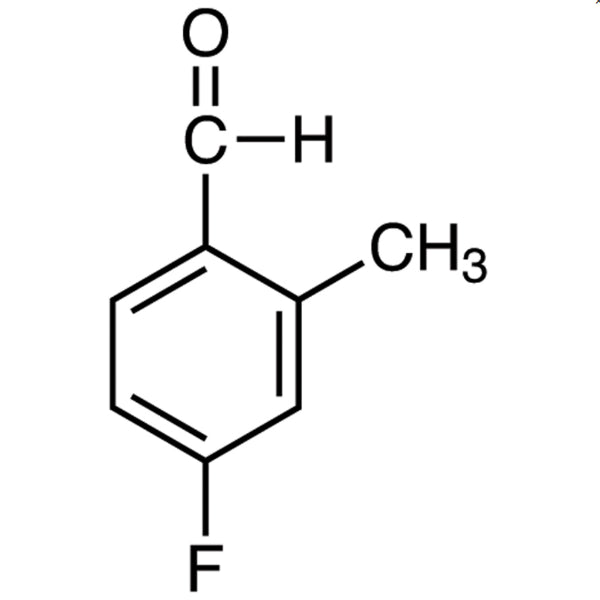

TCI F0793 4-Fluoro-2-methylbenzaldehyde is a positional isomer within the family of methyl-substituted fluorinated benzaldehydes, distinguished by a methyl group occupying the ortho position relative to the formyl group. On paper this difference in substituent placement looks minor, but in practical synthesis it matters a great deal: it shapes the steric environment around the carbonyl centre, influences the rate of nucleophilic addition reactions, and determines how the molecule orients itself when binding to biological targets. In the laboratory, this compound becomes the intermediate of choice whenever the final molecular framework demands that specific ortho-methyl substitution pattern.
The property that makes this material attractive is the combination of formyl group reactivity with the electronic influence of the fluorine atom and the steric effect of the neighbouring methyl group. The ortho methyl group partially shields the carbonyl, which can improve selectivity in certain reactions, while the fluorine atom lowers the electron density of the ring and frequently improves the metabolic stability of derivative molecules. This pairing of controlled reactivity and tunable electronics is precisely what synthetic chemists look for when planning a multi-step route.
The compound is generally supplied as a clear liquid with good solubility in common organic solvents, so it is readily applied to both low-temperature reactions and reflux conditions without requiring equipment beyond standard synthesis glassware. For Indonesian research laboratories, university chemistry departments, and pharmaceutical R&D groups, this makes it a practical building block that integrates into existing workflows without special infrastructure investment.
TCI brochures (PDF)
- Fluorination Reagents, Fluorinated Building Blocks 2026-03-18 · p. 26
Related TCI products
- TCI F1197 147624-13-3 3-Fluoro-2-methylbenzaldehyde
- TCI F0791 135427-08-6 4-Fluoro-3-methylbenzaldehyde
- TCI F0746 22062-53-9 5-Fluoro-2-methylbenzaldehyde
- TCI B5213 537050-14-9 2-Bromo-4'-fluoro-3'-(trifluoromethyl)acetophenone
- TCI B5074 749927-69-3 4-Bromo-2-fluoro-N-methylbenzamide
- TCI B4872 10472-88-5 2-Bromo-4-fluoro-6-nitroaniline
- Pharmaceutical intermediate synthesis — the ortho-methyl substitution pattern allows chemists to construct drug scaffolds that specifically require this geometry around the aromatic ring.
- Nucleophilic addition and condensation chemistry — the reactive formyl group provides a reliable handle for building carbon-carbon bonds under standard synthetic laboratory conditions.
- Structure-activity relationship studies — the defined fluorine and methyl placement lets researchers systematically probe how substituent position affects binding and biological target orientation.
- Fluorinated building block libraries — the fluorine atom reduces aromatic ring electron density and often improves metabolic stability of the resulting derivative compounds.
- Selective carbonyl transformations — steric shielding from the adjacent methyl group can enhance reaction selectivity where an unhindered benzaldehyde would give mixed products.
| Brand | TCI (Tokyo Chemical Industry) |
|---|---|
| CAS number | 63082-45-1 |
| Molecular formula | — |
| Purity | — |
| Category | Chemistry > Building Blocks > Fluorinated Building Blocks |
| Pack sizes | — |
| Physical form | clear liquid, readily soluble in common organic solvents |
| Storage | store in a cool, dry place in a tightly closed container |
- Product Code: F0793
Store this product in a cool, dry, well-ventilated area inside a tightly closed original container, protected from direct sunlight and away from heat sources or open flames. Because the material is a liquid aldehyde, containers should be resealed promptly after each use to limit exposure to air and moisture. Handle in a fume hood using appropriate personal protective equipment, including safety goggles, chemical-resistant gloves, and a laboratory coat. Avoid inhalation of vapours and contact with skin or eyes, and keep the compound separate from strong oxidising agents. Always consult the manufacturer's safety data sheet before use.
—
Produk Terkait
-
3-Fluoro-2-methylbenzaldehyde TCI F1197
Regular price From Rp 823.200,00Regular price -
4-Fluoro-3-methylbenzaldehyde TCI F0791
Regular price Rp 2.359.350,00Regular price -
5-Fluoro-2-methylbenzaldehyde TCI F0746
Regular price From Rp 2.411.850,00Regular price -
2-Bromo-4'-fluoro-3'-(trifluoromethyl)acetophenone TCI B5213
Regular price From Rp 505.050,00Regular price -
4-Bromo-2-fluoro-N-methylbenzamide TCI B5074
Regular price From Rp 1.035.300,00Regular price -
2-Bromo-4-fluoro-6-nitroaniline TCI B4872
Regular price Rp 1.140.300,00Regular price -
1-Bromo-3-fluoro-2-nitrobenzene TCI B4842
Regular price From Rp 1.273.650,00Regular price -
N2-(tert-Butoxycarbonyl)-4-fluoro-1,2-phenylenediamine TCI B4237
Regular price From Rp 980.700,00Regular price