

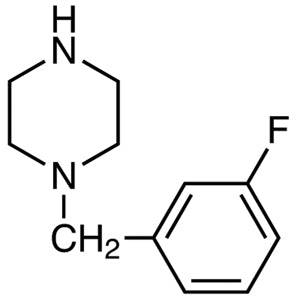
1-(3-Fluorobenzyl)piperazine is a versatile chemical compound widely used in laboratory settings for the synthesis of complex molecules. As a building block in organic chemistry, it plays a crucial role in the development of new compounds and materials. Its unique structure allows for structural modifications, making it an essential tool for researchers aiming to create compounds with specific properties. This compound is commonly found in chemical research laboratories, where it supports a wide range of synthetic pathways and experimental designs.
The presence of a fluorine atom at the 3-position of the benzene ring significantly influences its chemical behavior. This fluorine group imparts distinct polarity and reactivity, making the compound ideal for reactions that require precise structural changes or functional group modifications. Its ability to react with various reagents enhances its utility in complex chemical processes. The stability of its molecular structure ensures reliable performance in laboratory applications, contributing to its popularity among chemists.
In Indonesian laboratories, 1-(3-Fluorobenzyl)piperazine is frequently used in both fundamental and applied chemical research. It supports studies in organic synthesis, pharmaceutical development, and materials science. Its availability through AMI Scientific ensures that researchers have access to this essential compound for their experiments and innovation efforts. Its role in advancing scientific knowledge makes it a valuable resource in the chemical research community.
Related TCI products
- TCI F1336 70931-28-1 1-(4-Fluorobenzyl)piperazine
- TCI C2965 231278-20-9 4-[3-Chloro-4-(3-fluorobenzyloxy)phenylamino]-6-iodoquinazoline
- TCI T3075 107890-32-4 1-(4-Trifluoromethylbenzyl)piperazine
- TCI T2741 30459-17-7 1-(4-Trifluoromethylphenyl)piperazine
- TCI T2739 63854-31-9 1-(2-Trifluoromethylphenyl)piperazine
- TCI B2764 27469-60-9 1-[Bis(4-fluorophenyl)methyl]piperazine
- Organic synthesis: This compound is widely used in organic synthesis for its ability to undergo various chemical transformations, making it ideal for creating complex molecular structures.
- Pharmaceutical development: Its unique chemical properties make it a valuable tool in the development of new drugs and therapeutic agents.
- Materials science research: The compound's reactivity and structural flexibility support the creation of advanced materials with specific functional properties.
- Structural modification studies: Its role as a building block allows researchers to explore the effects of structural changes on molecular behavior and reactivity.
- Analytical chemistry applications: It is used in analytical procedures to test reactivity, stability, and compatibility with different reagents and solvents.
| Brand | TCI |
|---|---|
| CAS number | 55513-19-4 |
| Molecular formula | — |
| Purity | — |
| Category | Chemistry > Building Blocks > Fluorinated Building Blocks |
| Pack sizes | Available in various quantities as per supplier specifications |
| Physical form | Solid or liquid, depending on supplier packaging |
| Storage | Store in a cool, dry place away from light and moisture |
This compound should be stored in a cool, dry environment, away from direct sunlight and moisture to maintain its stability and reactivity. It is recommended to use airtight containers made of glass or high-density polyethylene to prevent contamination and degradation. Due to its chemical nature, it should be handled with appropriate personal protective equipment, including gloves and safety goggles, to ensure laboratory safety. Proper ventilation is essential when working with this compound to minimize exposure to vapors. Regular monitoring of storage conditions is advised to ensure the compound remains in optimal condition for use in research applications.
—
Produk Terkait
-
1-(4-Fluorobenzyl)piperazine TCI F1336
Regular price From Rp 610.050,00Regular price -
4-[3-Chloro-4-(3-fluorobenzyloxy)phenylamino]-6-iodoquinazoline TCI C2965
Regular price From Rp 743.400,00Regular price -
1-(4-Trifluoromethylbenzyl)piperazine TCI T3075
Regular price Rp 1.829.100,00Regular price -
1-(4-Trifluoromethylphenyl)piperazine TCI T2741
Regular price Rp 1.618.050,00Regular price -
1-(2-Trifluoromethylphenyl)piperazine TCI T2739
Regular price Rp 9.514.050,00Regular price -
1-[Bis(4-fluorophenyl)methyl]piperazine TCI B2764
Regular price From Rp 769.650,00Regular price -
1-Benzyl-3-[2-(trifluoromethyl)phenyl]piperazine TCI P2875
Regular price From Rp 3.367.350,00Regular price -
1-Benzyl-3-(4-fluorophenyl)piperazine TCI F1303
Regular price From Rp 2.094.750,00Regular price

![4-[3-Chloro-4-(3-fluorobenzyloxy)phenylamino]-6-iodoquinazoline (CAS 231278-20-9) - TCI C2965 - AMI Scientific](http://amiscientific.com/cdn/shop/files/TCI2510C2965.jpg?v=1767099034&width=533)


![27469-60-9 1-[Bis(4-fluorophenyl)methyl]piperazine - AMI Scientific](http://amiscientific.com/cdn/shop/files/TCI2510B2764.jpg?v=1768815392&width=533)
![2456414-49-4 1-Benzyl-3-[2-(trifluoromethyl)phenyl]piperazine - AMI Scientific](http://amiscientific.com/cdn/shop/files/TCI2510P2875.jpg?v=1767136759&width=533)
