
![2456414-49-4 1-Benzyl-3-[2-(trifluoromethyl)phenyl]piperazine - AMI Scientific](http://amiscientific.com/cdn/shop/files/TCI2510P2875.jpg?v=1767136759&width=1946)
![2456414-49-4 1-Benzyl-3-[2-(trifluoromethyl)phenyl]piperazine - AMI Scientific](http://amiscientific.com/cdn/shop/files/TCI2510P2875.jpg?v=1767136759&width=1445)
1-Benzyl-3-[2-(trifluoromethyl)phenyl]piperazine from TCI is a fluorinated building block that combines a piperazine ring with a benzyl group on the nitrogen at position 1 and a phenyl ring carrying an ortho-trifluoromethyl substituent on the carbon at position 3. In medicinal chemistry laboratories, chemists use it to build fluorine-containing molecules. Fluorine is very common in modern drug design because it can tune the physicochemical and biological properties of candidate compounds, which makes this compound a useful starting point for synthesis.
Researchers often choose this compound because of how its structural features work together. The trifluoromethyl group is known to raise lipophilicity and change the electron distribution of the aromatic ring. It also often helps a molecule resist oxidative metabolism. In the ortho position, it adds a steric effect that can influence molecular conformation. The piperazine ring has a free nitrogen at position 4 that can be functionalised selectively, and the benzyl group acts as a protecting group that can be removed at a later stage. Together, these features make the compound a versatile research scaffold.
For research laboratories in Indonesia, especially in pharmacy faculties, chemistry departments and drug research centres, this compound makes it easier to explore how fluorine affects biological activity. Synthetic chemists can use it to prepare series of related piperazine derivatives for structure-activity relationship studies. Postgraduate students and research groups working on early-stage drug discovery can also use it as a reliable intermediate. They get a well-defined fluorinated scaffold from an established brand without having to install the trifluoromethylphenyl group themselves.
Advantages (TCI brochure)
- Carbon-substituted (3-position) piperazine building block for expanding structural diversity
TCI brochures (PDF)
- 3-Substituted Piperazine Synthetic Reagents and Building Blocks for Drug Discovery Research 2025-07-10 · p. 1
- Fluorination Reagents, Fluorinated Building Blocks 2026-03-18 · p. 38
Related TCI products
- TCI F1303 1248908-23-7 1-Benzyl-3-(4-fluorophenyl)piperazine
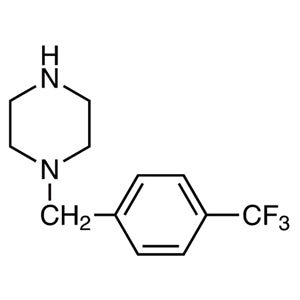
- TCI T3075 107890-32-4 1-(4-Trifluoromethylbenzyl)piperazine
- TCI T2741 30459-17-7 1-(4-Trifluoromethylphenyl)piperazine
- TCI T2739 63854-31-9 1-(2-Trifluoromethylphenyl)piperazine
- TCI B2764 27469-60-9 1-[Bis(4-fluorophenyl)methyl]piperazine
- TCI F1336 70931-28-1 1-(4-Fluorobenzyl)piperazine
- Medicinal chemistry synthesis: the compound provides a ready-made fluorinated piperazine scaffold for building new drug candidates that combine an aryl piperazine core with a trifluoromethyl group.
- Structure-activity relationship studies: the free nitrogen at position 4 can be functionalised selectively, so researchers can prepare a series of analogues and compare how each change affects biological activity.
- Fluorine effect investigations: the ortho-trifluoromethyl group lets chemists study how fluorine changes lipophilicity, electron distribution, conformation and metabolic stability in a candidate molecule.
- Protecting group strategy in multistep synthesis: the benzyl group on nitrogen 1 protects that position during early steps and can be removed later to open a second site for derivatisation.
- Academic research and teaching projects: university laboratories can use this well-defined building block in advanced synthesis projects that show how heterocyclic and fluorinated motifs are combined in modern drug design.
From the TCI brochure
- Building block for drug discovery research
| Brand | TCI (product code P2875) |
|---|---|
| CAS number | 2456414-49-4 |
| Molecular formula | — |
| Purity | — |
| Category | Chemistry > Building Blocks > Fluorinated Building Blocks |
| Pack sizes | Check the product page for the pack sizes currently offered |
| Physical form | See the TCI product specification and Certificate of Analysis |
| Storage | Follow the storage conditions on the TCI label and Safety Data Sheet |
Store this compound in its original, tightly closed container, following the conditions stated on the TCI label and Safety Data Sheet. Keep it in a cool, dry, well-ventilated area away from direct sunlight, moisture and incompatible substances such as strong oxidising agents. After opening, reseal the container promptly, and make sure any transfer containers are clean, dry, chemically compatible and clearly labelled. Only trained personnel should handle the material, in a fume hood or other well-ventilated area, wearing suitable protective gloves, safety glasses and a laboratory coat. Avoid inhaling dust or vapour and avoid contact with skin and eyes. Always read the Safety Data Sheet before use, and dispose of waste according to local regulations and institutional procedures.
References cited in the TCI brochure
- Robin Gueret. Visible-Light-Driven CarboxyLic Amine Protocol (CLAP) for the Synthesis of 2-Substituted Piperazines under Batch and Flow Conditions Organic Letters, 2020. doi:10.1021/acs.orglett.0c01759
Produk Terkait
-
1-Benzyl-3-(4-fluorophenyl)piperazine TCI F1303
Regular price From Rp 2.094.750,00Regular price -
1-(4-Trifluoromethylbenzyl)piperazine TCI T3075
Regular price Rp 1.829.100,00Regular price -
1-(4-Trifluoromethylphenyl)piperazine TCI T2741
Regular price Rp 1.618.050,00Regular price -
1-(2-Trifluoromethylphenyl)piperazine TCI T2739
Regular price Rp 9.514.050,00Regular price -
1-[Bis(4-fluorophenyl)methyl]piperazine TCI B2764
Regular price From Rp 769.650,00Regular price -
1-(4-Fluorobenzyl)piperazine TCI F1336
Regular price From Rp 610.050,00Regular price -
1-(3-Fluorobenzyl)piperazine TCI F1092
Regular price From Rp 1.590.750,00Regular price -
1-(2-Fluorophenyl)piperazine TCI F0728
Regular price Rp 6.042.750,00Regular price



![27469-60-9 1-[Bis(4-fluorophenyl)methyl]piperazine - AMI Scientific](http://amiscientific.com/cdn/shop/files/TCI2510B2764.jpg?v=1768815392&width=533)


