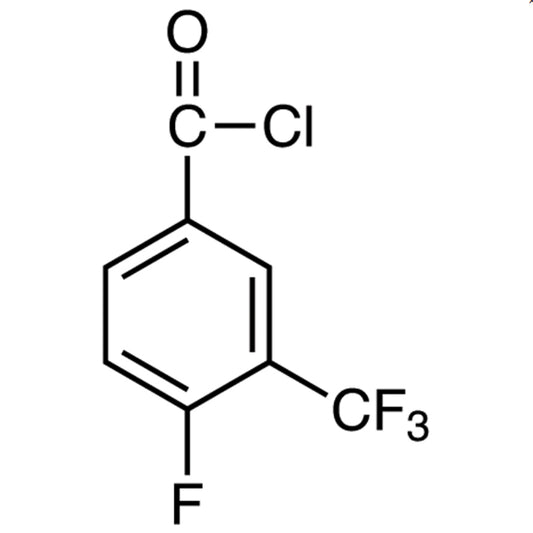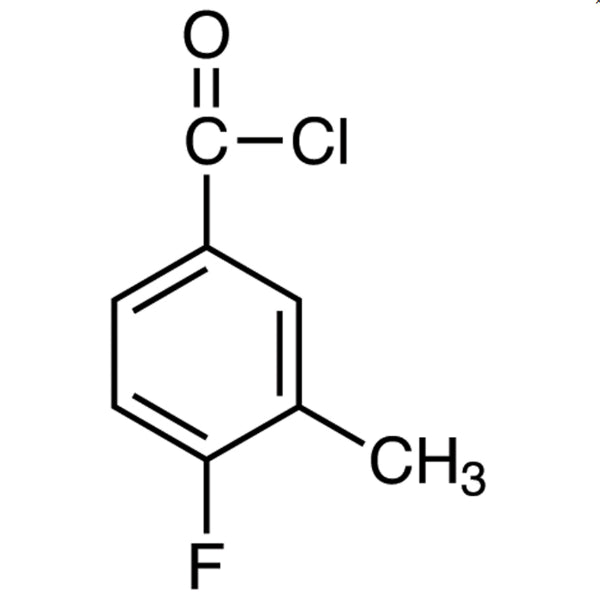
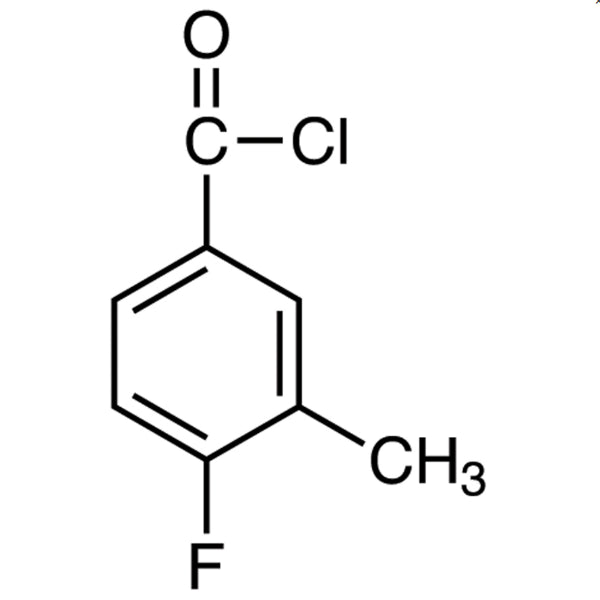
4-Fluoro-3-methylbenzoyl Chloride is a chemical compound widely used as a building block in the synthesis of complex organic compounds. Its molecular structure contains both a fluorine group and a carbonyl group, making it a versatile reagent in organic chemistry. This compound plays a crucial role in laboratories where functional group transformations and ester formation reactions are required. Its presence in chemical synthesis allows researchers to introduce fluorine atoms into organic molecules, which is essential for creating compounds with specific biological or chemical properties.
The compound's high reactivity and compatibility with various chemical reactions make it a preferred choice for synthetic chemists. It is particularly useful in nucleophilic substitution reactions and in the formation of ester linkages. The presence of the fluorine atom enhances the compound’s ability to participate in selective chemical transformations, making it a valuable tool in both academic and industrial research settings. Its stability under controlled conditions further supports its reliability in laboratory applications.
In Indonesian laboratories, 4-Fluoro-3-methylbenzoyl Chloride is commonly used in chemical research, pharmaceutical development, and material science. It is particularly favored by researchers and graduate students working on fluorinated compound synthesis. Its utility in creating novel compounds with desired properties makes it an essential reagent in the chemical toolkit of Indonesian scientific institutions.
Related TCI products
- TCI F1127 1682-10-6 4-Fluoro-3-(trifluoromethyl)benzenesulfonyl Chloride
- TCI F1124 176225-09-5 4-Fluoro-2-(trifluoromethyl)benzenesulfonyl Chloride
- TCI F0966 351-52-0 3-Fluoro-4-methoxybenzyl Chloride
- TCI F0767 171243-30-4 3-Fluoro-5-(trifluoromethyl)benzoyl Chloride
- TCI F0764 207981-46-2 2-Fluoro-5-(trifluoromethyl)benzoyl Chloride
- TCI F0659 67515-56-4 4-Fluoro-3-(trifluoromethyl)benzoyl Chloride
- Organic synthesis applications benefit from its fluorine and carbonyl groups, enabling targeted chemical modifications in compound development.
- Pharmaceutical research utilizes this compound for the creation of fluorinated drug molecules with enhanced bioavailability and metabolic stability.
- Material science experiments leverage its reactivity to synthesize advanced polymers and functional materials with specific chemical properties.
- Academic research in chemistry often incorporates this reagent for teaching and experimental purposes in fluorinated compound synthesis.
- Industrial chemical processes use it as a key intermediate in the production of specialty chemicals and fine chemicals with high functional group versatility.
| Brand | TCI |
|---|---|
| CAS number | 455-84-5 |
| Molecular formula | — |
| Purity | — |
| Category | Chemistry > Building Blocks > Fluorinated Building Blocks |
| Pack sizes | Available in various quantities as per standard chemical supply practices |
| Physical form | Liquid or solid, depending on formulation and supplier packaging |
| Storage | Store in a cool, dry place away from moisture and direct sunlight |
This compound should be stored in a cool, dry environment to maintain its chemical integrity. It is recommended to keep it in a tightly sealed container to prevent exposure to moisture and air. Due to its reactivity, it should be handled in a well-ventilated area, preferably under a fume hood, to ensure safety. Avoid contact with incompatible substances such as strong bases or reducing agents. Always use appropriate personal protective equipment, including gloves and safety goggles, when handling this material. Proper storage and handling practices help ensure the compound remains stable and effective for laboratory use.
—
Produk Terkait
-
4-Fluoro-3-(trifluoromethyl)benzenesulfonylChloride TCI F1127
Regular price From Rp 1.220.100,00Regular price -
4-Fluoro-2-(trifluoromethyl)benzenesulfonylChloride TCI F1124
Regular price From Rp 1.273.650,00Regular price -
3-Fluoro-4-methoxybenzylChloride TCI F0966
Regular price From Rp 2.491.650,00Regular price -
3-Fluoro-5-(trifluoromethyl)benzoylChloride TCI F0767
Regular price From Rp 955.500,00Regular price -
2-Fluoro-5-(trifluoromethyl)benzoylChloride TCI F0764
Regular price Rp 2.199.750,00Regular price -
4-Fluoro-3-(trifluoromethyl)benzoylChloride TCI F0659
Regular price From Rp 610.050,00Regular price -
2-Bromo-4'-fluoro-3'-(trifluoromethyl)acetophenone TCI B5213
Regular price From Rp 505.050,00Regular price -
4-Bromo-2-fluoro-N-methylbenzamide TCI B5074
Regular price From Rp 1.035.300,00Regular price