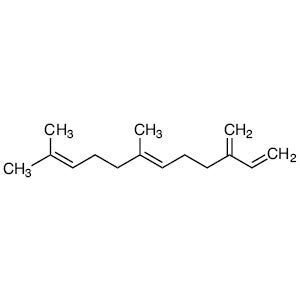
Trans-beta-Farnesene is an organic compound belonging to the terpenoid family, widely used in chemical laboratories as a building block for the synthesis of complex molecules. This compound plays a crucial role in organic chemistry by serving as a precursor in various chemical reactions. Its unique molecular structure allows it to participate in a range of synthetic pathways, making it a valuable resource for researchers. In laboratory settings, Trans-beta-Farnesene is essential for the development of new compounds with applications in pharmaceuticals, cosmetics, and industrial chemicals. Its chemical stability and reactivity enable it to interact with a variety of reagents, facilitating the creation of more complex chemical structures.
The compound is characterized by its relatively high boiling and melting points, which simplify the processes of isolation and purification. These physical properties make it a preferred choice for laboratories requiring high-quality and consistent chemical materials. Additionally, its stability under various reaction conditions ensures reliable results in experimental procedures. The compound's versatility and predictable behavior in chemical reactions contribute to its widespread use in both academic and industrial research environments.
In Indonesian laboratories, Trans-beta-Farnesene is commonly used in organic chemistry research, particularly in the synthesis of natural and synthetic compounds. It is also frequently employed in studies related to fragrance and bioactive substances. Due to its specific properties, it is an essential component in the development of chemical products and the advancement of scientific research in Indonesia.
- Organic synthesis research where Trans-beta-Farnesene serves as a versatile building block for creating complex molecules.
- Pharmaceutical development for the synthesis of bioactive compounds with therapeutic potential.
- Cosmetic formulation studies involving the creation of fragrance and aroma compounds.
- Industrial chemical production for the development of specialty chemicals and intermediates.
- Natural product synthesis where the compound is used to mimic or replicate natural terpenoid structures.
| Brand | TCI |
|---|---|
| CAS number | 18794-84-8 |
| Molecular formula | — |
| Purity | — |
| Category | Chemistry > Building Blocks > Non-Heterocyclic Building Blocks |
| Pack sizes | Available in standard laboratory quantities as per supplier specifications |
| Physical form | Liquid |
| Storage | Store in a cool, dry place away from direct sunlight |
Trans-beta-Farnesene should be stored in a cool, dry environment, away from direct sunlight and sources of heat. It is recommended to use sealed containers made of glass or high-density polyethylene to prevent contamination and maintain its chemical integrity. Due to its reactivity, it should be handled in a well-ventilated area, and appropriate personal protective equipment, such as gloves and safety goggles, should be worn. Avoid exposure to incompatible materials, and ensure that storage conditions are consistent with standard laboratory safety protocols. Proper labeling and storage are essential to ensure safe handling and prevent accidental exposure.
—
Produk Terkait
-
alpha-Caryophyllene TCI C0957
Regular price Rp 3.048.150,00Regular price -
Nerolidol(cis-andtrans-mixture) TCI N0454
Regular price Rp 1.353.450,00Regular price -
1,3-Pentadiene(cis-andtrans-mixture)(stabilizedwithTBC) TCI P1841
Regular price Rp 10.229.100,00Regular price -
trans-1,3-Pentadiene(stabilizedwithTBC) TCI P0647
Regular price From Rp 1.829.100,00Regular price -
trans-2-Pentene TCI P0635
Regular price Rp 6.599.250,00Regular price -
beta-Methylstyrene(cis-andtrans-mixture)(stabilizedwithTBC) TCI P0495
Regular price Rp 4.771.200,00Regular price -
2-Pentene(cis-andtrans-mixture) TCI P0064
Regular price From Rp 1.035.300,00Regular price -
trans-4-Octene TCI O0136
Regular price From Rp 848.400,00Regular price