

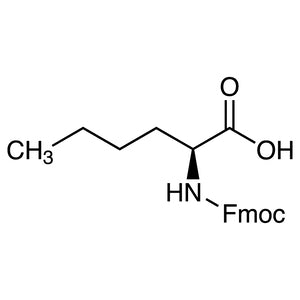
TCI F1324 77284-32-3 Fmoc-Nle-OH is a chemical compound widely used in peptide synthesis, particularly in solid-phase peptide synthesis techniques. This compound plays a crucial role in the construction of complex peptide chains, which are essential for biochemical and pharmacological research. In laboratory settings, it serves as a key building block for creating peptides with specific structural characteristics. Its application extends to drug development, protein research, and biological analysis, making it a versatile tool for scientists working in various fields of chemistry and biology.
The compound is preferred due to its chemical reactivity and specificity, which enable efficient and controlled reactions during synthesis. The Fmoc (9-fluorenylmethyloxycarbonyl) group provides stability during the initial stages of peptide synthesis, while the Nle (Norleucine) amino acid residue adds structural diversity. These properties make it ideal for generating peptides with precise sequences and functional groups. Additionally, its reactivity allows for easy coupling and cleavage reactions, enhancing the efficiency of the synthesis process.
In Indonesian laboratories, Fmoc-Nle-OH is commonly used in chemical and molecular biology research. It is a popular choice due to its availability, quality, and ease of use across various experimental scales. Researchers in educational institutions and research organizations rely on this compound for its reliability and effectiveness in producing high-quality peptides for their studies.
TCI brochures (PDF)
- Amino Acids and Peptide Synthesis Reagents 2025-08-14 · p. 22
Related TCI products
- TCI B5350 68856-96-2 N-(tert-Butoxycarbonyl)-4-methoxy-D-phenylalanine
- TCI B5322 159622-10-3 (1R,2S)-1-[(tert-Butoxycarbonyl)amino]-2-vinylcyclopropanecarboxylic Acid
- TCI B5011 85466-66-6 N-(tert-Butoxycarbonyl)-N-methyl-D-phenylalanine
- TCI B4877 131724-45-3 N-(tert-Butoxycarbonyl)-4-cyano-L-phenylalanine
- TCI B4369 114873-07-3 N-(tert-Butoxycarbonyl)-4-trifluoromethyl-L-phenylalanine
- TCI B4356 100564-78-1 N-(tert-Butoxycarbonyl)-L-homophenylalanine
- Solid-phase peptide synthesis where Fmoc-Nle-OH serves as a protected amino acid for sequential peptide chain construction.
- Drug development projects requiring the synthesis of peptides with specific amino acid sequences for therapeutic applications.
- Biochemical research involving the study of protein structures and interactions using custom-designed peptides.
- Molecular biology experiments that require the production of peptides for use in assays or as tools for functional studies.
- Analytical chemistry applications where peptides are used for biomarker detection or as standards in mass spectrometry analyses.
| Brand | TCI |
|---|---|
| CAS number | 77284-32-3 |
| Molecular formula | — |
| Purity | — |
| Category | Chemistry > Chemical Biology > Peptide Chemistry |
| Pack sizes | Available in various quantities as per standard laboratory supply options |
| Physical form | Solid powder |
| Storage | Store in a cool, dry place away from light and moisture |
This compound should be stored in a cool, dry environment, away from direct light and moisture to maintain its chemical integrity. It is recommended to use airtight containers to prevent exposure to humidity and contaminants. When handling, ensure proper laboratory safety protocols are followed, including the use of gloves and protective eyewear. Avoid inhalation of powder particles and ensure adequate ventilation in the workspace. The compound is not hazardous under normal storage conditions but should be treated with care during synthesis procedures to prevent accidental contamination or exposure. Always follow standard laboratory safety practices when working with chemical reagents.
—
Product Categories
- Chemical BiologyPeptide ChemistryAmino Acid Derivatives [Peptide Chemistry]
- Chemical BiologyPeptide ChemistryUnnatural Amino Acid Derivatives
- Pharmaceutical Development and Drug Discovery Research ReagentsPeptide ChemistryAmino Acid Derivatives [Peptide Chemistry]
- Pharmaceutical Development and Drug Discovery Research ReagentsPeptide ChemistryUnnatural Amino Acid Derivatives
Produk Terkait
-
N-(tert-Butoxycarbonyl)-4-methoxy-D-phenylalanine TCI B5350
Regular price From Rp 1.670.550,00Regular price -
(1R,2S)-1-[(tert-Butoxycarbonyl)amino]-2-vinylcyclopropanecarboxylicAcid TCI B5322
Regular price From Rp 637.350,00Regular price -
N-(tert-Butoxycarbonyl)-N-methyl-D-phenylalanine TCI B5011
Regular price From Rp 1.590.750,00Regular price -
N-(tert-Butoxycarbonyl)-4-cyano-L-phenylalanine TCI B4877
Regular price From Rp 2.466.450,00Regular price -
N-(tert-Butoxycarbonyl)-4-trifluoromethyl-L-phenylalanine TCI B4369
Regular price Rp 6.253.800,00Regular price -
N-(tert-Butoxycarbonyl)-L-homophenylalanine TCI B4356
Regular price Rp 664.650,00Regular price -
N-(tert-Butoxycarbonyl)-4-phenyl-L-phenylalanine TCI B4289
Regular price Rp 2.571.450,00Regular price -
Boc-Cha-OH TCI B4244
Regular price From Rp 2.862.300,00Regular price

![159622-10-3 (1R,2S)-1-[(tert-Butoxycarbonyl)amino]-2-vinylcyclopropanecarboxylic Acid - AMI Scientific](http://amiscientific.com/cdn/shop/files/TCI2510B5322_7b687177-5993-48bc-b732-b8687acd11a9.jpg?v=1767861556&width=533)


