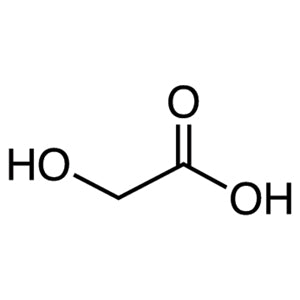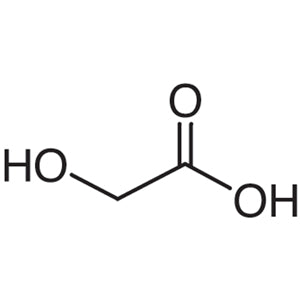
Glycolic Acid supplied as an aqueous solution of approximately 70 percent, offered by TCI under catalogue number G0110, is the simplest alpha hydroxy acid, carrying both a carboxyl group and a hydroxyl group on adjacent carbon atoms. This combination of two functional groups gives the material a dual role in the laboratory: it acts as an organic acid strong enough to adjust acidity and dissolve mineral deposits, and at the same time serves as a bifunctional building block that can undergo esterification, etherification, and condensation polymerisation into polyglycolide, a material widely studied in the field of biodegradable materials.
The properties that make this reagent a preferred choice begin with its very small molecular size, its complete solubility in water, and its higher acidity compared with acetic acid, a consequence of the electron-withdrawing effect of the hydroxyl group at the alpha position. Supply in aqueous solution form makes pouring and volumetric measurement straightforward, spares the user the difficulty of handling a strongly hygroscopic solid, and speeds up the preparation of working solutions because the material is already completely dissolved. Its mild chelating character is a further advantage.
In Indonesian laboratories this reagent fits naturally into routine bench work where an acid of known behaviour is needed without the handling burden of a hygroscopic solid. The solution form supports direct volumetric dispensing during the preparation of working solutions, while the mild chelating character is put to use in cleaning metal surfaces and dissolving inorganic scale on equipment. Its role as a bifunctional building block also supports synthetic and materials-oriented investigations.
- Acidity adjustment in aqueous systems, where the material functions as an organic acid strong enough to set and control the acidity of a solution reliably.
- Dissolution of mineral deposits, where the acid strength of the reagent allows precipitated mineral matter to be brought back into solution during sample handling.
- Esterification and etherification chemistry, where the adjacent carboxyl and hydroxyl groups give two reactive handles on a single very small molecular framework.
- Condensation polymerisation into polyglycolide, supporting work on biodegradable materials, a field in which this polymer has been extensively studied by researchers.
- Cleaning of metal surfaces and dissolution of inorganic scale on equipment, where the mild chelating character of the molecule assists the removal process.
| Brand | TCI |
|---|---|
| CAS number | 79-14-1 |
| Molecular formula | — |
| Purity | — |
| Category | Chemistry > Building Blocks > Non-Heterocyclic Building Blocks |
| Pack sizes | — |
| Physical form | aqueous solution, approximately 70 percent in water (approximately 12 mol/L) |
| Storage | keep in a closed container under the conditions stated on the supplier label |
- Catalogue number: G0110
Store the solution in its original tightly closed container, kept upright in a designated area for acidic reagents and away from incompatible materials. Containers should be of a material resistant to organic acids, and bottles should be closed immediately after dispensing so that the solution strength is not altered. Handle the material in a well ventilated area or fume hood, wearing safety glasses, gloves, and a laboratory coat, since this is an acidic solution capable of causing irritation on contact with skin or eyes. Wipe up spills promptly and rinse the affected surface with water. Label all working solutions clearly with contents and preparation date, and consult the supplier safety data sheet before first use.
—
Product Categories
Produk Terkait
-
GlycolicAcid TCI G0196
Regular price Rp 717.150,00Regular price -
LithiumAcetoacetate TCI A1478
Regular price From Rp 3.180.450,00Regular price -
ArachidonicAcid TCI A0781
Regular price From Rp 2.332.050,00Regular price -
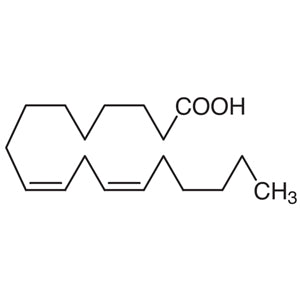
LinoleicAcid TCI L0124
Regular price From Rp 1.829.100,00Regular price -
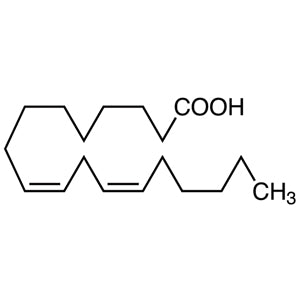
LinoleicAcid TCI L0053
Regular price From Rp 1.485.750,00Regular price -
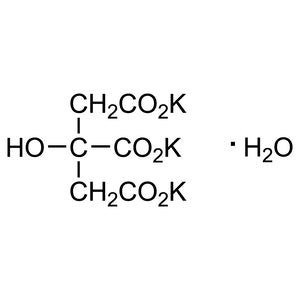
TripotassiumCitrateMonohydrate TCI T4391
Regular price From Rp 452.550,00Regular price -
TrisodiumCitrateDihydrate TCI T4390
Regular price From Rp 452.550,00Regular price -
BenzoicAcid TCI B2635
Regular price From Rp 505.050,00Regular price