

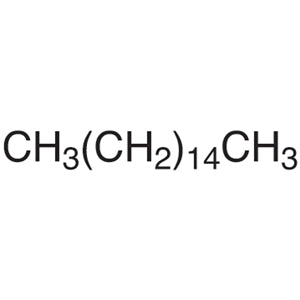
TCI H0066 Hexadecane, also known as cetane, is a straight-chain saturated hydrocarbon with sixteen carbon atoms that appears as a colourless liquid at room temperature. It is one of the most important n-alkanes in the laboratory because its name is attached to the concept of the cetane number, the benchmark for the ignition quality of diesel fuel. Beyond that reference role, hexadecane is widely used as a high-boiling non-polar solvent, as the model oil phase in emulsion research, and as a reference compound in chromatographic analysis and hydrocarbon biodegradation studies.
The properties that make this material so useful are its chemical stability as a saturated alkane carrying no functional groups, combined with low volatility and a high boiling point. It is practically insoluble in water, forming a clear oil phase that is easy to distinguish, and it does not readily take part in reactions, so it can safely be used as a heat-transfer medium or as an experimental matrix. That inert character also makes it a consistent standard oil phase for interfacial tension measurements and emulsion stability work. Because it is a pure liquid with a defined chain length, experimental results are easy to reproduce.
In Indonesian laboratories, hexadecane is typically drawn on by fuel and energy testing groups working with diesel quality concepts, by university and institutional research units studying emulsions and surfactants, and by environmental laboratories examining the biodegradation of hydrocarbons. Its role as a chromatographic reference compound also makes it a routine presence in analytical laboratories. The available pack sizes suit both small method-development trials and larger, longer-running experimental programmes.
Related TCI products
- TCI S0288 544-76-3 Hexadecane [Standard Material for GC]
- TCI D5961 55553-81-6 5,12-Dioxahexacyclo[7.6.1.0~2,8~.0~4,6~.0~10,15~.0~11,13~]hexadecane (mixture of isomers)
- TCI B1456 81367-59-1 1-Bromo-2-methylhexadecane
- TCI B0599 112-82-3 1-Bromohexadecane
- TCI I0408 544-77-4 1-Iodohexadecane
- TCI H0993 6920-24-7 1,2-Hexadecanediol
- Cetane number reference work: hexadecane is the compound from which the cetane scale takes its name, making it the natural reference material for laboratories dealing with diesel fuel ignition quality concepts.
- High-boiling non-polar solvent: its high boiling point and low volatility let it serve as a reaction or dissolution medium where a low-boiling solvent would evaporate away during extended heating.
- Model oil phase in emulsion research: as a chemically inert, water-insoluble pure liquid, it provides a consistent and clearly distinguishable oil phase for emulsion formulation and stability studies.
- Interfacial tension measurement: the absence of functional groups and the defined chain length give reproducible interfacial behaviour, so it works as a standard oil phase against which surfactants can be compared.
- Chromatographic and biodegradation reference compound: its defined sixteen-carbon straight chain makes it a reliable reference peak in chromatographic analysis and a standard substrate in hydrocarbon biodegradation studies.
| Brand | TCI |
|---|---|
| CAS number | 544-76-3 |
| Molecular formula | — |
| Purity | — |
| Category | Chemistry > Building Blocks > Non-Heterocyclic Building Blocks |
| Pack sizes | 25 mL, 100 mL, and 500 mL |
| Physical form | colourless liquid at room temperature |
| Storage | keep in a tightly closed container in a cool, dry, well-ventilated place away from heat and ignition sources |
Store hexadecane in its original tightly closed container in a cool, dry and well-ventilated area, away from heat, open flame and other ignition sources. Glass bottles or other containers compatible with non-polar organic liquids are suitable; keep the closure tight to prevent contamination and moisture ingress. Handle in a fume hood or an area with adequate ventilation, and wear the usual personal protective equipment — safety glasses, chemically resistant gloves and a laboratory coat. Avoid contact with skin and eyes, do not discharge residues into drains, and collect waste as organic solvent waste in line with your laboratory's disposal procedures.
—
Produk Terkait
-
Hexadecane[StandardMaterialforGC] TCI S0288
Regular price Rp 2.094.750,00Regular price -
5,12-Dioxahexacyclo[7.6.1.0~2,8~.0~4,6~.0~10,15~.0~11,13~]hexadecane(mixtureofisomers) TCI D5961
Regular price From Rp 2.650.200,00Regular price -
1-Bromo-2-methylhexadecane TCI B1456
Regular price Rp 5.644.800,00Regular price -
1-Bromohexadecane TCI B0599
Regular price From Rp 505.050,00Regular price -
1-Iodohexadecane TCI I0408
Regular price Rp 2.174.550,00Regular price -
1,2-Hexadecanediol TCI H0993
Regular price From Rp 1.749.300,00Regular price -
1,16-Hexadecanediol TCI H0552
Regular price From Rp 3.817.800,00Regular price -
Sodium1-Hexadecanesulfonate TCI H0415
Regular price From Rp 1.961.400,00Regular price
![544-76-3 Hexadecane [Standard Material for GC] - AMI Scientific](http://amiscientific.com/cdn/shop/files/TCI2510S0288.jpg?v=1767138614&width=533)
![5,12-Dioxahexacyclo[7.6.1.0~2,8~.0~4,6~.0~10,15~.0~11,13~]hexadecane (mixture of isomers) (CAS 55553-81-6) - TCI D5961 - AMI Scientific](http://amiscientific.com/cdn/shop/files/TCI2510D5961.jpg?v=1767109486&width=533)


