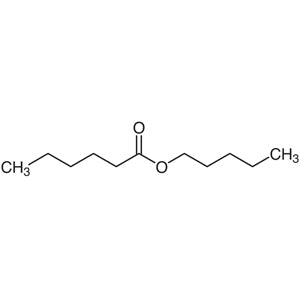
Amyl Hexanoate, also known as pentyl hexanoate, is an ester formed from hexanoic acid and amyl alcohol, giving it a six-carbon acyl chain paired with a five-carbon alkyl group. The compound is widely recognised as an ester with a soft, fruity aroma, and for that reason it serves as an important reference material in flavour analysis laboratories, food aroma research, and organic chemistry studies that deal with esterification reactions. Within the TCI catalogue, this product belongs to the Non-Heterocyclic Building Blocks group, indicating its role as both a starting material and a comparison compound.
The principal property that makes Amyl Hexanoate a preferred choice is its character as a medium molecular weight, lipophilic ester: it dissolves readily in organic solvents while showing very limited solubility in water. This behaviour simplifies its separation during liquid-liquid extraction as well as headspace analysis. Its distinctive fruity aroma makes it an easily recognisable marker compound in sensory testing and gas chromatography. The ester group can also be hydrolysed back into its constituent acid and alcohol, which is why the material is frequently used to demonstrate esterification equilibrium and saponification reactions.
In Indonesian laboratories, Amyl Hexanoate is typically encountered in flavour and food aroma work, in analytical method development built around gas chromatography, and in university teaching laboratories where esterification and saponification are part of the practical curriculum. Its position in the TCI catalogue as a non-heterocyclic building block also makes it a convenient reference standard and comparison compound for synthetic organic chemistry groups working on ester chemistry.
TCI brochures (PDF)
- Lipids 2025-12-17 · p. 12
- Flavour analysis reference material — its soft, fruity aroma and well-defined ester structure make it a dependable comparison compound when identifying or confirming ester peaks in flavour profiles.
- Food aroma research — as a recognised fruity ester, it serves as a marker compound for studies that characterise volatile aroma constituents in food and beverage samples.
- Gas chromatography marker compound — its lipophilic, medium molecular weight character and distinctive aroma make it easy to recognise and track during chromatographic separation and method development.
- Headspace analysis — very limited water solubility combined with good solubility in organic solvents allows this ester to partition predictably, which suits headspace sampling workflows well.
- Teaching laboratory demonstrations — the ester group can be hydrolysed back to hexanoic acid and amyl alcohol, making it ideal for illustrating esterification equilibrium and saponification in practical classes.
| Brand | TCI |
|---|---|
| CAS number | 540-07-8 |
| Molecular formula | — |
| Purity | — |
| Category | Chemistry > Building Blocks > Non-Heterocyclic Building Blocks |
| Pack sizes | available in the standard catalogue pack sizes offered by TCI for this item; please confirm the required size when ordering |
| Physical form | — |
| Storage | keep in a tightly closed container in a cool, well-ventilated place away from ignition sources |
- Chemical class: ester of hexanoic acid and amyl alcohol; lipophilic, medium molecular weight, soluble in organic solvents and very sparingly soluble in water
Store Amyl Hexanoate in its original tightly closed container in a cool, dry, well-ventilated area, away from heat, open flames, and other ignition sources. Because it is a volatile, aroma-active ester, containers should be resealed promptly after use to prevent loss of material and to avoid aroma carry-over that could interfere with sensitive flavour or chromatographic work. Glass bottles with chemically resistant closures are suitable; avoid containers that may be attacked by organic solvents. Handle inside a fume hood, use gloves and safety glasses, and keep the material away from strong oxidising agents, strong acids, and strong bases, which can promote hydrolysis of the ester group. Consult the manufacturer's safety data sheet before use and follow your laboratory's standard chemical handling procedures.
—
Produk Terkait
-
IsoamylHexanoate TCI I0899
Regular price From Rp 610.050,00Regular price -
PropylHexanoate TCI P1940
Regular price Rp 557.550,00Regular price -
4-NitrophenylHexanoate TCI H0484
Regular price From Rp 2.862.300,00Regular price -
2,4,6-TribromophenylHexanoate TCI H0113
Regular price Rp 2.439.150,00Regular price -
MethylHexanoate TCI H0111
Regular price From Rp 505.050,00Regular price -
IsobutylHexanoate TCI H0110
Regular price Rp 477.750,00Regular price -
IsoamylHexanoate(contains2-MethylbutylHexanoate) TCI H0109
Regular price Rp 530.250,00Regular price -
EthylHexanoate TCI H0108
Regular price From Rp 505.050,00Regular price